Dive Brief:
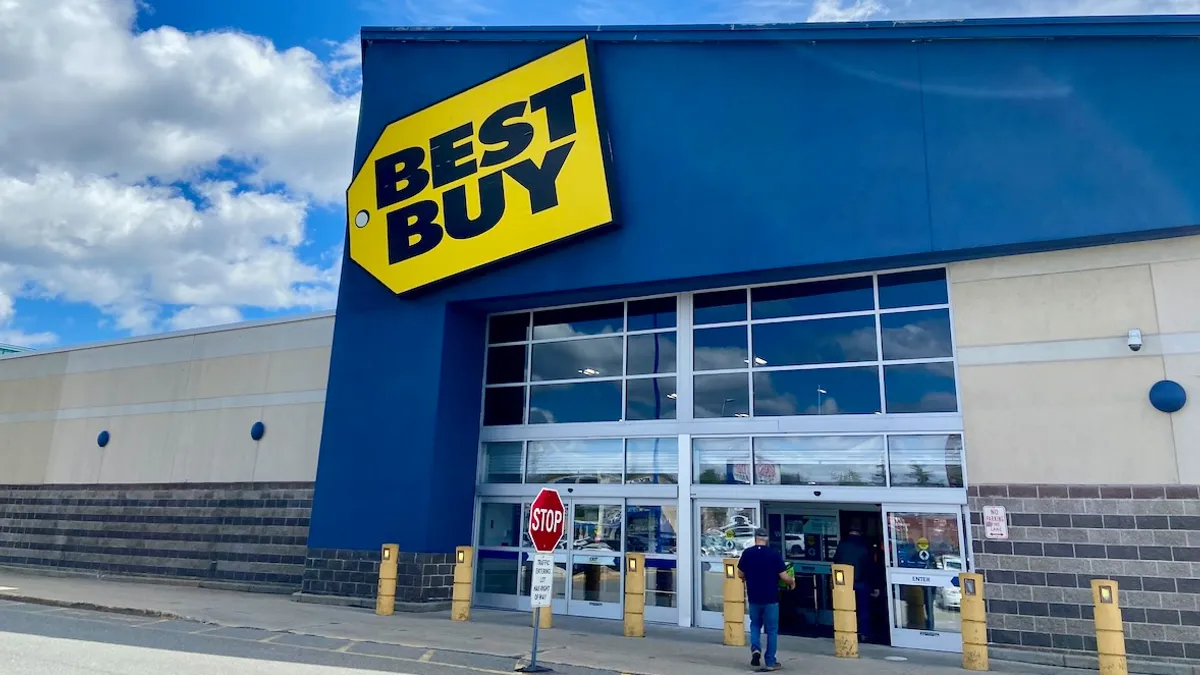
- Months away from handing off the CEO reins, Best Buy chief Corie Barry on Thursday said the company was pleased with its results, which were better than expected. The company recorded enterprise revenue up 2% in Q1, to $8.9 billion.
- Comps also rose 2%, with growth across most major categories, while net earnings were up almost 37% to $276 million. While the results were a win in some respects, the retailer is still underperforming the broader electronics market, analysts said.
- Barry, who will transition out of the CEO role this fall, said consumers are value-focused but continue to spend for need or innovation reasons. While tax refunds likely boosted the electronics retailer this quarter, Barry said there are no indications that consumers have pulled forward their purchases.
Dive Insight:
Ahead of taking on the CEO post in November, Best Buy Chief Customer, Product and Fulfillment Officer Jason Bonfig used Thursday’s earnings call to outline his vision for the company.
The executive’s priorities for the business include expanding Best Buy’s reach, elevating the Best Buy experience, maintaining its position as a human-focused company and transforming Best Buy into a retail media, advertising and technology company.
“We’re not just a retailer anymore,” Bonfig said Thursday, expounding on the growth opportunities available through secondary business lines like advertising.
Those forms of revenue generation have long been a boon for retailers like Amazon, which sees higher growth from categories like seller services and subscriptions than from its retail operations.
Best Buy’s revenue has slowed in recent years as the category has suffered months of decline in the post-COVID era. But the retailer is also now underperforming the overall electronics market, which grew 3.6% in the U.S. in Q1, according to GlobalData Managing Director Neil Saunders.
“Clearly, Best Buy’s numbers have come in some way below this which underscores that it continues to lose market share,” Saunders said. “This is especially concerning as the market growth was partly driven by one-off factors, most notably higher tax refunds, so there was only a short window in which to take advantage of the opportunity.”
While Barry said Thursday that trends in the sector appeared to be stabilizing after years of volatility, the retailer continues to operate in a category with numerous competitors. Saunders noted that Best Buy’s previous differentiator was customer service and a discovery-based experience, but these are less relevant in the world of online videos, AI and improved service elsewhere.
“The edge Best Buy once had has been eroded,” Saunders wrote.
Bonfig’s plan to change that includes several improvements to Best Buy’s core retail positioning.
That includes growing its marketplace, which launched last summer, while also expanding newer categories like collectibles and investing in AI commerce through partnerships with the likes of OpenAI and Google. Bonfig, who currently heads up the customer experience, also wants to bring that lens to his position as chief executive, leading the business with a guiding question of how to improve the customer experience.
One answer to that is through changes to Best Buy’s store format. The retailer plans to broaden its footprint through the opening of more medium- and small-format locations, which target smaller markets and have a more curated assortment. Medium-sized stores are about 20,000 square feet, while small stores will range from 12,000 to 15,000 square feet and target an urban shopper.
While these changes are intended to support Best Buy’s larger format stores, Bonfig is also targeting changes at the core footprint. In 70 Best Buy locations, the retailer is consolidating empty space throughout the store and using it for new experiences. Fifty of the locations will see a Meta experience where shoppers can test its virtual reality and AI devices, while the remaining 20 will see an outdoors assortment led by Best Buy subsidiary Yardbird. Bonfig said there are hundreds of Best Buy locations that could be using their space more strategically and might see the same changes in the future.