Dive Brief:
-
J.C. Penney’s holiday quarter did the retailer few favors, as total Q4 net sales fell 8% year on year to $1.9 billion, according to financial filings last week. Net loss ballooned by 77% to $113 million.
-
For the full fiscal year, the decline helped drive down total net sales more than 5% to $6 billion. The department store ended 2025 with a $173 million net loss, wider than 2024 by over 2%. Cash and cash equivalents plummeted over 67% to $88 million.
-
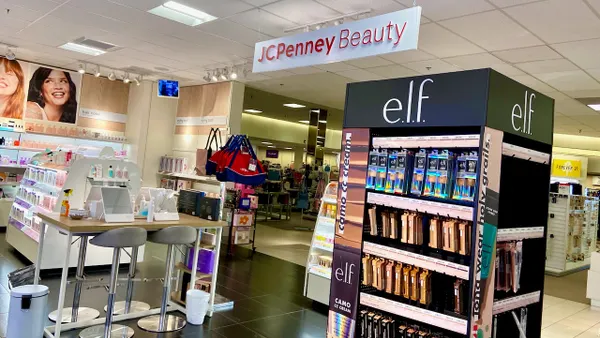
A J.C. Penney spokesperson noted “strong performance across key categories” last year, including beauty, fine jewelry and home. That plus expansion of some premium brands boosted traffic and frequency, the spokesperson said by email.
Dive Insight:
After making some progress in its turnaround during the previous two quarters, J.C. Penney slipped over the holiday season, as sales declines accelerated in the final quarter of the year. The department store’s annual report was released last week as part of a real estate trust’s financial reporting package.
“The trajectory, which was gradually improving, has clearly reversed direction,” GlobalData Managing Director Neil Saunders said by email.
Sales fell in part because some stores closed, but even so the retailer’s top-line was weaker than the overall market, per GlobalData.
“That suggests JCP lost relevance over the holiday period, despite the things it has been doing to improve the proposition,” Saunders said. “That’s concerning and something the business needs to correct in the current fiscal year.”
The bottom line must also be addressed, though the company has some backing because it is operated by a large conglomerate, Catalyst Brands, according to Saunders. Last year J.C. Penney, which was bought out of bankruptcy five years ago by two of its landlords, joined forces with the operating entities of several brands in Authentic Brands Group’s portfolio to form Catalyst.
As part of a sourcing agreement under Catalyst, J.C. Penney is obligated to purchase certain Authentic licensed products. Last year, Penney paid Authentic $11 million in royalty and other payments, according to its annual report last week.
Catalyst also provided nearly $500 million that went toward wiping out Penney’s long-term debt, Saunders said. That debt was replaced by a new $600 million asset-based lending term loan, per Penney’s report.
“While that sits as a loan elsewhere in the corporate structure, it gives JCP flexibility,” Saunders said.
The Penney spokesperson said that marketing and customer experience continues to be a priority but that the company is also focused on cost control. Throughout the year the retailer “remained focused on serving America's working families with compelling value and relevant merchandising.” Its ‘Yes, JCPenney!’ campaign boosted customer engagement and contributed to the strong performance in key categories, the spokesperson said.
“With disciplined expense management and zero long-term debt at year end, we are well-positioned to continue furthering JCPenney’s momentum through strategic investments in customer experience and brand-building initiatives,” the spokesperson said.
That operational balancing act falls to Catalyst, which takes some pressure off Penney itself, Saunders said. But 2026, already nearing its halfway point, could be a pivotal year for the struggling department store.
“Moving forward, the idea behind Catalyst Brands is to provide shared central services so this may take some of the operating expense off the shoulders of JCP,” he said. “But swinging the group into the black is still a very tall order — especially when the sales line is not stable.”