


There was no shortage of AI-related announcements from retailers in 2025.
From mass retailers to apparel brands, companies across the industry laid bare their efforts to utilize — and adapt to — AI internally and in consumer-facing ways.
But despite the seemingly endless AI mentions from retailers in 2025, the industry is falling behind others.
Sectors such as telecommunications and finance outpace manufacturing and retail in adoption of the technology, according to the 2025 AI industry adoption study by the Wharton School at the University of Pennsylvania.
The outpacing of retail is surprising, “given the number of potential use cases around customer experience, workforce management, marketing, supply chain, and pricing,” the report noted. Additionally, the return on investment is slower for retail, likely due to its more complex physical operations compared to other industries.
Still, companies like Amazon seem eager to use AI to streamline internal processes and make work more efficient. Additionally, retailers such as Target are reading the tea leaves, showing some consumers are using external AI platforms for product research and recommendations, rapidly changing their shopping behaviors.
Between Nov. 1 and Dec. 1, AI-driven U.S. e-commerce traffic increased 758% year over year, according to Adobe's Holiday Shopping report from this year. Specifically on Cyber Monday, AI traffic to U.S. retail sites grew 670%.
However, the actual base of users remains modest when looking at larger e-commerce retail traffic, per Adobe’s findings.
“It's still a very small base,” Nikki Baird, vice president of strategy and product at retail technology provider Aptos, told Retail Dive. "We're like on the long tail before the inflection point still. But having said all of that, I think retailers should be very worried about it because they lose complete control and visibility of everything that … took that consumer to that particular product page.”
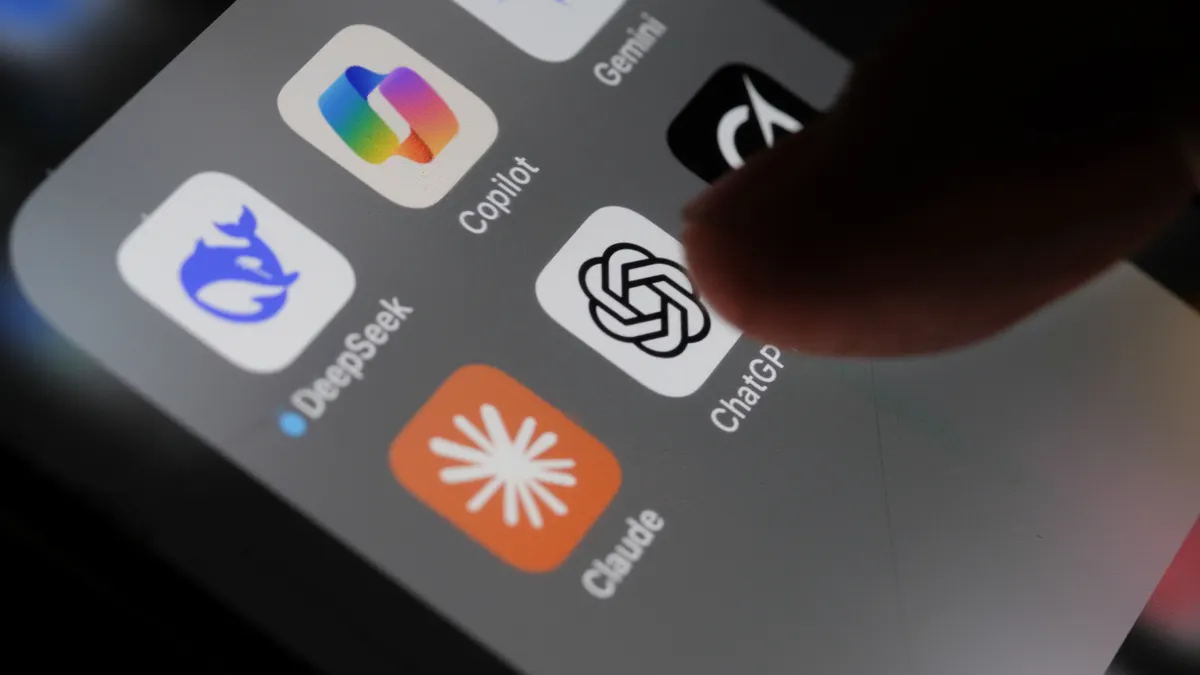
This may be the reason why some mass retailers — those with the capital to spend — have been building their own AI agents in addition to making deals with external platforms like OpenAI’s ChatGPT, where some shoppers are choosing to do their own product research.
If you can’t beat them, join them. And indeed, many retailers have done just that.
Whether or not it’s yielded a good ROI for retailers, 2025 was awash with AI news. Here's a list of companies that made concrete generative AI announcements throughout the year.
Walmart
Walmart launched a generative AI assistant for merchants called Wally that helps with tasks such as data entry and advanced calculations. The retailer also debuted a customer-facing AI agent dubbed Sparky to help plan purchases and summarize product reviews, as well as marketplace seller AI tools to speed up go-to-market rates.
The moves feed into a larger, centralized “super agent” strategy from Walmart that integrates similar technology across the business. In addition to working with OpenAI for employee training courses on AI, Walmart also enabled the ChatGPT Instant Checkout feature for chat users to shop Walmart products without leaving the platform.
Target
Target expanded its generative AI strategy in 2025 as incoming CEO Michael Fiddelke has made technology a core priority for the company’s turnaround. The retailer has utilized the technology internally to speed up merchandise ideation and review applications for third-party marketplace sellers.
The retailer launched an in-platform ChatGPT shopping app, allowing customers to make multi-item purchases, buy fresh food products and select from several fulfillment options. For the holidays, Target also debuted an AI- powered gift finder tool on its own e-commerce website.
Ashley
Furniture retailer Ashley debuted the ability for customers to buy products directly through the AI search platform Perplexity and pay using PayPal. Consumers can also use it to ask for product recommendations.
Amazon
E-commerce giant Amazon updated a seller tool it previously debuted in 2024 with new agentic AI capabilities. The updated version, available to U.S. merchants initially, can monitor inventory levels, analyze demand patterns, optimize shipments and more.
Amazon also released a conversational assistant for marketers that uses AI to help with product and audience research, brainstorming and storyboarding, and more.
For consumers, the company added an "Interests" feature to a small subset of U.S. app and mobile users, allowing shoppers to enter prompts into the AI-backed tool to receive products recommendations. The tool can make recommendations based on various preferences, including price limits.
Levi Strauss & Co.
Denim brand Levi’s — which in 2023 created controversy with the introduction of AI-generated models — this year announced a deal with Microsoft to deploy an agentic AI framework across the company. A “super-agent” meant to integrate an agentic network across IT, human resources and operations is expected to roll out in 2026.
Etsy
E-commerce marketplace Etsy was one of the first companies — alongside Shopify — to debut products on ChatGPT’s Instant Checkout feature, allowing platform users to buy products without leaving the chat.
Etsy also debuted new AI-powered tools for sellers to support tasks such as naming listing titles. The company also started utilizing AI for customer communications like push notifications and personalized homepages, as well as curated product collections that are first developed with human intelligence.
Wayfair
Home goods retailer Wayfair launched a generative AI tool, dubbed Muse, that allows users to find inspiration through AI images of home interiors. Consumers can then shop linked products using the “Explore this Muse” button.
Stitch Fix
Personal styling e-commerce company Stitch Fix launched a beta version of a style visualization tool called Stitch Fix Vision. The tool uses AI to create an image of a client’s likeness wearing shoppable outfits, helping them decide on products. Customers must upload a selfie and a full-length photo through the company’s app to access to tool.
David’s Bridal
Wedding attire retailer David’s Bridal launched an AI powered tool that helps couples manage wedding tasks. The free tool, called Pearl Planner, features an AI assistant, registry integration and vendor recommendations.
Saks Fifth Avenue
Luxury retailer Saks Fifth Avenue tapped Amazon Web Services and NLX for an AI-powered customer service tool, which has helped to reduce call volume. Users can speak to the visual, voice-guided interactive tool to learn the status of their order and more.
Best Buy
On a company earnings call, Best Buy CEO Corie Barry shared that the electronics retailer began using AI for customer support services, personalized email marketing and product search tools. The executive hinted at the potential for further agentic AI integrations in the near future.
Guitar Center
Musical instruments retailer Guitar Center debuted an in-store AI shopping assistant called Rig Advisor that customers access through a QR code. The assistant lets users input an artist, song, tone or gear-related questions to receive real-time recommendations tailored to their specific location’s inventory options.
EBay
E-commerce marketplace company eBay joined the list of companies that launched an AI tool for sellers to build out product listings. The functionality uses a photo and title provided by sellers to then generate AI-powered product details and categories.
Additionally, eBay said it was using AI to help sellers in the U.K. and the U.S. respond to buyer messages.
Lowe’s
Home improvement retailer Lowe’s launched an AI adviser tool named Mylow developed in partnership with OpenAI. The tool helps to answer customer questions. It’s available to MyLowe’s rewards members through the retailer’s website, though the company said it would later debut through its app with voice capabilities.
Home Depot
Home Depot debuted a set of generative AI tools called Magic Apron intended to improve search results and answer questions. The Magic Apron suite is available on “millions” of product pages online and through the retailer’s mobile app.