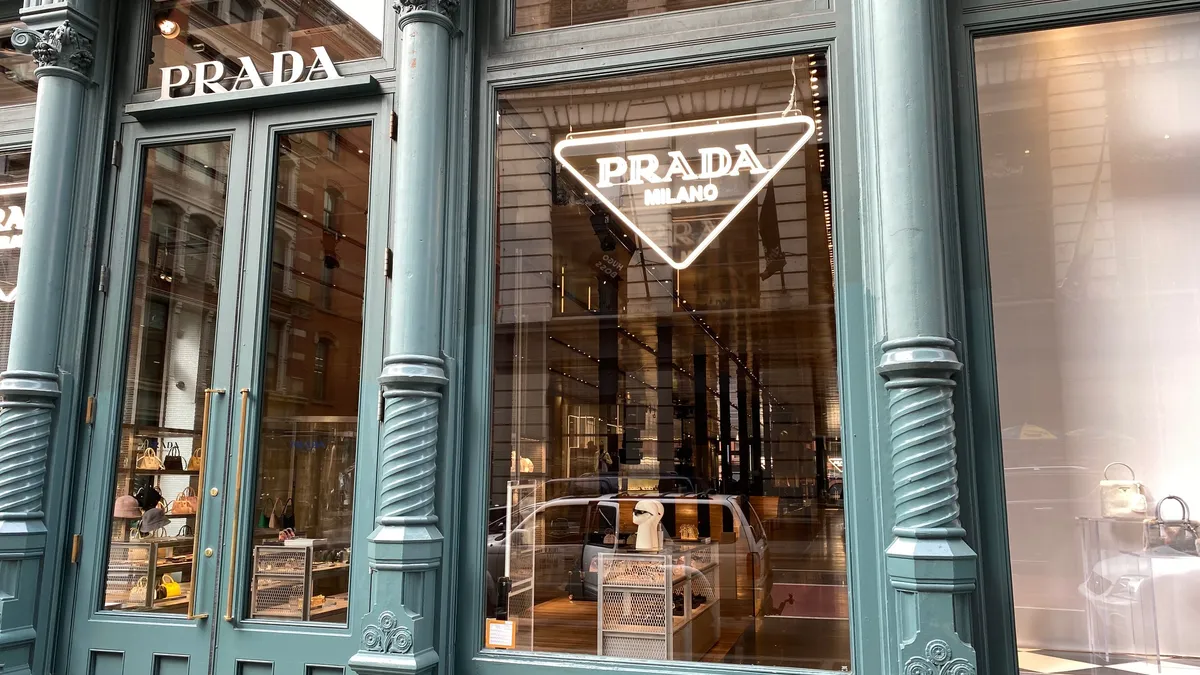
On a warm afternoon in late July, a line of people snaked south down Broadway and curled west around the Prada store onto Prince Street.
But shoppers weren’t there for luxury fashion. They were queued up to a small wooden stand near the corner of Mercer Street to get a free sample from cosmetics brand Milk, which was doing a pop-up activation in the neighborhood.
It’s a perfect snapshot of SoHo’s current landscape, where high-end brands such as Gucci and Chanel share a zip code with mass retailers including American Eagle and Target, and a makeshift wooden sidewalk shack can set up shop a block away from Apple and Louis Vuitton.
“SoHo has the broadest reach,” said Aylin Gucalp, senior vice president in the retail group at commercial real estate firm CBRE. “It's our largest market from a store count, and that means there's really a street for every type of brand where the brand can fit and make sense.” Gucalp added that the area has “something for everyone. There are the mass brands on Broadway. There are contemporary brands on Greene. There are the luxury brands on Mercer.”
What makes SoHo tick
Stores in SoHo benefit from having a robust presence of restaurant and hospitality businesses, said Thomaï Serdari, professor of marketing and director of luxury and retail MBA at the Leonard N. Stern School of Business at New York University.
“SoHo has this added privilege of having the historic district and being a cobblestone neighborhood,” Serdari said. “It is very nice to walk down there.” In addition, Serdari said the area “has maintained a lot of interesting places to eat and drink, and that is what creates a lot of traffic. The nature of the neighborhood has saved retail traffic down there.”
Tourism also helps drive traffic.
“SoHo is a big destination,” said Marie Driscoll, CEO of retail consultancy Driscoll Advisors and professor at The New School. “It's kind of like the mall of New York City, except it's not enclosed.”
Yet unlike some malls, there’s a sense of discovery in SoHo that can be hard to manufacture, said GlobalData Managing Director Neil Saunders.
"What SoHo offers is a sense of place."

Neil Saunders
Managing Director, GlobalData
“With a traditional mall, there's a lot of planning that goes on,” Saunders said. “Obviously, there's usually one landlord, and it is a process that is very engineered. I mean that works well sometimes, but it's not really an organic evolution.”
He added that consumers “can have the mall experience anywhere in the United States, or arguably anywhere in the world. What SoHo offers is a sense of place.”
SoHo is also not tied to a single anchor tenant the way some traditional malls are, or the way Herald Square is dominated by Macy’s.
“There are definitely things within SoHo that you wouldn't want to lose, but the area is not really defined by any one of them,” Saunders said. “The area is really defined by having lots of different things clustered in one place. It wouldn't be great if any of those big things left, but the area could probably adapt around it and survive in a way that it'd be much more difficult for, say, Hudson Yards or a traditional mall to do.”
To wit, Bliss Spa quietly shuttered its last brick-and-mortar location in June, leaving SoHo after 30 years. In addition, outdoor retailer REI closed its flagship SoHo store in July as part of a larger restructuring. However, the area has barely blinked, and new-ish tenants, including ChatGPT maker OpenAI, have already staked a claim. The tech company already leases about 90,000 square feet of office space across three floors above where REI had its Puck Building store, although there’s no word yet on who will take over the ground floor retail space.
New York City’s ‘organic, living and breathing’ neighborhood
Of course, Manhattan has no shortage of shopping locations, including Times Square, luxury corridors such as Madison Avenue and Fifth Avenue and more traditional malls such as Hudson Yards. Williamsburg, Brooklyn, is also up-and-coming.
But not all retail is created equal, especially when it comes to price and availability. The average Q2 2026 retail rent on SoHo’s Prince Street, between Broadway and West Broadway, was $1,408 per square foot, according to data from CBRE. The only area of Manhattan with a higher asking price — $2,540 per square foot — was the Midtown luxury corridor of Fifth Avenue between 59th street and 49th street, which is home to the Louis Vuitton flagship store and beleaguered department store Saks Fifth Avenue. Meanwhile, Times Square average rent was just below SoHo at $1,400 per square foot.
However, Times Square has considerably more vacancies than SoHo. The Real Estate Board of New York H1 2026 Manhattan Retail Report indicated that there were “fewer than 20 actively marketed spaces” for SoHo and Madison Avenue, while “Times Square and Herald Square still account for more than one-third of all available storefronts citywide.”
Commercial real estate firm JLL’s Q2 2026 report found that SoHo reached a new record low availability rate of 8% for the quarter, which tied with Madison Avenue’s rate, and was just below Williamsburg, which had an availability rate of 10.8% for the period. Times Square availability, by contrast, was 22.1%.
“Times Square is not doing well because, frankly, it's disgusting,” Saunders said, adding, “locals don't even want to walk through Times Square because it's just a nightmare.”
By contrast, “Madison [Avenue] is for luxury,” Gucalp said, adding that other neighborhoods in New York City, such as Times Square, Herald Square or even Fifth Avenue may not be right for every brand. “But there's usually some place in SoHo or on Madison, depending on if you're a luxury tenant or not.”
She added that for some luxury brands with locations on Madison Avenue and on Fifth Avenue, “SoHo became the natural second store,” Gucalp said, adding that “Williamsburg is an excellent second store if that is your customer.”
One luxury brand that hasn’t moved to SoHo is Hermès, which already has stores on Madison Avenue and in the Meatpacking District. The company will open its third New York City store, in Williamsburg, Brooklyn, in September. The brand closed its Wall Street location in July.
Gucalp said that as a retail neighborhood, “Williamsburg still has room to grow and is growing.” However, she added, “it almost feels a little unfair to be comparing them. I think Williamsburg has a really great residential market that is immediately surrounding it. SoHo's density is much less in terms of residential.”
She added that “the ownership behind SoHo is very diverse. It is everything from institutional money to co-ops and condo boards. Williamsburg is quite a bit different. It is concentrated in a handful of owners. SoHo is almost developed, to a degree, organically, in the way people kind of shift to be with their peers, whereas in Williamsburg, there is actually a curation there by ownership.”
Meanwhile, Saunders said, “Hudson Yards is artificial. It's engineered. It was created from scratch,” while SoHo “isn't really something that someone has tried to create. It's an organic, living and breathing area that's been there for years, and I think that's what people like.”
For retailers, SoHo is also an important element of their marketing message. Adirondack Capital Partners' most recent U.S. High Street Retail Capital Markets Report found that SoHo was the country's “most active trophy retail market,” and accounted for 43% of all trophy retail transactions nationwide.
“As brands think about renting space in New York City, it's partly to do retail there, and it's partly to be there for brand awareness, and it's partly for marketing purposes,” said Driscoll. It’s also where shoppers go to get a photo op for social media. “You get bragging rights for having been [to SoHo], for having a selfie in front of Polène or for having the coffee at Buck Mason, or for going into Aritzia over the weekend when they have the live DJ,” Driscoll said.
However, SoHo’s brand mix isn’t the main draw, said Saunders. “You can actually find the mix of brands almost anywhere in terms of major shopping destinations,” he said. “But [SoHo] is also about the depth of experience you get from a place. People are not just coming out necessarily to buy something. They almost want to be entertained.”
He added that SoHo’s experiential element was hard to duplicate. “People can do all the convenient, easy stuff online,” Saunders said. “When they're out in person, they want something that's a bit deeper and isn't just about convenience and ease and sterility. And a place like SoHo is really good at delivering that.”
Serdari said that in some ways, SoHo thrives simply because it lives up to its own hype.
“SoHo is successful because of its own history,” she said. “That icon, that imaginary space that we all carry with us in our heads of the definition of what SoHo is, that is what makes SoHo work, rather than the fact that Gucci is there or Louis Vuitton is there or Prada is there.”