It’s been another week with far more retail news than there is time in the day. Below, we break down some things you may have missed during the week and what we’re still thinking about.
From a Best Buy sneaker to revenue falling at Kate Spade, here’s our closeout for the week.
What you may have missed
Brooks sprints to 14% revenue growth in first half
Brooks Running posted a record Q2 and reported revenue grew 14% in the first half of the year. Growth was strong across regions, with the Americas up 9%, Asia-Pacific increasing 10% and revenue surging 39% in Europe, the Middle East and Africa, the retailer said Wednesday. The running brand said it also remained the No. 1 retailer in the U.S. specialty retail footwear market for the sixth consecutive month.
Though Brooks did not provide figures for Q2 by itself, sales decelerated noticeably from Q1, when the privately held company reported revenue growth of 23%. Trail running continued to see robust growth in Q2, growing more than 70% year over year, while accessories increased 29%.
“Around the globe, running continues to play an increasingly important role for people prioritizing health and wellness in their lives,” CEO Dan Sheridan said in a statement. “At Brooks, we aim to give runners the very best product and experiences to pursue that. Our first-half results reflect that focus and the incredible work of our teams globally.”
Mud Jeans files for bankruptcy
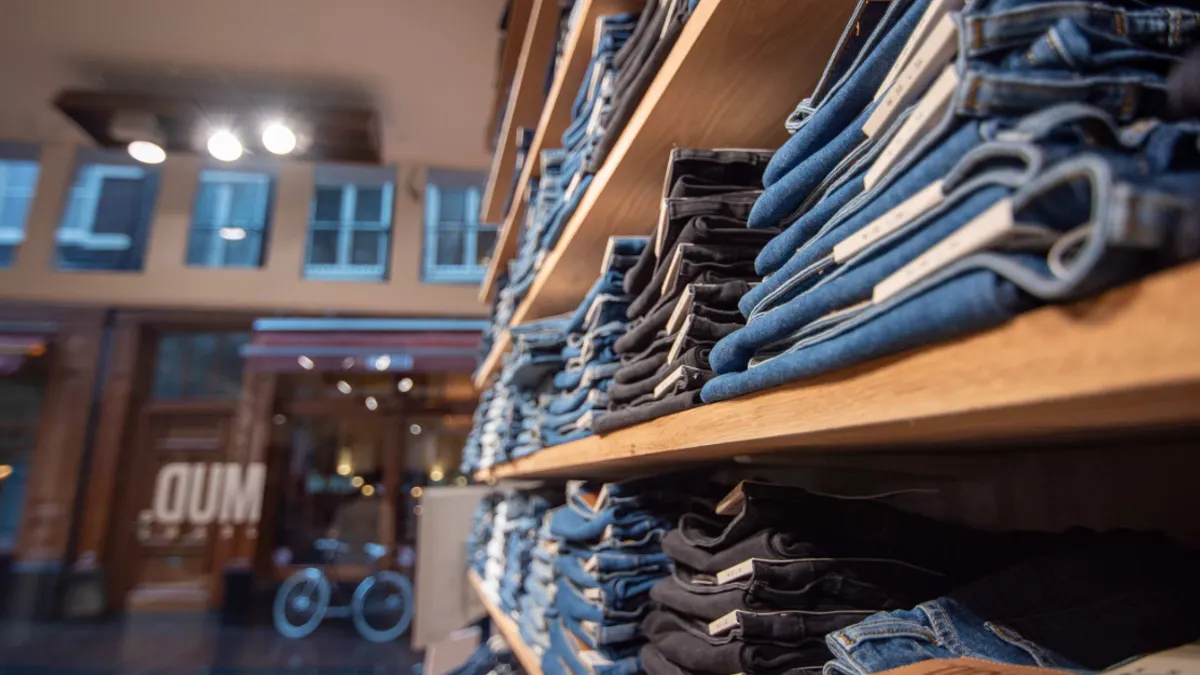
Debt led circular denim brand Mud Jeans to file for bankruptcy, CEO and co-owner Dion Vijgeboom said in a post on LinkedIn.
“Over the past months, our team worked tirelessly to build a sustainable future for this company,” Vijgeboom wrote. “We believed there was a way forward. But despite all our efforts, the financial burden of historic debt ultimately proved too great to overcome.”
The company said in a Facebook post that it is aware that the bankruptcy raises questions about customer orders, and its repair and take-back services. Mud Jeans said it would inform the public through updates on its website as it learns more. New orders have temporarily been paused.
“Mud Jeans is more than a company. It is an idea, a community and a blueprint for what the future of fashion can look like,” Vijgeboom said. “We sincerely hope this bankruptcy is not the final chapter, but the beginning of a new one.”
Retail therapy
Best Buy makes a sneaker
Best Buy debuted a 3D printed sneaker in honor of the company’s 60th anniversary, according to a Monday press release. The electronics retailer — not typically known for apparel merchandise — created the sneaker in collaboration with Nexbie, and it features no stitching or glue.
The limited-edition product comes in blue and yellow colorways and is priced at about $160.
What we’re thinking about
7%
That’s how much revenue at Kate Spade fell in the fourth quarter, reaching $235.1 million. Parent company Tapestry’s overall revenue grew 9% year over year to $1.9 billion, driven by a 15% increase at Coach.
“Our fourth quarter outperformance capped a year of strong growth, as we meaningfully exceeded expectations and achieved key financial commitments we established at our Investor Day two years ahead of plan,” Tapestry CEO Joanne Crevoiserat said in a statement. “Our success is by design, demonstrating the power of our Amplify strategy. Through intentional choices, disciplined execution, and an unwavering focus on the consumer, we have built a stronger, more focused organization.”
North America, its largest region, saw revenue increase 7%. Revenue in Greater China increased 33% and in Europe 22%.
Looking ahead, Tapestry expects fiscal 2027 revenue to be between $8.4 billion and $8.5 billion, representing an increase in the mid-single digits. Operating margin for the year is expected to expand by 50 basis points year over year.
What we’re watching
Is the ‘K-shaped economy’ over?
Bank of America economists are the latest to turn against the letter K in describing the U.S. economy, where the rich get richer and the poor get poorer.
For about a year and a half, spending patterns, including those based on Bank of America credit and debit card data, produced a chart resembling the alphabet’s 11th letter — higher-income groups spent more, and lower-income groups spent less. More recently, though, spending across income groups is impressively aligned, according to Bank of America Senior Economist David Tinsley.
“What we've seen in our data — it’s kind of remarkable, really — over the last couple of months, has been convergence,” he said in a video conference with reporters Thursday.
This doesn’t include the top 5% of U.S. households, as their spending continues to outpace the rest by about 1.5 percentage points, likely due to the booming stock market, he said.
Heather Long, chief economist at Navy Federal Credit Union, ditched the K shape a while ago in favor of the E, which takes fuller account of middle-income earners. Gas prices are still squeezing consumers, though inflation in July, per the federal government, was in line with expectations, she said Wednesday. Prices eased in key areas like rent, but inflation still “wiping out wage gains for many,” she said in emailed comments.
“The longer this goes on, the more people will be forced to belt tighten later this year,” she said.