A bill that is close to becoming law would deepen the involvement of U.S. Immigration and Customs Enforcement in combating retail crime. If it does, it would come at a time when federal crime-fighting agents are being diverted to support mass deportations, and as the public grows increasingly wary — even intolerant — of ICE’s tactics.
A Senate vote on the Combating Organized Retail Crime Act, known as CORCA, is expected by the end of the year, after passage in the House of Representatives in May. The bill, a top goal of retail industry lobbyists for years, has bipartisan support in both houses of Congress. It would create a new bureaucracy at the Department of Homeland Security — the Supply Chain Crime Coordination Center — within the Homeland Security Investigations unit.
ICE’s director would appoint the head of the new center.
Many retailers and loss prevention experts support CORCA because it streamlines cooperation between local, state and federal law enforcement and the private sector, with the goal of fighting crime. But some experts, including people in retail, loss prevention, immigration law and civil rights law, warn that it puts retailers in the middle of an immigration crackdown that has little to do with theft.
Industry groups are not focused on these concerns. In their answers to queries from Retail Dive, the National Retail Federation and the Retail Industry Leaders Association, both top CORCA boosters, sidestepped questions about ICE’s role and the diversion of HSI resources to immigration enforcement. The ICSC, which represents shopping centers, didn’t respond.
David Johnston, the NRF’s vice president of asset protection and retail operations, has testified in favor of the legislation, including earlier versions from previous Congressional sessions that didn’t get a floor vote. In an emailed statement, Johnston said that “CORCA, as written, defines the narrow scope of criminal activity involving organized retail crime and provides congressional oversight of the proposed Center under HSI.”
Problems old and new
But some experts say it’s impossible to define the scope, narrowly or otherwise, because the law doesn’t spell out exactly what these crimes legally entail and their impact has never been measured. In fact, the NRF stopped publishing its assessment of the impact in 2023, following Retail Dive’s discovery that the group had conflated two outdated survey-based shrink estimates from different years, which both factored in inventory losses unrelated to any crime.
"I see people talk about organized retail theft, but we have really not a lot of strong understanding of what's driving it and the scope of the problem, and whether or not the actual problem is getting bigger,” said Jeff Asher, a crime analyst and co-founder of AH Datalytics. “It's all about resource allocation, understanding the scope of the problem, and evaluating the impact of your policies. And you can't do any of that without a strong data foundation.”
“Through this, retailers are going to be deputized to help ICE."

Jina John
Senior Policy Counsel for AI, Privacy, and Technology, American Civil Liberties Union
One flaw of CORCA is that it lumps together cargo theft and retail theft, even though it’s unclear how related those crimes or their perpetrators actually are, he said. Another is the engagement of HSI and ICE.
“I don't know why ICE would be involved in this to begin with,” Asher said by phone. “It seems like we've taken a homeland security approach to a problem that isn't particularly well defined, and I think that's problematic.”
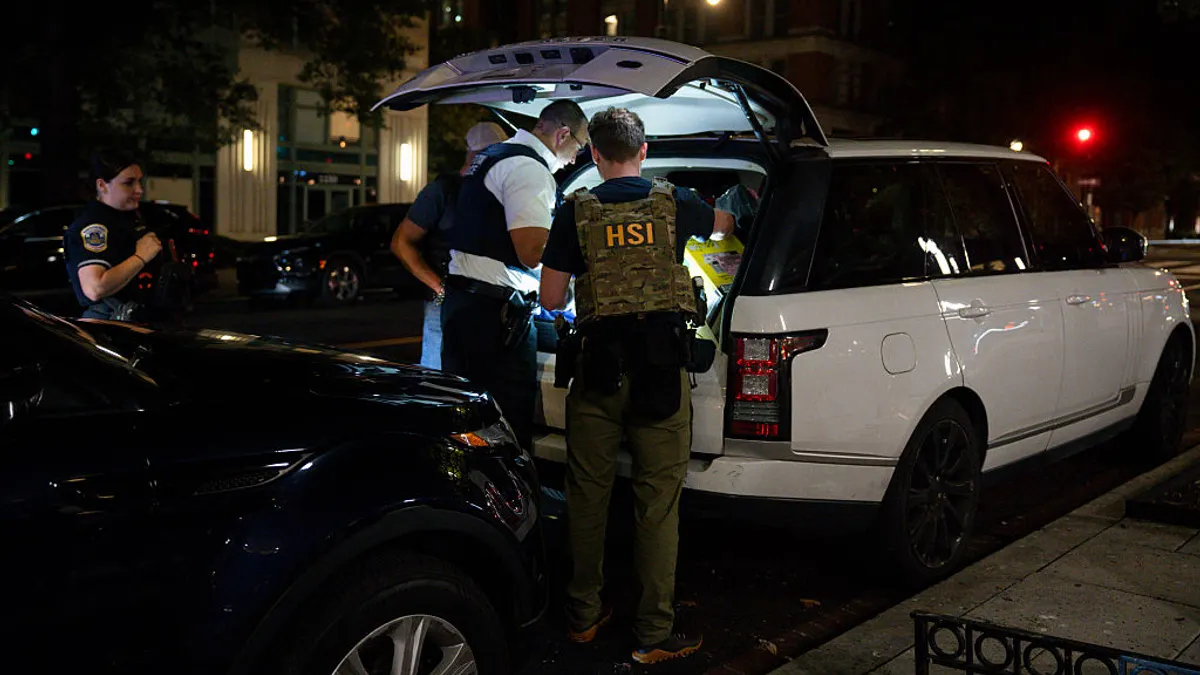
HSI agents and ICE are already employed in fighting organized retail crime, but the entity created by CORCA would be able to coordinate data across federal, state, local and tribal law enforcement and private entities in an unprecedented way, according to Jina John, senior policy counsel for AI, Privacy, and Technology at the American Civil Liberties Union.
“Through this, retailers are going to be deputized to help ICE,” she said by video conference.
Diverting resources
If CORCA passes, a new crime hub would be established at a time when DHS is increasingly redirecting resources and personnel to immigration enforcement, according to research from the Cato Institute, a libertarian think tank.
Last year, nearly 90% of HSI agents — 6,198 out of 7,100 — were diverted to support ICE Enforcement and Removal Operations, according to the report. HSI, whose media contact is at ICE, didn’t immediately respond to emailed questions about CORCA and Cato’s findings.
“I would imagine that many retailers, small or large, don't want their stores becoming a locus for racial profiling and aggressive immigration enforcement actions."
Heidi Altman
Vice President of Policy, National Immigration Law Center
“HSI's role, which is part of ICE, has really expanded. It has gone from looking at transnational crimes and national security issues to what we've seen in the past year and a half — that, at times, it's been almost exclusively about immigration enforcement,” the ACLU’s John said. “Not entirely, but almost exclusively. And we've seen those abuses.”
The public has increasingly turned against ICE, with over half of Americans saying they have little to no confidence in the agency, according to a poll from YouGov taken in July, after ICE agents killed people in Texas and Maine. Half are in favor of abolishing ICE, according to that report. Nearly 60% agree that ICE surges in places like Minnesota make communities less safe, according to a poll from PRRI, a nonpartisan think tank that researches religion, culture and public policy.
HSI is no longer “firewalled from civil immigration enforcement,” according to Heidi Altman, vice president of policy at the National Immigration Law Center.
“I would imagine that many retailers, small or large, don't want their stores becoming a locus for racial profiling and aggressive immigration enforcement actions,” she said by phone. “You have this retail-crime enforcement mechanism that is within ICE, plunged into communities and working directly with retailers.”
Evan Armstrong, senior vice president of government affairs at RILA, said in a statement that "CORCA does not give ICE new immigration-enforcement powers or turn organized retail crime enforcement into an immigration function.” He didn’t respond to follow-up questions about Cato’s report and the Trump administration’s directive to employ existing agents and resources for immigration enforcement.
The NRF didn’t respond directly to questions about these issues, except to say that Congress could tackle them after the bill becomes law. Retail Dive reached out to several co-sponsors of the bill in both the House and Senate, including 10 Democrats who reportedly pulled their support, but none have responded.
Consequences for retailers
In advocating for CORCA, industry groups, law enforcement and asset protection professionals often cite safety concerns. “Organized retail and supply chain crime is a public safety issue that impacts retail and supply chain workers, consumers and communities nationwide,” NRF’s Johnston told Retail Dive.
But lawyers specialized in immigration and due process warn that stores could become the nexus of disruptive and even violent encounters with federal agents, along with data collection that could entangle everyday shoppers. Some within the retail industry and loss prevention field share such concerns.
“This disproportionately affects lower income and minority groups."
Nick Egelanian
President, SiteWorks
Nick Egelanian, president of retail development firm SiteWorks, said that CORCA is likely to have “many unintended negative consequences” that retailers and retail property owners should want no part of.
“This disproportionately affects lower income and minority groups. This is a slippery slope we have no business wading into,” he said by email. “This particular bill is terribly conceived by involving Homeland Security and ICE.”