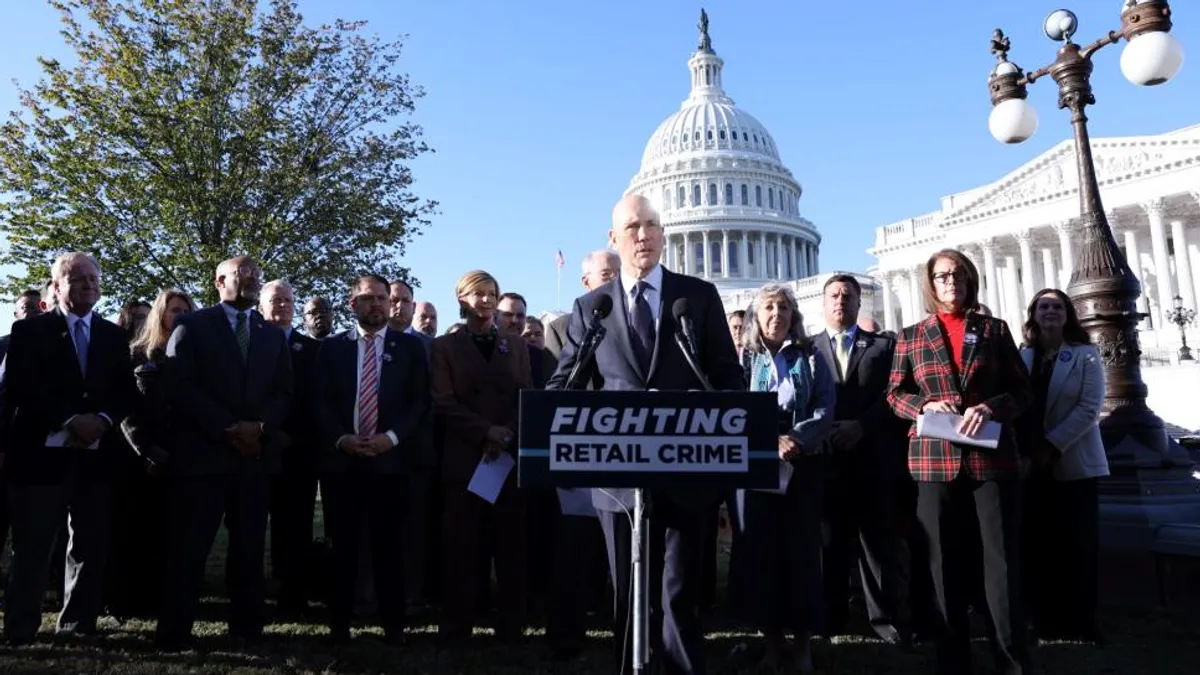
An anticrime bill targeting organized retail theft easily passed the U.S. House of Representatives on Tuesday in a bipartisan vote. The legislation now goes to the Senate.
The vote is a milestone for the National Retail Federation and Retail Industry Leaders Association, which have pushed for this legislation for years.
The bill targets “organized crime involving the illegal acquisition of retail goods and cargo for the purpose of selling those illegally obtained goods through physical and online retail marketplaces” and aims to address “the cross-jurisdictional, interstate, and international aspects of these crimes,” according to its text.
To combat theft and violence in stores and at cargo points, the bill would create an “Organized Retail and Supply Chain Crime Coordination Center” under the Department of Homeland Security for federal, state, local, territorial and tribal efforts. A director for the office would be appointed by U.S. Immigration and Customs Enforcement.
In separate statements Tuesday, both the NRF and RILA urged passage of the bill in the Senate.
“NRF has been leading the fight on behalf of retailers for passage of this legislation through direct engagement with federal, state and municipal law enforcement, coordinating fly-ins for lobbying by home state retail asset protection professionals, providing expert testimony and conducting fact-based research,” NRF chief lobbyist David French said.
The group’s research and facts haven’t always been dependable, however. In 2023, the group retracted a key statistic in a special report on crime after Retail Dive found that its estimate of the impact of organized retail crime was off by an order of magnitude. The only statistic from NRF cited in the bill passed Tuesday is that, from 2019 to 2023, larceny incidents rose by 93%, with a 90% rise in average dollar loss; the financial impact is not mentioned.
In 2024, the NRF stopped conducting research into inventory loss after releasing reports annually for more than three decades. In recent quarters, many retailers that had flagged shrink and theft as a major problem said losses are down significantly, in some cases to pre-pandemic levels.
Some asset-protection experts see the improvement as the result of operational changes – like adding staff and preventing pricing and merchandising errors — more than of anticrime efforts.
Indeed, if the organized crime bill does eventually become law, retailers are unlikely to notice a difference in their inventory losses, or shrink, according to Brand Elverston, a loss prevention specialist who works with major retailers and brands. That’s in part because, despite the focus on ORC, retailers have “no idea the impact of ORC to their total shrink.”
More, the legislation addresses only one aspect of “a very distributed retail challenge,” he said by email.
“When the math is hammered out, ORC is estimated as a single-digit (if not fractional) percentage of the single-digit percentage of total sales lost to shrink. Perspective has to matter,” he said. “Not saying ORC isn't a problem – it is. And it was time for federal legislation to give law enforcement recourse. But, as a retailer – this is good, but likely won't appear on my P&L, where shrink is noticed.”