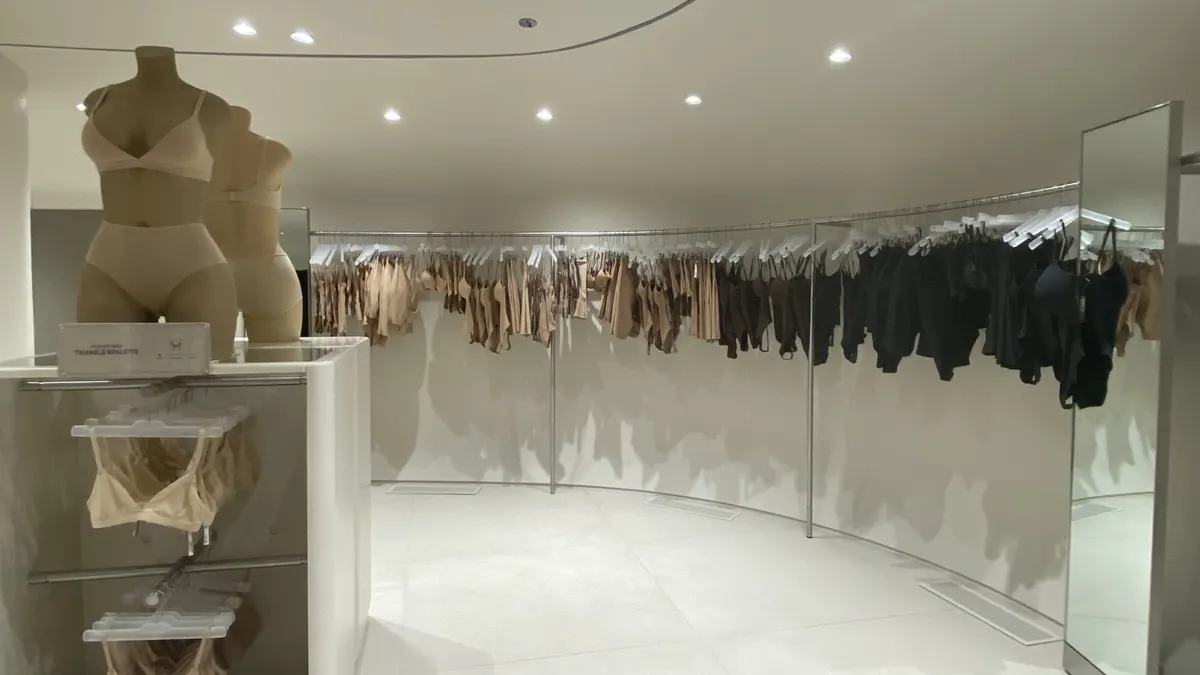
The first name on everyone’s lips this year didn’t make it long enough to end up on this list: Saks Global filed for bankruptcy in mid-January after months of speculation and vendor challenges.
The company has already announced the closure of its off-price business, save a few stores, and Authentic Brands Group now holds a larger stake in the entity that controls the perpetual master license to its IP, which could complicate the bankruptcy. While the question of whether Saks Global will file has been answered, plenty still remain about the luxury department store conglomerate’s future as it undergoes restructuring, including whether burned vendors are interested in coming back.
Even before the filing, some brands were turning to alternatives like Nordstrom, Bloomingdale’s and even Macy’s, Fitch Ratings Senior Director David Silverman said. But Saks Global is in the unique position of being one of only a handful of choices for some of the brands it sells — and the luxury malls it anchors.
New-age mall tenants like Target and Dick’s Sporting Goods aren’t likely to appeal to a high-end mall. And likewise, high-end brands have fewer paths to sell their wares.
“A Joann vendor has Michaels, has Walmart, has a lot of other options,” Silverman said. “There is Nordstrom, there's Bloomingdale's, there's some higher-end Macy's or Dillard’s, but Saks and Neiman's have historically been very important for those vendors.”
That bodes well for the company’s ability to draw them back in, but the same can’t be said for others in the throes of bankruptcy. In general, vendors have more choices than before, Silverman said, which is one of the factors that led to the liquidation of Party City and Joann last year.
As for retailers currently at risk, they’re facing many of the same problems the industry grappled with last year: a financially stretched consumer, an ever-shifting tariff environment and a tough labor market. Only it’s now been almost a full year of tariff-induced chaos and shoppers have been pressured for several consecutive years.
“The defaults in the retail sector remain elevated and our list of at-risk retailers is as long today as it was last year,” Raya Sokolyanska, vice president of corporate finance at Moody’s Ratings, said.
Prior to the pandemic, which tipped many retailers into bankruptcy, Moody’s vulnerable retailer list leaned more heavily toward apparel and department stores. Now, Sokolyanska sees a mix of sectors represented, including retail-adjacent companies.
For retailers that find themselves in distressed territory, debt is often a key source of pressure — and it's been hard to refinance in recent years. Moody’s Sokolyanska says around 2022, vulnerable retailers began having a tougher time with refinancing and other financial measures to avoid bankruptcy — and that continues in 2026. The ratings firm has a negative outlook for the retail industry as a whole this year.
Retailers who could refinance already did so in 2025, according to Bea Chiem, sector lead for retail at S&P Global Ratings, though they will likely keep their eyes open for any additional windows of opportunity that emerge this year.
The strength of the consumer is another threat. Sokolyanska called it “remarkable” how well consumer spending has held up in recent years, but warned that shoppers can’t handle much more in terms of price increases. Indeed, a recent report from Wells Fargo said consumers felt more confident at the height of the pandemic than they do now.
For Chiem, one of the key measures to watch this year is the employment outlook, which could hold clues to consumer wellbeing.
“When is that consumer going to further crack? We kept waiting,” Chiem said, noting sales — including during the holiday period — were still relatively good last year. The trajectory of the job market could end up being critical to their resilience in 2026. “Consumers can spend as long as they have a job. And so if that continues to weaken, that will get pressured.”
Already, there doesn’t seem to be much upgrade or replacement activity in categories like electronics, which usually rely on those cycles to drive sales, Fitch’s Silverman noted. Housing prices are also worth watching, as are geopolitics, which continue to shift quickly.
“People ask, ‘What do you think could surprise you this year?’” Silverman said. “And my answer is: ‘Everything, every day.’”
Forecasting default vulnerability is not a firm science. Some of the retailers in this article are at more imminent risk than others — but as the pandemic showed, an unexpected event can tip retailers over the edge that otherwise may have survived.
For this article, we use CCC-level rankings from Fitch, which have a “substantial credit risk” and a “real possibility” of default, as well as tier 1 and tier 2 markets of concern lists, which represent companies outside of Fitch’s coverage.
We also use Moody’s Caa-level ratings and S&P’s CCC and CCC+ ratings. Caa-level ratings at Moody’s qualify as a “very high credit risk,” though there is variance within this category. A CCC ranking at S&P implies default scenarios in the next 12 months, while a CCC+ rating does not specify a timeline of default.
Here’s a closer look at some of retail’s more vulnerable players.
J. Crew Group
J. Crew Group's financial vulnerability
| Agency | Classification or rating | Description | |
|---|---|---|---|
| Fitch Ratings | Tier 2 Market Concern List |
|
|
| Moody's Ratings | Caa1 | These businesses are in the higher performance end of this category, but still have poor standing and a “very high credit risk.” | |
| S&P Global Ratings | CCC+ | These businesses have an “unsustainable capital structure” but no set timeline for default. |
SOURCE: Fitch Ratings, Moody's Ratings and S&P Global Ratings
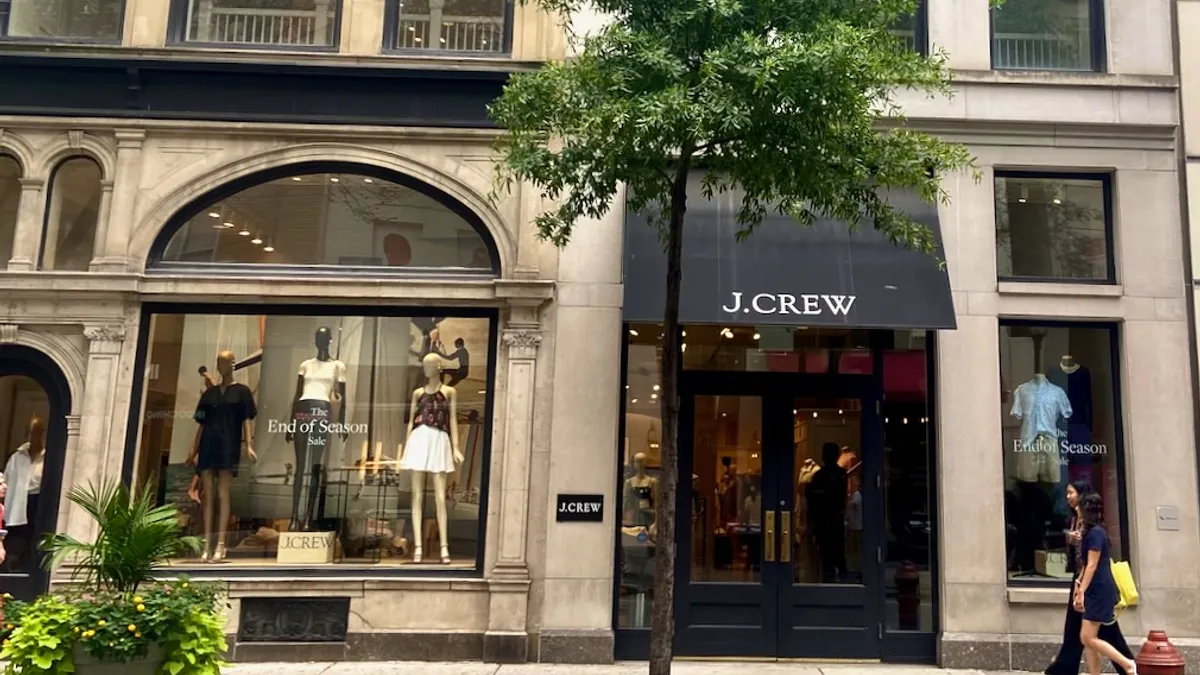
J. Crew Group, which filed for — and exited — bankruptcy in 2020 after years of challenges, is back at risk. Amanda O’Neill, retail director at S&P Global Ratings, said J. Crew, known for its preppy styles, has struggled to get its assortment and pricing strategy right in an increasingly competitive environment.
In the current economy, it’s especially important for retailers in discretionary categories like apparel to give shoppers a good enough reason to buy, Moody’s Sokolyanska said. Ralph Lauren, for example, has invested deeply in its technology, operations and brand, she noted, separating it out from J. Crew.
“The consumer that they serve is not meaningfully that different from the consumer that J. Crew serves,” Sokolyanska said. “The financial results of the companies are very different — and so in a highly fashion-sensitive, highly discretionary space, the value of long-term investment in brand, technology, marketing and operational capabilities becomes even more paramount, and that's when we see the bifurcation in results.”
J. Crew Group in 2023 confirmed a round of layoffs tied to a review of its organization, intended to support efficiency and long-term growth. However, the company has continued to struggle in driving traffic and consumer demand.
S&P downgraded J. Crew’s parent company, Chino’s Intermediate 2, in December, after a third quarter comparable sales decline of 8.2% bit into profitability. The retailer should still be able to cover its cash needs over the next 12 months, according to the ratings agency, but store opening plans and margin pressures will continue to hurt the company’s finances.
“Internally generated cash from operations has been insufficient to fund company’s store growth, which we view as unsustainable in the longer term and could limit the company’s ability to navigate challenges,” the analysts wrote.
The pandemic was one such unexpected challenge that tipped the retailer into bankruptcy the last time. Fitch’s Silverman noted that Madewell, a bright spot prior to J. Crew’s 2020 filing, could have potentially saved the retailer from court had the pandemic not interrupted its IPO efforts.
J. Crew Group did not respond to a request for comment on its financial standing.
Torrid
Torrid's financial vulnerability
| Rating's agency | Classification or rating | Description |
|---|---|---|
| Fitch Ratings | Tier 2 Market Concern List | These businesses have a higher degree of uncertainty about an upcoming default than Fitch’s tier 1 list. Reasons could include that the market is supportive of the company’s securities or the company has longer-term maturities. |
| Moody's Ratings | Caa1 | These businesses are in the higher performance end of this category, but still have poor standing and a “very high credit risk.” |
| S&P Global Ratings | CCC+ | These businesses have an “unsustainable capital structure” but no set timeline for default. |
SOURCE: Fitch Ratings, Moody's Ratings and S&P Global Ratings
Plus-size retailer Torrid has been battling sales declines, merchandising mishaps and tariff woes, among other challenges in recent years. The retailer laid off 5% of its headquarters staff in 2023 as part of a cost-saving initiative and last year announced it would close up to 180 stores in 2025.
The retailer in December reported Q3 net sales fell 10.8%, with comps declining 8.3% and net loss expanding to $6.4 million. Torrid also said it had already closed 74 locations and reiterated expectations for more store closures ahead.
S&P subsequently downgraded the company and said the apparel brand’s capital structure is unsustainable “given weak credit metrics, including insufficient coverage over its interest and amortization requirements over the next 12 months.” Torrid has about $35 million of interest expenses and $17.5 million of mandatory principal amortization payments, according to S&P.
While these payments restrict Torrid’s flexibility, the analysts also noted a history of merchandising missteps at the retailer, which reflects an “inability to sufficiently track, adjust, and control the execution of its strategy in the face of increasing competitive pressures.”
Another potential pressure is the popularity of GLP-1s. Fitch’s Silverman said it was unclear what impact that will have on players like Torrid, which cater to plus-size customers, but greater adoption of the weight loss drugs could have implications across the retail industry. It could change food consumption trends and also impact apparel sales.
“As GLP adoption increases, that could actually be a driver of replacement cycles as consumers need new clothes and want to buy new clothes as their body changes,” Silverman said.
Torrid did not respond to a request for comment on its financial standing.
Guitar Center
Guitar Center's financial vulnerability
| Rating's agency | Classification or rating | Description |
|---|---|---|
| Fitch Ratings | Tier 2 Market Concern List | These businesses have a higher degree of uncertainty about an upcoming default than Fitch’s tier 1 list. Reasons could include that the market is supportive of the company’s securities or the company has longer-term maturities. |
| Moody's Ratings | Caa2 | These businesses are in the mid-range of this category and have poor standing and a “very high credit risk.” |
| S&P Global Ratings | CCC+ | These businesses have an “unsustainable capital structure” but no set timeline for default. |
SOURCE: Fitch Ratings, Moody's Ratings and S&P Global Ratings
Guitar Center has a history of defaults, high leverage and is situated in a category that’s not consumers’ top priority, according to Sokolyanska.
CEO Gabe Dalporto said last January that the 2024 holiday season was Guitar Center’s strongest in years, but 2026 is set to be another year where shoppers have less money to spend, which means essentials are top of mind over discretionary buys.
Discretionary retailers “are most at risk when a portion of consumer spending is more challenged and when the consumer is very deliberate about where they use their dollars,” Sokolyanska said.
Following a debt exchange last summer, S&P upgraded Guitar Center to CCC+, saying it likely has time and sufficient liquidity over the next 12 months to execute on its strategic initiatives but still has an “unsustainable” capital structure due to high debt and cash flow deficits. The retailer is working to refine product assortment and build out its digital business; heavy discounting needed to clear out inventory temporarily hampered free operating cash flow in 2024.
Guitar Center already went through Chapter 11 in 2020, driven by the pandemic and the long-term impact of a leveraged buyout. The retailer got rid of more than $800 million of debt in the bankruptcy, but five years later, it’s still struggling under the weight of its debt load.
The retailer changed up its leadership a little over two years ago, with then-board member Dalporto taking over as CEO and Guitar Center veteran Tim Martin returning to serve as CFO. A new chief merchandising officer joined the music retailer last year from Wayfair.
Guitar Center did not respond to a request for comment on its financial standing.
QVC Group
QVC Group's financial vulnerability
| Rating's agency | Classification or rating | Description |
|---|---|---|
| Fitch Ratings | CCC+ | These businesses have a “substantial credit risk” and a “real possibility” of default. |
| Moody's Ratings | Caa3 | These businesses are in the lower performance end of this category and have poor standing and a “very high credit risk.” |
| S&P Global Ratings | CCC | These retailers have “default scenarios envisioned in the subsequent 12 months.” |
SOURCE: Fitch Ratings, Moody's Ratings and S&P Global Ratings
QVC Group has the highest amount of outstanding rated debt on Moody’s list and has “significantly elevated default risk.” The retailer, known for its TV shopping model, has struggled to maintain relevance for years — and recently rolled out a strategy to capitalize on TikTok, streaming and other more modern platforms.
While CEO David Rawlinson said last year that the pivot to social media and streaming leaves QVC Group in a good position “to use our exceptional content creation and selling capabilities to capture market share,” it will take time to make that switch.
“It's a very challenged retailer,” Silverman said. There are two main questions regarding its strategy pivot: “One is whether the pivot is successful. And number two, whether there's enough runway and time for it to be successful.”
The social and streaming side of the business accounts for less than 10% of the whole at QVC Group, Silverman said, and the rest is in decline. QVC Group also has debt maturities that come due within the next few years, but Silverman said that the company is still generating cash, which is positive. The company’s latest earnings report in Q3 showed revenue down 6% and operating income down 61%.
QVC Group did not respond to a request for comment on its financial standing.
Rugs USA
Rugs USA's financial vulnerability
| Rating's agency | Classification or rating | Description |
|---|---|---|
| Fitch Ratings | Tier 2 Market Concern List | These businesses have a higher degree of uncertainty about an upcoming default than Fitch’s tier 1 list. Reasons could include that the market is supportive of the company’s securities or the company has longer-term maturities. |
| Moody's Ratings | Caa1 | These businesses are in the higher performance end of this category, but still have poor standing and a “very high credit risk.” |
| S&P Global Ratings | CCC+ | These businesses have an “unsustainable capital structure” but no set timeline for default. |
SOURCE: Fitch Ratings, Moody's Ratings and S&P Global Ratings
Rugs USA is reflective of a broader home space that has been challenged over the last few years. A pandemic boom in the home space turned into categorywide stagnation as shoppers bought en masse and then shifted their spending elsewhere.
That’s led to a number of bankruptcies in the sector in the past couple of years, including The Container Store in late 2024, At Home last June and Value City Furniture’s parent company just a few months ago. There are signs the space is recovering, Moody’s Sokolyanska said, but spending on any home-related items “is still more of a question mark in terms of modeling a meaningful recovery.”
At S&P, O’Neill says it’s companies with a more niche offering that are pressured now, while home retailers with a more diverse offering are doing better. S&P assigned Rugs USA a CCC+ rating in August last year after an out-of-court restructuring that reduced its funded debt by several hundreds of millions of dollars. The analysts at the time said the retailer would likely continue to face sales volatility and compressed free operating cash flow, but likely has enough liquidity to execute its turnaround initiatives over the next 12 months.
“In our view, ongoing weak consumer demand, uncertainties related to its supply chain and elevated competition will pose significant risks to the company’s turnaround efforts,” the ratings firm wrote.
Rugs USA aims to sell affordable, design-forward rugs and has orchestrated a series of collaborations in recent years, including with Kate and Kevin Love, Ashley Tisdale and designer Prabal Gurung.
In addition to a pressured consumer, home retailers have also faced increasing competition from the likes of Walmart, Target and Amazon, as well as e-commerce player Wayfair, according to Silverman.
“The home furnishings business is driven by some desire to refresh a look — pillows, whatever it is — and there aren't really fashions. There aren't really near-term fashion cycles,” Silverman said. “It's about the consumer desire to spend … the consumer has just been focused elsewhere.”
Rugs USA did not respond to a request for comment on its financial standing.
Gabe’s
Gabe's financial vulnerability
| Rating's agency | Classification or rating | Description |
|---|---|---|
| Fitch Ratings | Top (tier 1) market concern list |
|
| Moody's Ratings | Caa3 | These businesses are in the lower performance end of this category and have poor standing and a “very high credit risk.” |
| S&P Global Ratings | CCC | These retailers have “default scenarios envisioned in the subsequent 12 months.” |
SOURCE: Fitch Ratings, Moody's Ratings and S&P Global Ratings
Off-pricer Gabe’s already conducted an out-of-court restructuring over the summer last year, reducing debt and bringing in capital from a group of new owners. That helped it evade bankruptcy and continue planning for expansion ahead under a group of lenders.
“They have set some targets for us, working with our advisers, with our landlords, with our vendors, and in management within the company,” Gabe’s CEO Jason Mazzola told Retail Dive after restructuring last year. “If we can hit certain goals, we can achieve more dollars into the company to help keep us moving forward in a great direction.”
Despite the infusion, S&P in November said the capital structure of Gabe’s parent company remained unsustainable and it could “envision default scenarios over the next 12 months due to liquidity constraints.” Those analysts said Gabe’s restructuring reduced debt by $115 million and brought in $55 million to fund operations.
“While supply chain disruptions from tariffs likely will create opportunities that benefit off-price business models, we believe potential liquidity constraints will affect Gabe’s ability to buy excess inventory and weaken its competitive position,” S&P said in November.
Gabe’s did not respond to a request for comment on its financial standing.