Dive Brief:
-
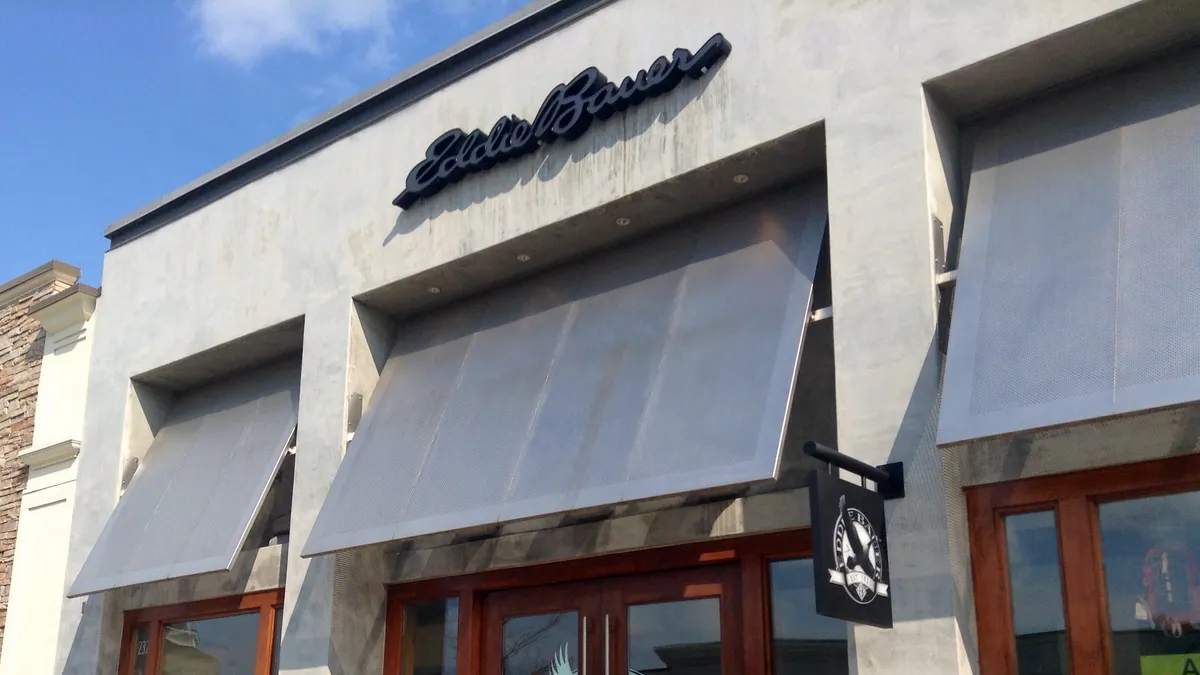
The entity operating Eddie Bauer’s stores in the U.S. and Canada filed for bankruptcy Monday, facing average weekly disbursements of some $1.6 million over the next thirteen weeks but with only about $20 million of cash on hand.
-
The company, which licenses the Eddie Bauer brand from Authentic Brands Group, is in the process of shuttering 175 stores; the brand began the year with a fleet of about 220 but some leases lapsed in January. Aggregate net sales proceeds from the closing sales will be about $21.3 million.
-
The wind-down will halt if the company can find a buyer, and there has been some interest, per court filings. The Chapter 11 process doesn’t apply to stores beyond North America or to the brand’s wholesale and e-commerce operations, which are all separate licensees.
Dive Insight:
The same day that Eddie Bauer’s stores operator, in filings with the United States Bankruptcy Court for the District of New Jersey, painted a dire picture of “macroeconomic and retail-specific market pressures and headwinds,” its e-commerce operator announced a new brand strategy centered on digital and wholesale.
Eddie Bauer’s brick-and-mortar operations are straining under liabilities of more than $1 billion (possibly as high as $10 billion) with assets of just $100 million to $500 million, per court documents. Its troubles began in 2023 with a shift in consumer preferences plus rising inflation and competition, according to a filing from Stephen Coulombe, managing director at Berkeley Research Group, which has been working with the Eddie Bauer stores operation since October.
“As a result, the Debtors have endured a sustained period of negative earnings,” Coulombe told the court.
Coulombe previously served as chief restructuring officer for Forever 21’s stores operator when it filed for bankruptcy last March. That brand, whose IP is also owned by Authentic, similarly licenses its wholesale and e-commerce to another entity. In September Authentic said it was close to a deal to reopen Forever 21 stores in the U.S. though so far no stores have opened; Authentic didn’t immediately respond to a request for an update.
Last month Authentic transferred Eddie Bauer’s e-commerce and wholesale licenses to another company, Outdoor 5, which also provides sourcing, manufacturing and wholesale expansion to other brands controlled by Authentic, including Quiksilver and Billabong. Eddie Bauer merchandise is already available at J.C. Penney, a sibling brand within operating parent Catalyst Brands.
Catalyst CEO Marc Rosen said Eddie Bauer was scrambling to address sales declines, supply chain issues and other challenges and that tariff uncertainty exacerbated those struggles.
“While the leadership team at Catalyst was able to make significant strides in the brand, including rapid improvements in product development and marketing, those changes could not be implemented fast enough to fully address the challenges created over several years,” he said in a statement.
Catalyst formed about a year ago, merging the operations of various brands whose intellectual property is owned by Authentic, including Aéropostale, Brooks Brothers, Eddie Bauer, Lucky Brand and Nautica, with J.C. Penney and some of its private label and exclusive brands. Authentic and Simon Property Group, via a 50/50 venture dubbed Sparc, acquired Eddie Bauer about five years ago, and later Sparc and its entities became part of Catalyst. Monday’s bankruptcy filing involves only Eddie Bauer’s operations.
Aspects of Outdoor 5’s new strategy could trickle down to stores, including changes to garment design and manufacturing. Outdoor 5 on Monday said the brand refresh is focused in part on performance upgrades, including a relaunch of Eddie Bauer’s “First Ascent” line.