Bed Bath & Beyond wants to take care of everything in your home.
The company has been embarking on a turnaround that aims to redefine itself as more than a retailer through its push into home services and home ownership.
“What we're building is far bigger than a retail company,” President Amy Sullivan said in an interview with Retail Dive.
To underscore that mission, the company changed its corporate name, again, from Bed Bath & Beyond, Inc. to Neighborhood Intelligence. As of Aug. 17, the company moved its stock from the New York Stock Exchange to the Nasdaq, signaling the company’s “long-term commitment to innovation, technology, and data,” CEO Marcus Lemonis said.
A slew of recent acquisitions is supporting this strategy. While the deals may make Bed Bath & Beyond a bigger company, it’s unclear whether they’ll make it a stronger one.
Two acquisitions in particular — The Brand House Collective (formerly Kirkland’s Inc.) and The Container Store — faced financial challenges in recent years. Paired with Bed Bath & Beyond’s 2023 bankruptcy, it creates uncertainty around the company’s turnaround prospects.
“I think you've got a case of an amalgamation of falling knives, and none of the individual companies is going to prop up the others,” James Gellert, executive chair of financial analysis firm RapidRatings, said. “This is definitely going to be a question of: How well are these businesses going to be integrated? What costs can be taken out, and is the consolidation thesis going to take hold? Personally? I'm skeptical, but the ratings themselves are what's important, and they don't tell a story that suggests a clear win here.”
The strategy positions Bed Bath & Beyond as a fundamentally different kind of company than the one that filed for Chapter 11 just three years ago.
Faced with skepticism and a particularly challenging environment for home retailers, the company’s aspirations beyond traditional retail could be what it needs to survive.
As operational changes unfolded, Bed Bath & Beyond ushered in fresh leadership. In late 2023, businessperson and TV personality Marcus Lemonis stepped into the picture, joining the company’s board and becoming chairman just two months later.
By early 2025, Lemonis was leading the company as its principal executive officer.
When Lemonis officially became CEO at the start of the year, he outlined his vision for a new Bed Bath & Beyond predicated on the intersection of retail, home services and home ownership. As part of it, the company would operate its retail portfolio alongside services for home renovations and maintenance, real estate brokerage, warranties and insurance, among others.
But many of those recently acquired companies bring their own financial baggage.
Take The Container Store. It filed for bankruptcy in late 2024 after a $40 million investment from Bed Bath & Beyond’s parent company fell through.
And Kirkland’s, which eventually became The Brand House Collective, that same year began exploring strategic alternatives after experiencing sales declines. As a way to cut costs, the retailer worked to reduce store payroll, marketing, corporate overhead and third-party tech expenses.
RapidRatings specializes in assessing a company’s near- and medium-term financial health. A Financial Health Rating below a 40 is considered at least a “high risk,” while a Core Health Score below a 40 is considered to be at least in “poor health.”
Bed Bath & Beyond, and the companies it acquired, show poor financial health
“Having Bed Bath & Beyond at a 39 is almost the identical rating as the original Bed Bath & Beyond when it filed for bankruptcy,” Gellert said. “That doesn't mean it will file for bankruptcy, but it does mean that it's not much better than it was.”
The collection of financially weak businesses poses challenges as the new Bed Bath & Beyond navigates its future.
Other companies that have initiated similar acquisition strategies haven’t proven successful, according to Gellert.
“Historically, the retail roll-up strategies that included weaker companies have not fared particularly well,” he said. “A lot of the companies that have done poorly in retail acquisitions kind of look like this — Hudson’s Bay, Toys R Us, Sears, Kmart. … None of the financials are going to make this a success.
You take businesses that are desperate — but to some degree complementary — you put them together, you are going to have an undue responsibility on execution and on strategic vision. I don't know that any of these companies have a history of those two things.”
‘Location, location, location’
There’s an upside to the acquisitions, though — the real estate.
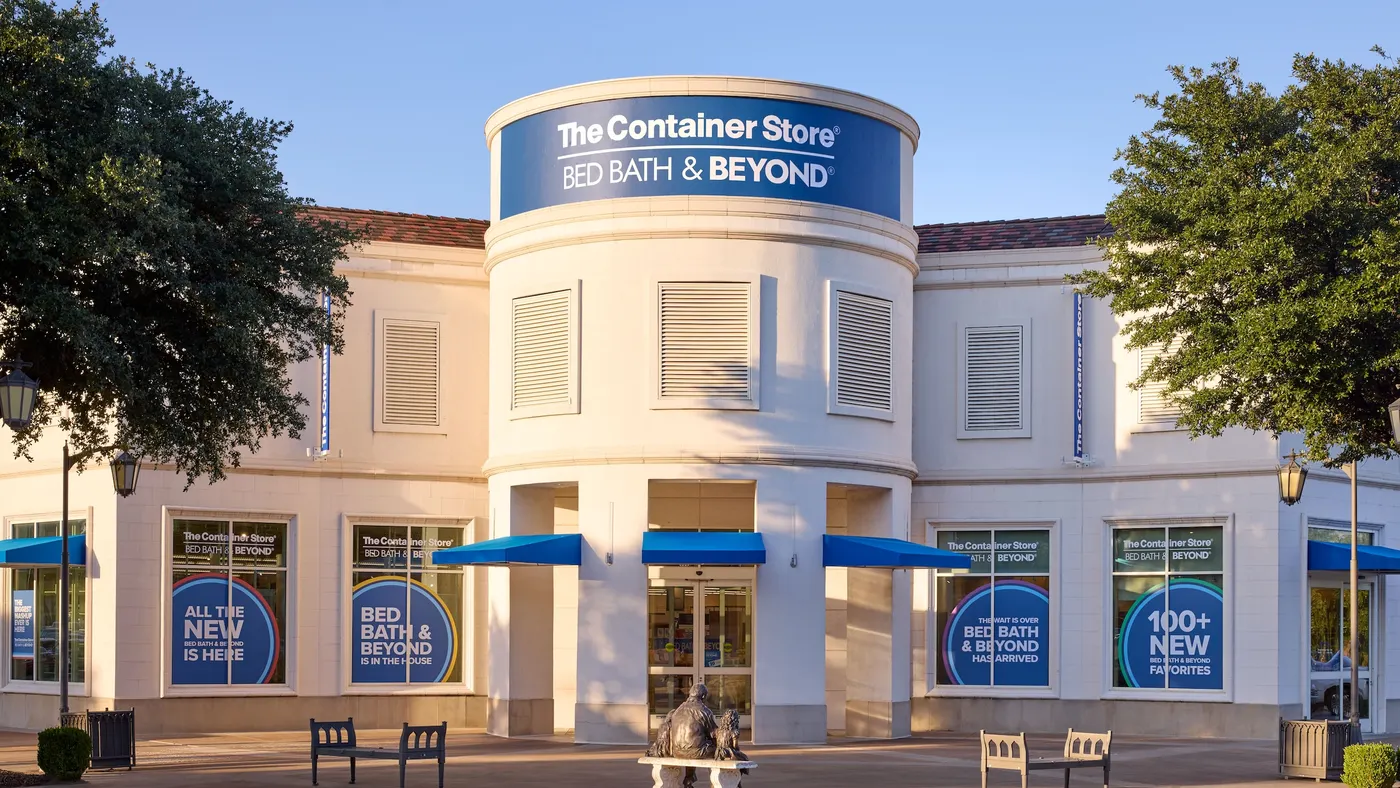
As part of its deal to acquire The Container Store, Bed Bath & Beyond is expanding its physical presence by opening co-branded stores with the retailer. The concept debuted this spring in The Container Store’s home state of Texas and will eventually roll out to the retailer’s entire footprint of roughly 100 stores.
The stores themselves “are in good locations,” Cristina Fernández, managing director and senior research analyst at Telsey Advisory Group, said. “That's a positive that they have good real estate and the locations are big.”
The retailer’s stores are situated in desirable locations, like Arlington, Virginia, and Bellevue, Washington, creating significant value as Bed Bath & Beyond looks to get its footing in physical retail once more.
“In terms of physical retail — which we know is not going away — location, location, location has always been the most important thing,” said Barbara Kahn, a professor of marketing at The University of Pennsylvania’s Wharton School.
The acquisitions have also brought in a new set of leaders to support Bed Bath & Beyond’s turnaround efforts.
That's an awful lot of activity, a lot of real estate, a lot of employees, a lot of history to work through.

James Gellert
Executive Chair, RapidRatings
Sullivan, who was Kirkland’s CEO, became the chief executive of Bed Bath & Beyond’s new Beyond Retail Group division when the deal to acquire The Brand House Collective was announced. In April, she was named president of the parent company, overseeing all three pillars of Bed Bath & Beyond’s strategy.
Her job is to “be the person that is making sure that the ecosystem exists to coexist for the consumer. That there's that red thread of consistency in how we show up to the customer, regardless of if we're in your home installing cabinets or we're selling you something at Bed Bath & Beyond or we're doing your baby registry with BuyBuy Baby,” Sullivan said.
Jason Delves, who was the CEO of Lumber Liquidator parent company F9 Brands since 2019, was named the chief executive of the Beyond Home Services pillar. And Brian LaRose, former Container Store CFO, became chief financial officer of the broader organization.
The success of Bed Bath & Beyond’s turnaround depends on how well executives can work to bring the various acquisitions together under one roof, while also executing on a new vision for the overall company.
“This is all going to come down to whether the new leadership is able to pull this off,” RapidRating’s Gellert said. “But that's an awful lot of activity, a lot of real estate, a lot of employees, a lot of history to work through.”
Bad timing
Bed Bath & Beyond’s attempted comeback comes during a rocky period for the sector. A weak housing market and poor consumer sentiment has contributed to sales declines across the home sector.
“The home sector being down is definitely a challenge. Everyone's competing for dollars,” Fernández said.
The home goods sector of retail has experienced regular year-over-year declines, according to monthly retail sales data from the U.S. Department of Commerce. And tariff policies have targeted the sector specifically, causing more problems for home retailers.
But Bed Bath & Beyond’s strategy to expand beyond traditional retail could unlock a potential new customer segment — contractors and developers — positioning them as a B2B company rather than just B2C, according to Michael Brown, senior partner and Americas retail leader at Kearney.
Targeting nontraditional customers is something other retailers connected to the housing market have been able to benefit from in recent months as consumer uncertainty lingers. Home improvement retailers Home Depot and Lowe’s have made investments to strengthen their offerings for the Pro customer segment as discretionary DIY spending remains pressured.
“[Bed Bath & Beyond’s] strategy says, ‘We're not going to try to just remake what we were. … We're going to be much more. We're going to be up and down the value chain, we're going to be connected. That will give us the opportunity to be different,’” Brown said. “Different in the market, but also to touch different consumers at different times for different reasons.”
A path forward
The sector’s issues are only a backdrop to the many challenges Bed Bath & Beyond faces within its business.
The company needs to foster new relationships with vendors to ensure their stores have the inventory and right assortment, according to Fernández. But even with the stores properly stocked, the company still needs to get customers through the door.
When Bed Bath & Beyond shuttered its stores following its 2023 bankruptcy, consumers found other places to shop for their homes.
“There's so many other stores that consumers are looking to,” Fernández said. “They kind of figured out how to shop for these categories that [it doesn’t] necessarily feel like there's a huge hole in the market.”
The company’s approach to marketing will also determine how successful its comeback is. Bed Bath & Beyond not only has to win back its former customers; it must also educate those customers on how to shop with the retailer without alienating existing customers of the other businesses it has acquired.
Kirkland’s targets the “decorator” and helping customers find the “final touches to a home,” Sullivan said. Meanwhile, The Container Store’s customers tend to spend more money per visit, but shop less frequently. And Bed Bath & Beyond connects customers with the essentials for their home, Sullivan said.
“I would think of it as unique customer files that exist today, that we're blending together,” she said. “The belief is we can then grow that customer file based on ‘Everything Home.’”
There's so many other stores that consumers are looking to.
Cristina Fernández
Managing Director and Senior Research Analyst, Telsey Advisory Group
The company is leaning on its partnership with Bilt, a home renter rewards provider, to create a more cohesive loyalty program for customers shopping across the company’s various banners. On the backend, the partnership has provided an AI-based predictive modeling tool for customer purchases, Sullivan said.
“If a customer makes ‘this’ kind of purchase, it likely means ‘this’ is going on in her life, and the next thing she's going to consider is ‘this,’” Sullivan said.
While retail remains a key part of the Bed Bath & Beyond story — it serves as the “front door” for customers entering its ecosystem — the home services and home operating system pillars will be the true “unlock” for the company as it looks to the future, Sullivan said.
Creating an ecosystem around a customer’s needs in the home will help it be a stronger company, Brown said.
“What we're starting to see at play is end-to-end ownership of the lifecycle of people's homes — how they get them, how they decorate them and how they enjoy them,” he said.
That could lead to a more successful iteration of Bed Bath & Beyond — if the company can get it right. Now, it's up to execution.