In less than six months under Chapter 11, Exemplar Luxury Group has reduced its debt load by some 75% – a drop of as much as $2.3 billion, according to advisory firm Octus.
ELG entered bankruptcy court in January with $3.4 billion in debt and exited Friday with $840 million, including $340 million on its asset-based loan facility and $500 million of exit term loans, according to court filings. The court-approved $500 million in new capital is from the ad hoc secured noteholder group, now the majority owners.
The company, formerly Saks Global, embarks on a turnaround in better financial shape than when it combined luxury department stores Saks Fifth Avenue, Neiman Marcus and Bergdorf Goodman in a highly leveraged $2.7 billion deal 18 months ago. But aspects of its post-bankruptcy financial framework could change that.
The setup is somewhat favorable in the near term because ELG can pay interest on one of the loans by adding debt to the balance rather than paying in cash, which enables cash flow, according to GlobalData Managing Director Neil Saunders. However, that and other elements of the settlement allow loans to grow.
“Now, to be fair, none of these things are current debt, but they point to a potentially weakening balance sheet in the future – which is a concern,” Saunders said by email. “It also signifies that the company is still in a bit of a pinch and is not operating free and clear.”
In a statement Friday, Geoffroy van Raemdonck, who continues as Exemplar Luxury Group CEO after taking the reins at Saks Global in January, expressed appreciation for the financial support of the new owners, who he said “understand the value of our banners and the growth opportunity.”
Van Raemdonck previously was CEO of Neiman Marcus Group but left after Saks Global acquired it in late 2024. The company spent the following year facing a vendor revolt over late payments and unpaid invoices, which led to inventory and sales declines and expanding losses.
“It is a new day for ELG and we are focused on executing our business plan with discipline and investing in the experiences that matter most to our customers,” he said. “Neiman Marcus, Saks Fifth Avenue and Bergdorf Goodman have long set the standard for luxury retail in the U.S., and we are committed to building upon that legacy."
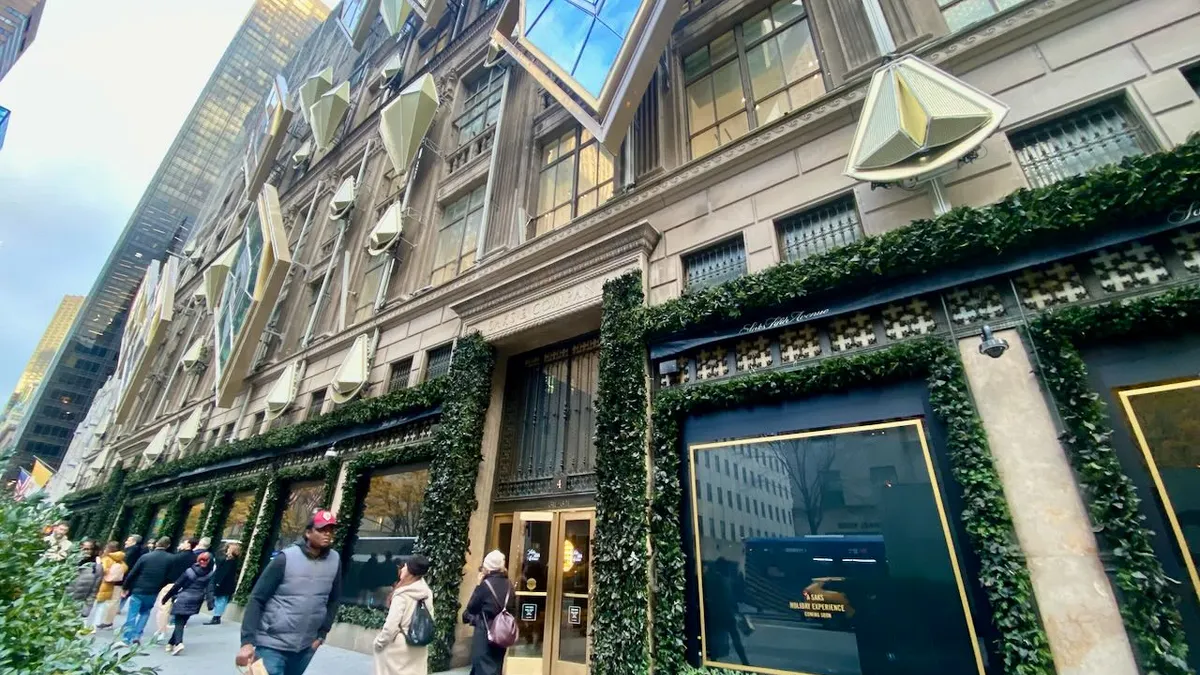
Still, while the debt load “is nowhere near as bad as it was, it remains a significant burden,” Saunders said. Also affecting liquidity is a $1.25 billion commercial mortgage-backed security loan on the New York City Saks Fifth Avenue flagship store. This is not the company’s debt per se, but court documents show that it must account for required payments, Saunders said.
The $1.25 billion mortgage is secured debt collateralized by the Saks Fifth Avenue New York flagship and is non-recourse to Exemplar Luxury Group, the company said by email Thursday.
The CMBS loan is nevertheless “still part of the burden,” according to Saunders.
“Admittedly, the debt may sit in a separate corporate entity, but it somehow must be serviced, and it looks like that will be via payments Exemplar makes on the store,” he said. “The terms of this are not clear, but the whole thing looks very tangled and overly complex. Unfortunately that is the result of previous financial shenanigans."