Dive Brief:
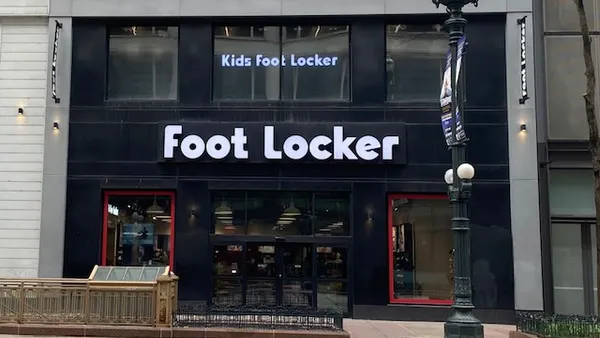
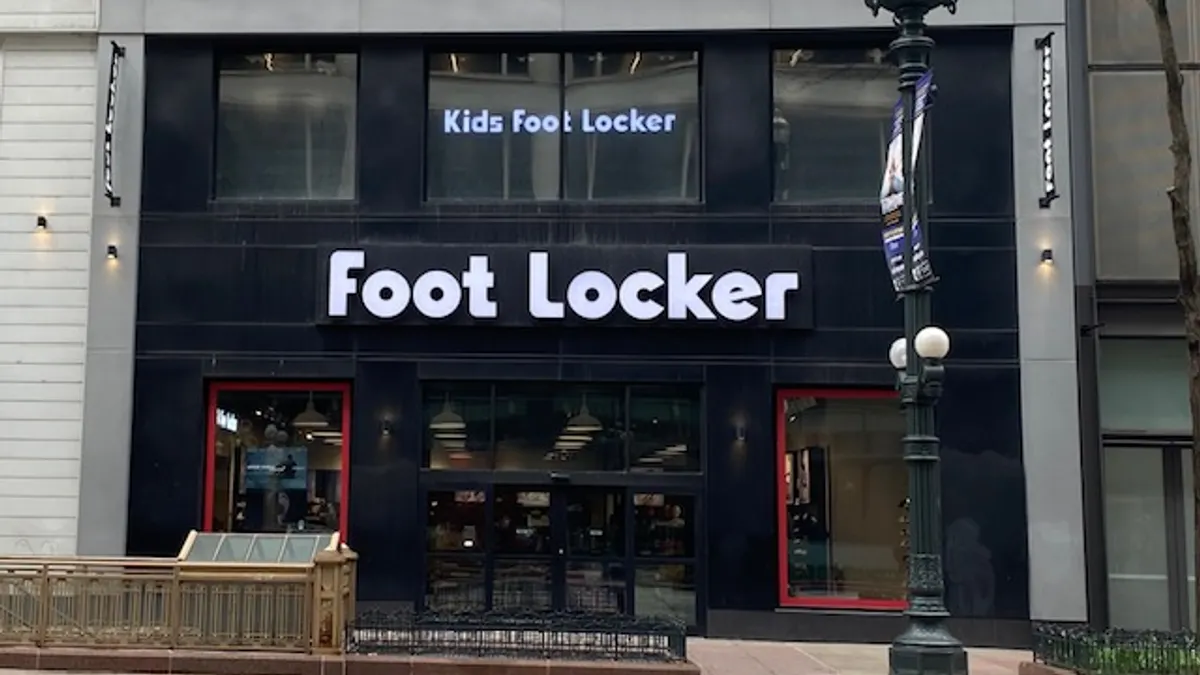
- Dick’s is planning to close fewer Foot Locker stores than it initially anticipated as it sees success with a “Fast Break” store pilot at 11 locations, Executive Chairman Ed Stack said on a call with analysts Thursday.
- The company has already expanded the concept to 10 additional stores in Los Angeles and plans to “rapidly scale” the format across its fleet this year. By back-to-school, Foot Locker plans to have renovated 250 of its locations.
- The news came as Dick’s reported Q4 and full-year earnings. Companywide, Q4 net sales were up nearly 60% to $6.2 billion, thanks to the addition of Foot Locker. As a stand-alone business, Dick’s grew sales 4% to $4 billion.
Dive Insight:
Just six months after acquiring Foot Locker, Dick’s Sporting Goods is projecting the banner will comp positively and turn a profit in 2026.
For the year ahead, Foot Locker is expected to produce comp growth of 1% to 3% and operating income of $100 million to $150 million. Dick’s, on the other hand, is projecting comps to increase between 2% and 4% and to generate $1.58 billion to $1.66 billion in operating profit. Together, that will result in 2026 net sales of around $22 billion, with operating income of up to $1.83 billion.
Dick’s is banking on its inventory cleanup efforts at Foot Locker and the sneaker banner’s new store formats to drive those results. The former is effectively over, Stack told analysts, with the company using Dick’s Going Going Gone banner to clear out excess Foot Locker inventory. The latter is still very much in the works, but the updated “Fast Break” format has led to impressive early results, so much so that Dick’s is expanding it to 250 Foot Locker stores across the U.S. and Europe in a matter of months.
“During Q4, our Fast Break stores drove very strong, positive comps, actually meaningfully exceeding the Dick’s business, while also delivering strong gross margin improvement,” Stack said. “The improvement is coming from the basics: clearer storytelling, better presentation and a more focused assortment where we removed roughly 30% of the styles on the shoe wall that were unproductive.”
The 11 test stores ran the gamut in terms of Foot Locker locations, including urban, suburban, high-volume and lower-volume stores, Stack said. That approach will continue as Foot Locker implements the changes across hundreds of stores this fall. In fact, Stack said the success has been so great that Dick’s now plans to close a “much smaller” amount of Foot Locker stores than initially expected.
“What we’ve found is some of those underperforming stores that are losing money or are just marginally profitable right now — based on what we’re seeing we can do from a Fast Break standpoint and renovating these stores — we can make these stores very profitable,” Stack said.
The executive added that this decision will contribute to lower profitability at Foot Locker in Q1 and Q2 because it would have been easier to just shutter the stores.
Meanwhile, Dick’s is expanding its own fleet. The retailer opened 16 House of Sport stores last year and 15 Field House locations and plans to grow both formats further this year, with 14 House of Sport and 22 Field House locations set to open in 2026. Fifteen Golf Galaxy performance centers are also opening in 2026.
All of that work on stores is pushing capital expenditures in 2026 up to $1.5 billion on a net basis. That compares to $976 million in 2025, which was already up 34% year over year.
“House of Sport and Dick’s Field House remain two of our most powerful and long-term growth drivers and we will continue expanding these formats with discipline,” CFO Navdeep Gupta said.
Dick’s CEO Lauren Hobart added that landlord interest for these stores is “extremely strong, giving us access to some of the best retail locations in the country.”
Analysts recognized the negative results at Foot Locker but some were more optimistic on the concept than others. GlobalData Managing Director Neil Saunders noted that the performance was expected and that Dick’s is “already taking corrective action,” adding that he was “impressed” at the speed with which Dick’s was addressing the banner’s challenges.
“Indeed, they seem to have done more in 6 months of ownership than Foot Locker accomplished in many years as a standalone business,” Saunders said in emailed comments. “The efforts should result in a turnaround in 2026, with comparables and profitability both expected to swing into positive territory. If this is achieved, it will be a major win that underlines the skill of the Dick’s leadership team.”
Jefferies analysts led by Jonathan Matuszewski were more cautious on the turnaround, saying it “feels premature” to tout success given the limited nature of the pilots at Foot Locker. The company will need to post recurring outperformance to justify the capital expenditures, according to those analysts.
“More important, it remains unclear whether the Dick’s banner can continue to execute at a high-caliber while this turnaround unfolds,” Matuszewski said.