As the home sector continues to face challenges brought on by low consumer confidence and a poor housing market, Bob’s Discount Furniture is finding success with higher-income households.
The furniture retailer, known for its everyday low prices, is seeing momentum grow among customers earning over $100,000.
“We're seeing an increase in our higher household income cohort that's trading into Bob's, and that's been really encouraging from a demand perspective — our demand remains healthy,” Bob’s Discount Furniture CFO Carl Lukach told Retail Dive following the retailer’s second quarter earnings release.
It comes as Bob’s has raised prices on some of its products, though Lukach noted the retailer is taking a “surgical” approach to those increases.
Executives on the company’s earnings call highlighted that Bob’s everyday-low-price model positions it to have a 20% to 25% price advantage over competitors, and a 10% advantage over competitors’ lowest advertised price.
“[We are] maintaining our value proposition,” Lukach said. “That is the Bob's way. It is critical to our business model.”
The retailer’s net revenue increased 8.8% year over year to nearly $620 million, driven by new stores and comparable sales growth, which increased 2.3% in the period.
Profits improved, with operating income expanding over 60% to $78.5 million and net income growing 64% to $57.8 million. Bob’s has also been approved for $45.1 million in IEEPA tariff refunds; as of June 28, the company had $41.9 million in IEEPA tariff refund receivables.
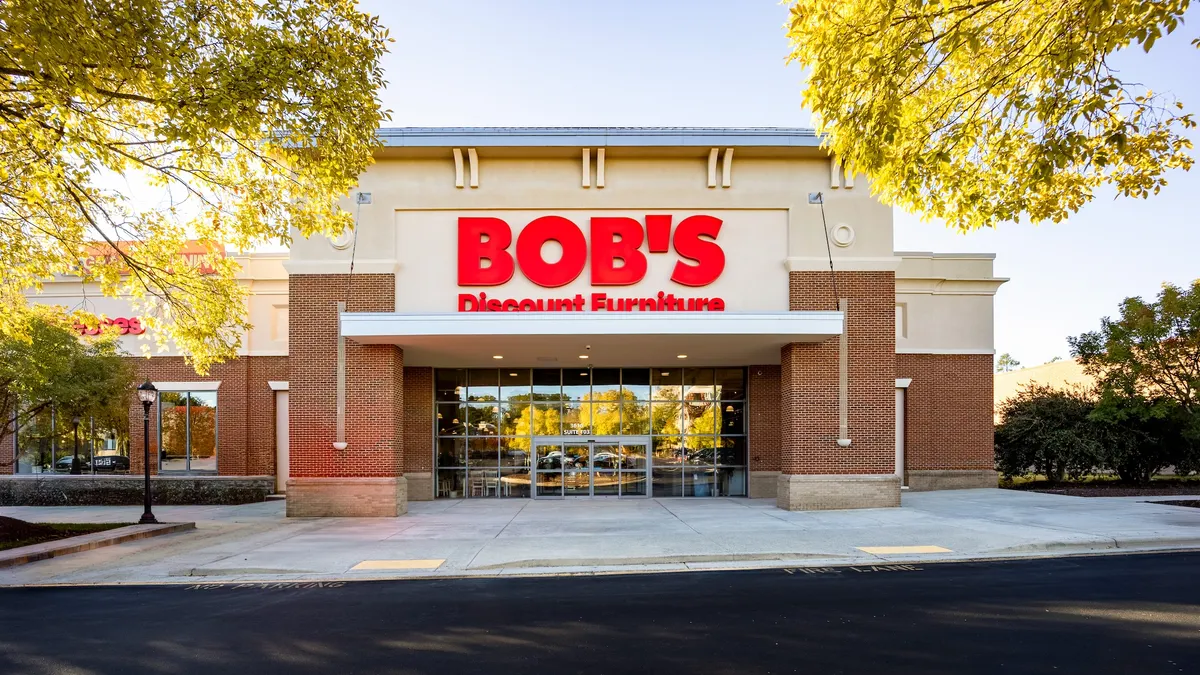
In the second quarter, Bob’s continued its brick-and-mortar expansion, which the company highlighted as a growth driver in its initial public offering earlier this year. The retailer opened four stores in Q2, including its first two stores in South Carolina, and is focused on building out its presence in the Southeastern United States.
“We're really encouraged by the early interest and the demand that we're expecting to get in continued Southeast expansion,” Lukach said.
Bob’s is on track to open 20 stores this year and debut a distribution center in Georgia early next year to support operations in the Southeast region, CEO Bill Barton said on the call. The company still sees an opportunity to operate at least 500 stores by 2035 — something the company initially outlined in its IPO — though it expects customer overlap to a degree.
“When we're opening up stores … we know if we're opening up a certain number of units in a region what the potential is. We may see cannibalization strategically as we think about the pace of those openings,” Lukach said. “Cannibalization is natural. It's part of the plan.”
But aside from a growing brick-and-mortar footprint, Bob’s is leaning into its digital capabilities to reach more customers.
The retailer’s OmniCart tool, which allows customers to shop seamlessly between its website and stores, continues to gain traction and is “driving stronger store-to-digital synergies and supporting higher cross-channel conversion,” Barton said. Bob’s e-commerce sales in the period increased nearly 25% year over year.
The company is also leveraging AI both in customer-facing capabilities, like personalized product recommendations, and on the backend to help with staff scheduling.
“As the lines between digital and physical retail continue to blur, we believe seamless integration matters most,” Barton said. “Our goal is to meet customers wherever they choose to engage with Bob’s and make the experience consistent, convenient and easy to complete.”