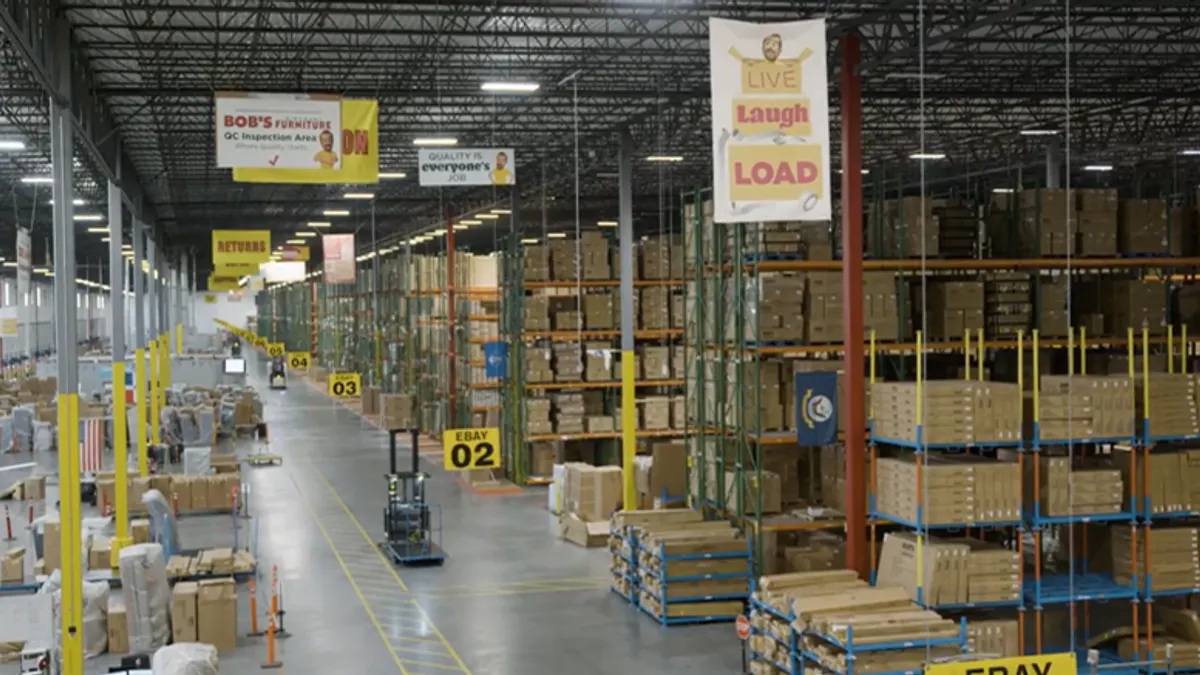

Bob’s Discount Furniture opened its first retail location combined with a distribution center outside of Cleveland, Ohio, in February, as the company seeks to speed up its order fulfillment.

“By pairing a retail store with a distribution center, we’re keeping inventory closer to our customers, allowing us to reduce line haul costs and enable easier fulfillment across ordering channels,” COO Ramesh Murthy told sister publication Supply Chain Dive in an email.
The retail portion of this dual format is inside the distribution center and "aligns well with our long-term growth strategy and our planned growth in the Midwest,” Murthy said.
The center will serve its regional distribution centers and multiple stores to enable faster delivery times and local inventory storage, Murthy said.
The retailer has eight stores in Ohio, “making the state an ideal test location for this new model,” Murthy said. The facility’s location in Solon, Ohio, is also close to major highways such as Interstate 480 and other key transportation routes, he said.
At this time, the company will monitor the Ohio facility to see if it will consider replicating the model in the future, the COO said.
Bob’s Discount Furniture also broke ground in March on a new facility in Macon, Georgia, which is expected to become operational in 2027. The 800,000-square-foot center will supply about 100 stores in the Southeast, Murthy said.
Macon will be Bob’s seventh distribution center in the U.S. The company opened several stores in the Southeast last year and expects the Macon facility to serve as a regional hub to support that expansion, Murthy said.
“Key capabilities at our distribution centers include tall ceilings and extensive racking systems to maximize storage capacity, along with more than 100 dock doors and technology to enable rapid inventory flow and real-time tracking,” Murthy said.
As Bob’s Discount Furniture builds on its fulfillment capabilities, it’s also grappling with higher costs associated with tariffs, according to a Q4 earnings call from March 17.
“Broadly speaking, the industry is dealing with a mix of logistical disruption, higher costs, and a difficult housing market,” Murthy said.