As retailers await their tariff refunds, Amer Sports CFO Andrew Page said the company has received a small amount back, but has no “visibility at all” into what could be coming down the line.
“The way that we're handling them is that as tariff refunds come in, then we realize it,” Page told Retail Dive in an interview. “We're not projecting any amount of tariffs to come in the future, we're not projecting the timing … there was no real pattern recognition that gives me an indication as to the cadence and sequencing of it.”
Amer Sports — which owns Arc’teryx, Salomon and Wilson, among others — is in a fortunate position compared to others in retail, in that the IEEPA tariffs that are currently being refunded had a minimal impact on operations to begin with. That means the refunds, too, will have no real impact on the company’s go-forward guidance.
The retailer notched a 32% revenue gain in Q1, reaching $1.9 billion, and expects the metric to be up 20% to 22% for the full fiscal year. The standout performance was driven largely by the company’s technical apparel segment, anchored by Arc’teryx, and its outdoors performance category, led by Salomon. Those business divisions grew by 33% and 42%, respectively, in the first quarter.
Even ball and racquet sports, which is headed up by Wilson, saw revenue grow 13% to $347 million. Operating margins in that segment are just 3.6%, though, compared to more than 20% in the other two business divisions.
The tough consumer backdrop doesn’t seem to be shaking Amer Sports much either, despite some of its brands commanding high price points. Page credits that to the company’s innovation, and the strong equipment and technical performance of its products. Those elements help shoppers feel they’re getting a strong return on their investment, even with the premium cost.
“The consumer is already going through the decision tree of where I'm going to spend my discretionary money,” Page said. “Once they get into the store, once they get into our website, they already made the decision — and I'm not seeing people trading down within our portfolio.”
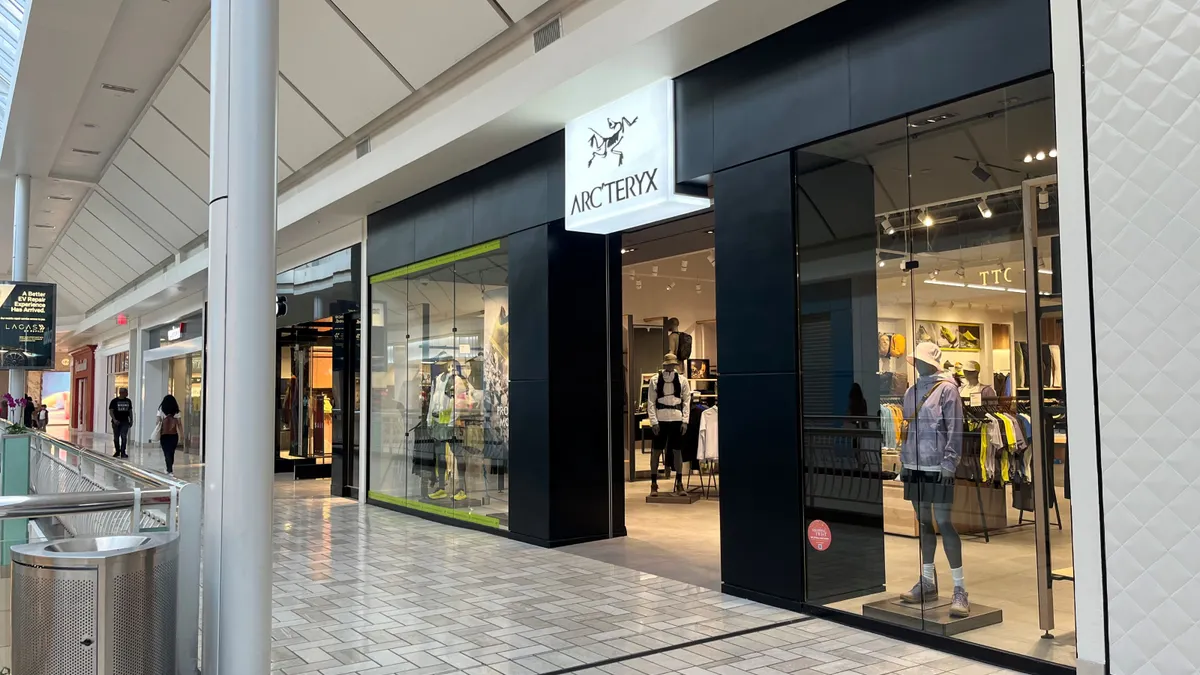
As a portfolio business, growth opportunities vary by brand. Arc’teryx, for example, is planning to open 30 to 35 net new stores this year and sees potential for the women’s business to expand meaningfully. Salomon will open 13 net new stores, as well as enter JD Sports and Foot Locker locations to fuel its footwear offering. Wilson, which is more of a wholesale business, is expanding its Tennis 360 offering from 250 to 400 Dick’s Sporting Goods stores and growing its distribution in China as well.
The nature of the business as a portfolio makes it easier for Amer Sports to invest deeply into opportunities across its three major growth brands, Page said, and pursue the channels and customers that work best for each retailer.
“We think that both channels are extremely important,” Page said of DTC and wholesale. “It depends on the brand.”
Arc’teryx, for example, does generally north of 70% of its sales through DTC channels, while Wilson does about the same percentage wholesale. The company’s decisions on channels are driven by “the nature of how consumers shop, how they experience the products” — and also by geography.
Shoppers in China prefer a more DTC environment when buying footwear, but in other geographies, a multibranded store is preferred. And although Wilson leans heavily wholesale, the retailer’s Tennis 360 initiative has involved more stand-alone locations and DTC efforts than other parts of the business.
“If we had tried to start growing most of Tennis 360 purely in its wholesale state, it would not have resonated with the consumer as a differentiated, elevated offer,” Page said. “That's why to tell that offensive brand story, we needed to run the mono-branded retail format and then we can amplify with wholesale.”