
Retail and eFulfillment run on a single and simple promise: if the system says it's in stock, it ships. Most operations fall short of keeping that promise not because of poor processes or undertrained staff, but because the data underneath those processes is wrong.
According to Auburn University's RFID Lab, the average retailer's inventory accuracy sits at around 65%. Up to 60% of inventory records contain errors. The financial cost of that gap: an estimated $400 billion in lost revenue annually, or 1 to 3% of sales for the individual retailer. Across the broader industry, inventory distortion (out-of-stocks and overstock combined) runs at roughly 6.5% of global retail sales, approximately $1.77 trillion a year.
These are not edge cases. They are the baseline for most retail warehouse operations today.
Four problems. One root cause.
The symptoms show up in different ways across a typical fulfillment operation. A distribution center shipping 20,000 orders a day at 98% location accuracy is quietly cutting or delaying around 400 orders it believed it could fill. A wrong location is not a problem discovered at quarter-end; it is an order cut in real time, with a customer at the other end who is not coming back. Research consistently shows that 71% of shoppers are less likely to buy from a retailer again after a poor fulfillment or returns experience.
The cycle count, the industry's traditional fix, is not keeping pace. Thousands of SKUs, fast-moving pick faces and constant reslotting create a moving target that periodic manual counts cannot reliably hit. Labor shortages affect around 78% of warehouses, with annual staff turnover averaging 36%, which means the team doing the counting is never the same team twice. Warehouse pickers already spend up to 60% of their time simply walking the aisles.
Returns compound it further. Roughly one in five online orders is returned, two to three times the in-store rate and returns-processing volumes have risen around 95% since 2019. Returned and reslotted stock that is not confirmed in the right location becomes next week's phantom inventory.
And peak makes everything worse. Accuracy that is good enough in March buckles in November. For unprepared facilities, seasonal demand spikes cause productivity drops of up to 30%. One bad data week at peak can erase a quarter's margin.
All four problems share the same root: teams are running on stale WMS data. The system reflects what should be there, not what is actually there.
What daily, wall-to-wall inventory truth looks like
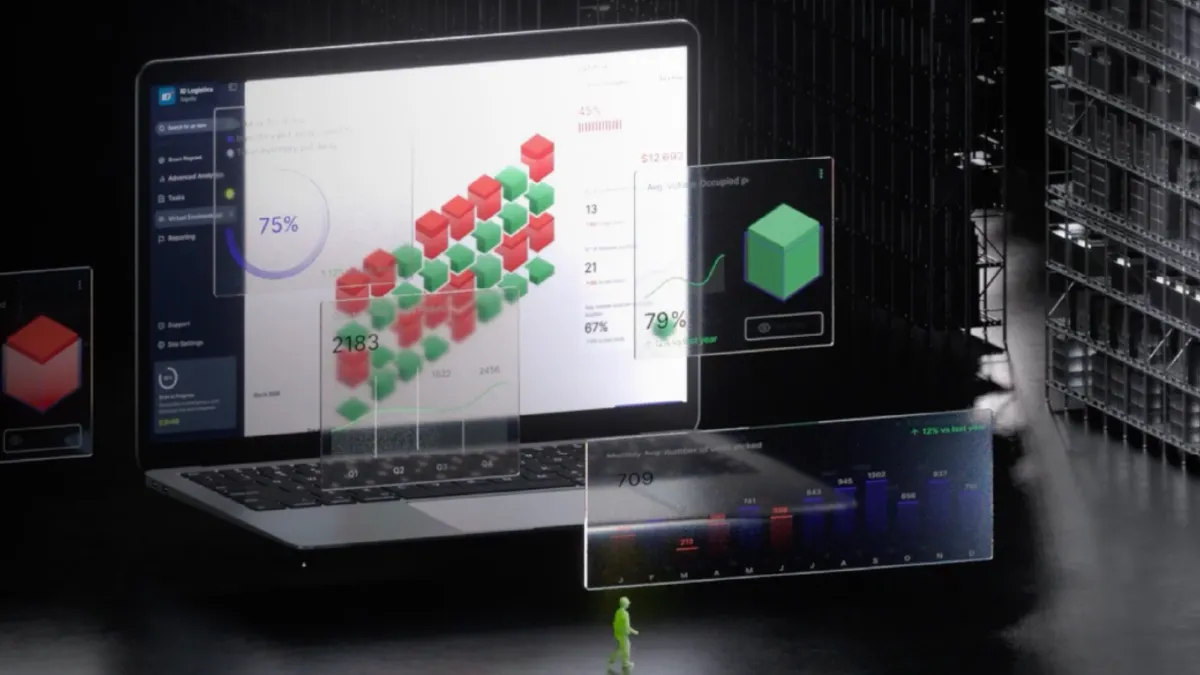
Dexory approaches this differently. Autonomous mobile robots scan over 10,000 locations per hour, operating around the clock without disrupting live operations. That data feeds DexoryView, a real-time digital twin of the warehouse that reconciles every physical location against the WMS on a daily basis.
The result: discrepancies are surfaced before pick tasks are generated, not when a picker hits an empty slot. Teams receive a prioritized action list at the start of every shift, ranked by order impact, so they fix the slots that will cost an order first. Exception-based cycle counting replaces blanket counts entirely. As one GXO team leader put it: "With the Dexory robot we find a misplaced pallet before we even know it is lost."
The operational outcomes are measurable. Metro Supply Chain achieved a 95% reduction in manual cycle count effort and 75% faster resolution of inventory discrepancies within three months. Vente-unique.com reduced stock shortages by 74% and cut inventory costs by 30%. NFI, one of North America's largest logistics providers, achieved an 80% reduction in manual effort and recouped its investment in two months. DCL Logistics, which powers fast-growing omnichannel brands, saw a 14% increase in pallet location accuracy and saved 16 labor hours per day.
An independent Forrester Total Economic Impact study put the aggregate return at 140% ROI within three years, with payback in under six months, alongside $2.25 million in total quantified benefits and a 40-hour-per-week reduction in empty location checks.
The strategic question
Gartner's Supply Chain Symposium 2026 framed it plainly: context debt is the new technical debt. Every shift run on outdated inventory data widens the gap between what systems show and what is on the floor. Static WMS reports are no longer a sufficient operating layer for retail fulfillment operations competing on speed, accuracy and customer promise.
The good news is that the technology to close this gap is deployable in weeks, often before the next peak season. The question is not whether retail warehouses need real-time inventory intelligence. The question is how long they keep guessing without it.
See how Dexory works for retail and eFulfillment operations.