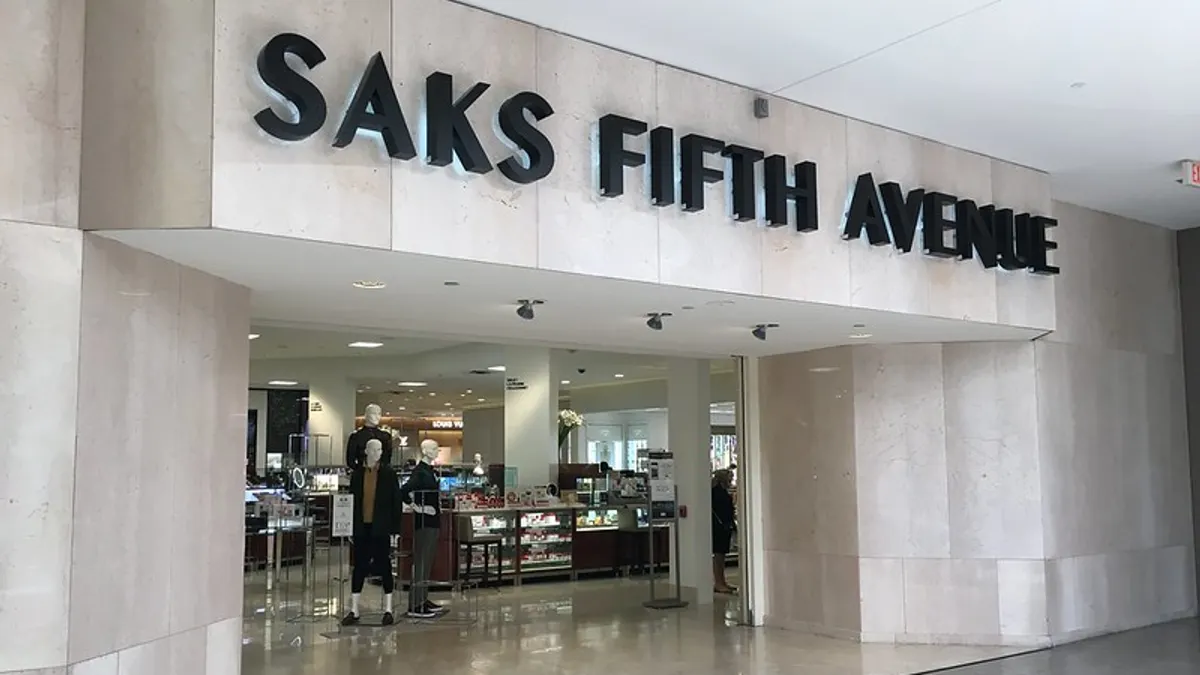
At dozens of its properties, Simon Property Group has wriggled out of a situation plaguing traditional malls across America. According to the real estate investment trust’s CEO, at nearly 60 of its shopping centers it’s now free of legal provisions — standard since the mid-20th century — that allow anchor tenants to veto renovations large and small.
These legal clauses – known as “reciprocal easement agreements” or “covenants, conditions and restrictions” – made sense back when malls were an innovative retail model designed to lean on what was then the popularity of department stores as anchor tenants. But those stipulations – which stick to the property regardless of who occupies it – are preventing malls from making badly needed updates. Sometimes even minor ones.
These agreements are notoriously difficult to alter, but Simon Property Group had an unusual lever to pull – the promise of a $100 million investment into Saks Global to help the luxury department store company acquire rival Neiman Marcus Group in late 2024.
Now that Saks Global has filed for bankruptcy, Simon Property Group has been forced to write off that investment. But, as CEO David Simon told analysts last month, not all is lost.
“We did a transaction with Saks Global as part of their funding for buying Neiman Marcus. Now as part of that, we decided we weren’t just going to make that investment unless we got compensated for it, so in case it blew up, we would be whole,” Simon Property Group CEO David Simon told analysts last month. “And very importantly — and I’m sure you’re familiar with REAs — but throughout the whole entire portfolio with Saks and Neiman and Off 5th, we got the right to build what we want, so we don’t have to go get their approval.”
That portfolio is considerable. According to Simon Property Group’s most recent annual report, which is for the year 2024, 57 malls include a Saks Fifth Avenue full-line store, Neiman Marcus, Saks Off 5th and/or Neiman Marcus Last Call. In bankruptcy filings, Saks Global said it is a tenant at 75 Simon locations.
What are REAs?
REAs and other CC&Rs are legal artifacts from the mid- to late-20th century that give mall anchor tenants considerable say over their landlords’ management of their property.
In those days, landlords wanted to lure department stores to the suburbs because department stores still ruled retail and enjoyed high-velocity footfall. The higher rents from inline tenants more than made up for the low rent and other concessions to their anchors, which were traffic-driving machines.
Those concessions included REAs and CC&Rs, in effect for perpetuity, that give anchor tenants veto power over a range of changes. That means not just major plans like overhauling an aging mall into a mixed-use retail center, but also a host of relatively minor changes like tweaks to the parking lot, tenant base or buildings.
It’s no surprise that David Simon would bring up these limitations as he contemplated a $100 million stake in Saks Global because most landlords take any opportunity to address them, according to Nick Egelanian, president of retail development firm SiteWorks.
“It would make sense that there was a lot of horse trading of approvals and waivers of REA rights and restrictions — and other related rights and restrictions — across a broad spectrum of locations and situations. This is a common practice when in department store negotiations,” he said by email. “As for value, such waivers can be very valuable, as department stores generally have the right to freeze mall site plans and prevent big and small changes alike to malls.”
These clauses are also intractable, unaltered by shifts like bankruptcy or change in ownership.
“Those negotiations have historically been really difficult and very painful. No one wants to give away rights,” Bryn Feller, managing director and senior vice president at commercial real estate firm Northmarq, said by phone. “A change to an REA may not even really impact a retailer whatsoever, and yet, the retailer wants to demand a pound of flesh. Other times it’s just not worth their attention.”
The price is right, right?
Given how difficult REAs are to change, Simon Property Group’s $100 million may have been a bargain. The REIT has swept away a major portion of these stipulations at 57 or more malls; at seven there are both a Saks Fifth Avenue and a Neiman Marcus, which frees up even more of the property.
That comes to under $2 million per mall.
An anchor tenant is usually unlikely to forfeit their REA advantage for $2 million, according to Peter Gerney, founder and principal at market research firm Gerney Research Group.
“Good luck — most won’t do it, because then they’re giving up their leverage in any kind of negotiation. So for Simon properties it’s a very good decision and money well spent,” he said by phone. “Simon just made his life easier at some of the best malls in the country.”
This coup has its limits, and some aspects are unclear. Neither Saks Global nor Simon Property Group immediately responded to emailed questions for this story.
Simon centers have anchors besides Saks Global stores, whose REAs and similar clauses remain in effect. It’s also possible that the waivers aren’t as far-reaching as David Simon implied.
“I don’t think it could ever be without any discretion. There has to be limitations and guardrails on it,” Feller said. “No lawyer for Saks would have ever given up on unchecked rights there. However, if they secure the capability of build and limit those sight lines, or limit parking ratios ... that has real material value for their properties.”
David Simon has touted other benefits stemming from the Saks Global investment that have not quite panned out, at least not yet. That includes the right to walk away from two Saks Global leases with overdue rent, but Saks Global is disputing that in court. He also said that the REIT “got the right to take that investment and convert it into a company that’s being run by Authentic Brands Group that owns the IP — not e-commerce, not stores — but owns the IP for Saks, Neiman, Bergdorf.”
However, Saks Global told Retail Dive that it “wholly owns its intellectual property, including the IP of its luxury retail brands, and licenses a subset of those rights to Authentic Luxury Group (ALG).” That Authentic Brands Group affiliate owns a 77% interest in the entity that holds a perpetual master license, according to a source familiar with the setup. These discrepancies suggest that the Simon-Saks REA situation, too, may have to be hashed out in court.
Bigger picture, though, Saks Global’s retreat from REAs at Simon centers is a bad sign for both parties because it reflects the ongoing decline of department stores – and the retail model that malls have depended on for at least half a century, Feller said.
“This is a bad look for Simon,” she said. “It’s not just about their investment even — it’s not just about the $100 million. It’s also the continuation of the story that we know — of the diminution of the department store. None of this is a good optic.”