Primark is making moves.
The fashion company last week appointed a CEO, Eoin Tonge, who had been acting as its interim for the past year.
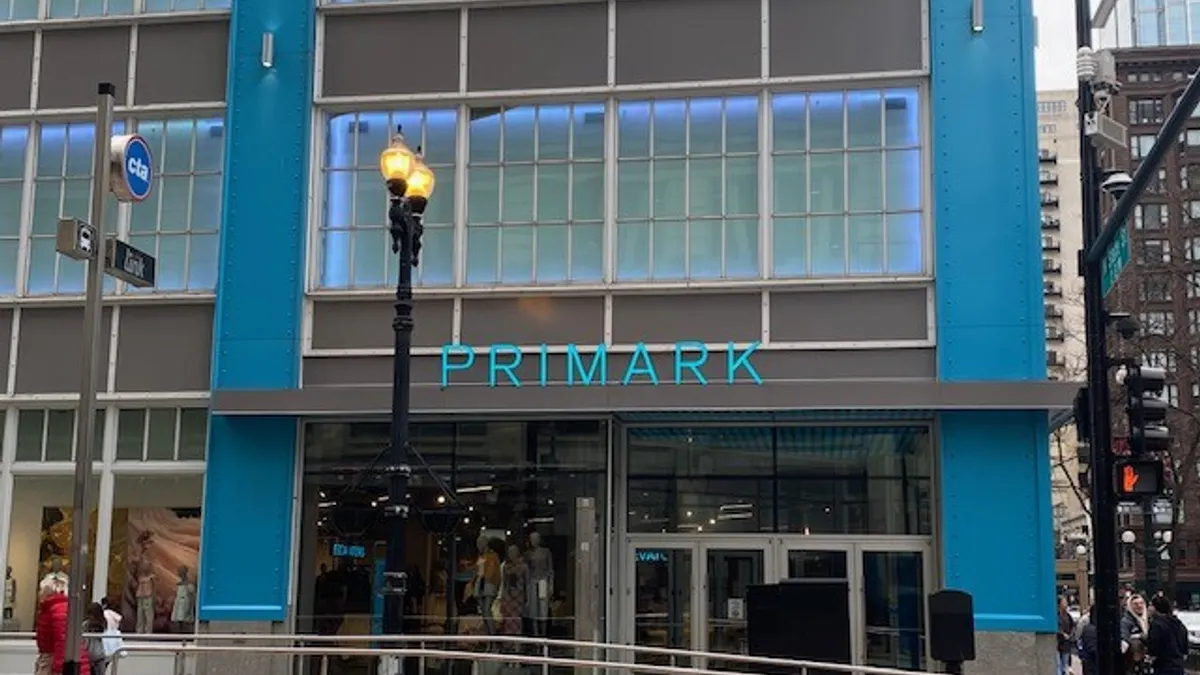
The Dublin-founded retailer also recently celebrated its 10-year anniversary in the U.S., has been expanding its nationwide presence with new locations in Texas, Illinois, Tennessee and Florida, and is eyeing a flagship store opening in New York City’s Herald Square this spring.
Rene Federico, Primark’s U.S. head of marketing, is just ready for more people in this country to know about the company.
“We talk about ourselves as the best kept secret in amazing retail,” she said in an interview with Retail Dive this fall. “We don’t want to be such a kept secret anymore.”
As consumers search for value even beyond low prices, Primark may be expanding its physical presence at the right moment.
“I think in the U.S., consumers had to compromise a lot, and we’re just unwilling to compromise,” Federico said of the retailer. “We want to give a great store experience, give people great products, great value — let them feel stylish and trendy … and do it in an accessible, affordable way.”
Primark’s (very) recent history
Almost exactly a year ago, Primark was in a tough spot.
Then-CEO Paul Marchant resigned from the company after an independent investigation was conducted regarding an allegation toward the executive.
“Paul Marchant acknowledged his error of judgment and accepts that his actions fell below the standards expected by the company,” the company said in a statement. “He has now made an apology to the individual concerned and to his Primark colleagues.”
At the time of his exit, parent company Associated British Foods announced Tonge as the interim chief. During his time as interim CEO, Tonge improved Primark’s product offer, sharpened its value perception and enhanced digital and marketing capabilities, according to the company. Now Tonge, who was once the chief financial officer and chief strategy officer at Marks and Spencer Group, will be at the helm, leading the retailer into a new era.
He will be joined by Filip Ekvall, who comes to Primark with nearly 20 years of experience from H&M Group, as chief commercial officer, a newly created role. In the position, Ekvall will bring together Primark’s product, retail, digital and customer functions across channels and markets.
While at H&M, Ekvall held leadership positions in Europe, South Korea and the U.K., eventually acting as the global director of sales overseeing around 4,000 stores. That experience may come in handy as Primark looks to expand its international presence.
The retailer has had to grow into a business of global scale, with differing needs across markets, George Weston, chief executive of Associated British Foods, said in a statement. Tonge was named to the top spot after a comprehensive search process, and “the changes he is implementing are at an early stage, but are already having a tangible benefit in a challenging environment.”
Holding steady: The (current) state of apparel
Even in spite of tariffs and inflation, the apparel market has been holding steady. The category rose 4% in January — the latest point of data for the category from the U.S. Commerce Department. Large specialty apparel retailers, who have been clear in earnings calls that tariffs have impacted margins, have been chugging along; Gap Inc. reported net sales increased 2% year over year in its latest quarter, Abercrombie & Fitch Co. was up 5% in Q4 and American Eagle Outfitters was up 10%, a record for the retailer.
Primark itself reported “modest sales growth” in its latest quarter, with overall sales increases driven by its international store expansion, according to a January note by Louise Deglise-Favre, lead apparel analyst at GlobalData.
Constant currency sales rose 12% in the U.S., per GlobalData, even though trading conditions remain volatile due to high tariffs and political tensions.
“Consumers resonated with Primark’s initiatives to strengthen its value proposition through improved product, stronger communication regarding prices and growing digital engagement,” Deglise-Favre said.
Primark is aware that the deciding factor for purchasing decisions for many consumers isn’t solely about price. Discerning shoppers want something fashionable, at the correct price, with great quality, per Primark’s Federico.
“Savvy shopping has become the new cool,” Federico said. “I think that consumers have found it’s kind of a flex.”
A (quickly) evolving Primark
Though it won’t be the first store in the state, the imminent opening of a Herald Square flagship store in New York City is set to kick off a new chapter with the Primark brand in the U.S. The 54,000-square-foot space will feature apparel, homewares and beauty across four floors.
“Opening a location in the epicenter of U.S. fashion is going to be an exciting milestone for Primark U.S.,” Primark U.S. President Kevin Tulip said in a statement at the time of the flagship’s announcement. “When the opportunity arose to bring Primark to Herald Square in Manhattan, a store with exceptionally high foot traffic, national influence, and perfectly located to attract customers who already know us from other Primark stores in the boroughs and surrounding areas, we knew it was the perfect fit.”
The location is “hugely important for us as a brand,” Federico said. “It’s a signal to the marketplace, to the industry, and to consumers and audiences that we matter in the conversation around style and in retail in general — that we’re a player in those forums.”
“It’s not to discount anything we’ve done up until now … but when you put those three things together — New York City, a Manhattan location on 34th Street, and Herald Square, in a space of that size that has the ability to fully encompass our brand experience — it’s going to be something that is a tool for us in more than just serving customers. It will be a marketing tool, it will really serve to energize the brand.”
But, Primark’s ambition isn’t limited to a Manhattan location. The company has released a flurry of announcements over the past few months.
At the start of the year, it launched its largest-ever activewear range across women’s, men’s and kidswear, which included an expansion into lifestyle, accessories and beauty for the first time.
The fashion company has also been stepping up its commitment to sustainability; nearly three-quarters of its clothes are currently made from recycled or more sustainably sourced fibers, up from 66% last year. The retailer is also decreasing its greenhouse gas emissions; embedding traceability into its supply chain; and integrating circular design elements into the design and manufacturing of its products.
At the top of the year, the retailer also debuted a youth-focused label, The Primark Scene, designed for young people who are underserved by both kids and adult apparel.
Another potential and substantial change that has been floated by analysts is the possibility of separating out Primark from its parent company.
“Let’s face it: Primark has little in common with ABF’s food empire of grocery and bakery brands,” James Watson, U.K. Partner at Argon & Co., wrote in a note at the start of the year.
“Primark’s revenue base is heavily concentrated in the UK, where growth has been largely flat. What’s more, fast fashion is facing a reckoning – grappling with online challengers like Shein and Temu undercutting on prices, while established players struggle with margin erosion and supply chain complexity,” Watson said. “Primark will need to scale international operations and build resilient supply chains via rapid and strategic investment.”
Associated British Foods is currently undergoing a review of a possible split.
“Given the scale that Primark has now attained and the need for better understanding of our Food businesses, the Board has been undertaking an in-depth review of the future shape of ABF to assess whether a separation of the Primark and Food businesses would be a better structure in the years ahead,” Michael McLintock, chairman of Associated British Foods, said in a statement in November. “I am leading the review and will update the market further when we are able to provide more detail."
The retailer is in international expansion mode, beyond what it is doing in the U.S. In January, Primark announced plans to open five locations in the Middle East — three in the United Arab Emirates' Dubai in March, April and May, followed by stores in Bahrain and Qatar, after opening a store in Kuwait last fall.
Primark is still planning to open its first store in Dubai this month, a company spokesperson said in response to questions regarding openings in the Middle East in light of current events. “This is a fast-moving situation which we are monitoring closely with Alshaya Group, our partner in the region,” the spokesperson said.
Additional stores will expand the retailer’s presence in Romania, with four new store openings planned this year.
“We’ve taken a very steady and detailed approach to our market expansion,” Federico said. “There’s a general excitement — authentic, genuine excitement — anytime we enter a market.”