

WASHINGTON — Value perception is more about vibes and less about the price for luxury retail CEOs.
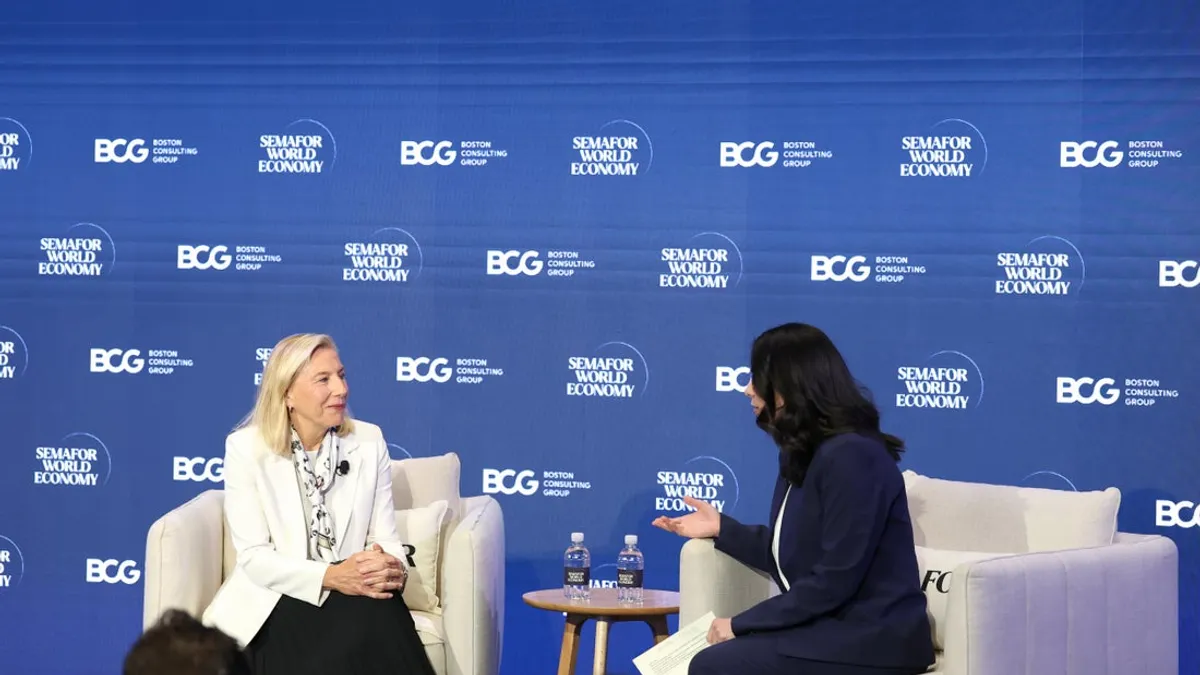
“We sell a dream,” Ralph Lauren President and CEO Patrice Louvet told an audience at the Semafor World Economy summit in Washington, D.C., on Wednesday. “Often, people just simplify this whole value equation to what's the price for the item, and in this industry, it’s so much more than that.”
The luxury fashion company thinks about value as the quality of its storytelling, product and shopping experience divided by price, the executive added. Ralph Lauren’s customer base has proven to remain resilient despite the broader macroeconomic pressures shoppers are facing, with average income for the brand’s consumer above $100,000.
Selling that dream involves creating positive experiences for customers that sometimes go beyond core apparel offerings. Louvet called out the success of Ralph Lauren’s coffee brand, Ralph’s, as an example. The coffee company first launched at a New York City Ralph Lauren flagship store in 2014 and has since expanded to several global cafes and coffee trucks.
As e-commerce continues to grow and AI has the potential to bring more purchases online, humans are going to be looking for even richer in-person experiences, Louvet added. Unique experiences such as Ralph’s — or even ensuring customers don’t wait in long lines outside Ralph Lauren locations — play a role in the brand’s storytelling strategy, the executive said.
“When you come into our stores, the concept is not ‘welcome to our stores’,” Louvet told the audience. “The concept is ‘welcome to our home.’”
Experiences are also a core part of Tapestry’s strategy to provide value to customers while maintaining pricing.
“Our focus is on this young consumer and people ask me all the time, ‘Isn't this young consumer under pressure?’ And, ‘How is it that your business is so healthy, given ... the backdrop?’” Tapestry CEO Joanne Crevoiserat told an audience at the conference on Tuesday. “And the answer to that question is: We stay close to our consumers. We really want to understand what they're going through, how they're feeling, so that we can deliver not only great product, but experiences in marketing."
For its Coach brand, that experience can show up through efforts like the in-store craftsmanship bars at select locations, which allow shoppers to customize certain bags. The effort allows younger customers to connect with friends and develop a product that is uniquely theirs, Crevoiserat noted.
Building an emotional connection for shoppers with Tapestry’s brands is important whether the consumer is feeling great or not at a macro level, the executive said. That statement comes as consumer sentiment has hit record lows.
On top of that pressure has been a year of heightened and ever-evolving tariff rates in the U.S. Despite cost pressures on Tapestry stemming from IEEPA-related tariffs, the company did not raise prices to offset it.
“The way we think about price in our business is … based on what the consumer sees,” Crevoiserat said. “We are focused on delivering value into the marketplace that the consumer recognizes. So we did not … take price up in response. We doubled down on our capabilities to understand the consumer and deliver innovation.”