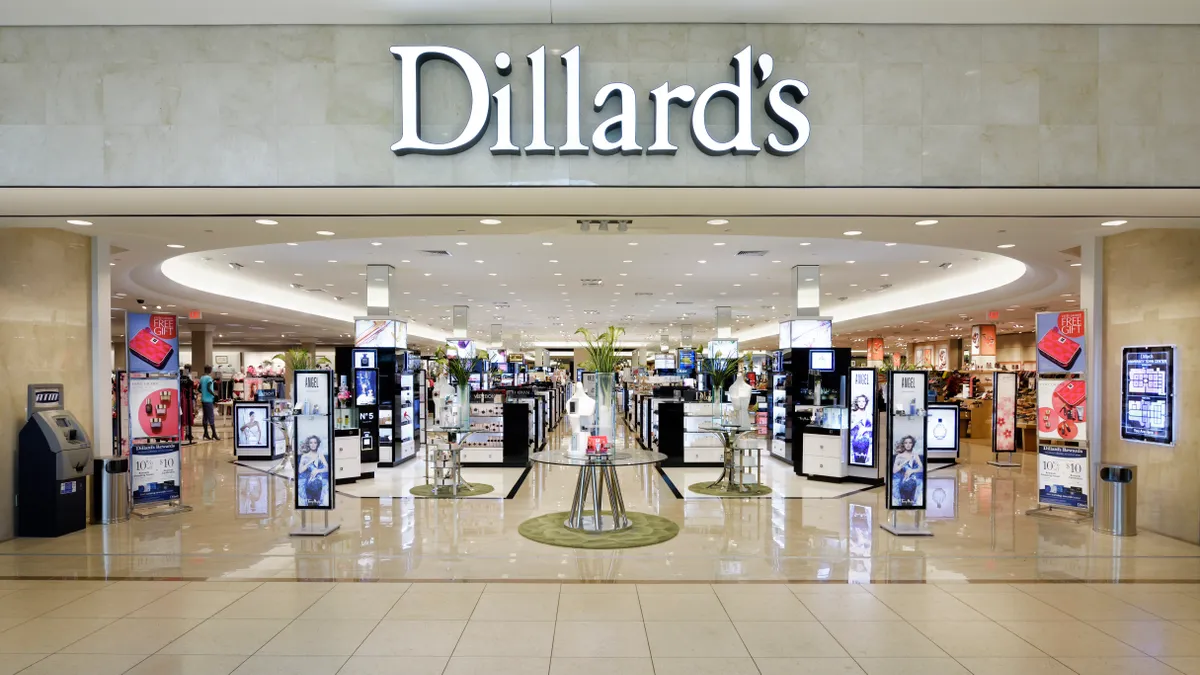
Dillard’s did its best to prove the viability of the department store model in the first quarter – sales rose, margins expanded and, perhaps most surprising, a new store opened.
There was growth in all merchandise categories in the period compared to a year ago, helping lift Dillard’s total Q1 retail sales (excluding its construction business) 3% year over year to $1.5 billion. Store comps also rose 3%.
“We are pleased to report a good start to 2026 with a profitable 3% sales growth supported by an increased 45.8% retail gross margin,” CEO William Dillard said in a statement Thursday. “We continue to focus on motivating our customer with newness in our merchandise assortment.”
That was a 30-basis-point increase in retail gross margin compared to last year, thanks to moderate strength in shoes and a slight increase in ladies’ accessories and lingerie. Gross margin was flat in cosmetics, juniors’ and children’s apparel, and men’s apparel and accessories; dropped slightly in women’s apparel; and fell moderately in home and furniture, the company said.
Profits surged by over 50%, with net income reaching $250.6 million, though that was largely due to a settlement over card swipe fees. Excluding that, net income rose about 4% year on year, per GlobalData research.
There were other signs of good health in Q1 as well. Search trends in the period were up, rising 9%, and promotions appear to be down, according to research from the UBS Evidence Lab.
Above all, the department store opened a store during the quarter, anchoring The Mall at Fairfield Commons in Beavercreek, Ohio, in space vacated by Macy’s. The new location, its first in the Dayton area, brings its fleet to 272 stores in 30 states, including 28 clearance centers.
This is in sharp contrast to its department store peers: Macy’s, Nordstrom, Saks Fifth Avenue and J.C. Penney have all closed full-line stores in recent years and opened few, if any.
Dillard’s expansion may not be overwhelming, but it’s nevertheless a good sign, given the chronically downbeat outlook for department stores and financial pressures on the consumer, according to GlobalData Managing Director Neil Saunders. It helps that Dillard’s customers are from households with higher incomes, according to GlobalData.
While “confidence is still down a little among Dillard’s shoppers, it is holding up significantly better than the overall average,” Saunders said in emailed comments. “This is very helpful in giving Dillard’s a more stable base against which to operate.”
By executing well, Dillard’s is making it as easy as possible for them to consider buying, according to Saunders.
“Even Dillard’s shoppers are a little more reluctant to spend and are more discerning when they do,” he said. “And Dillard’s continues to assuage these concerns with strong assortments, good standards of presentation, and excellent customer service.”