Dive Brief:
- Victoria’s Secret & Co. Q3 net sales rose over 9% year on year to $1.5 billion. Comps, including e-commerce, rose 8%, while in-store comps rose 5%.
- Full-price selling increased, which continued somewhat into Q4 despite holiday promotions, executives said Friday. Adjusted gross margin expanded by 170 basis points to 36.5%. Net loss shrank more than 22% to $15.6 million.
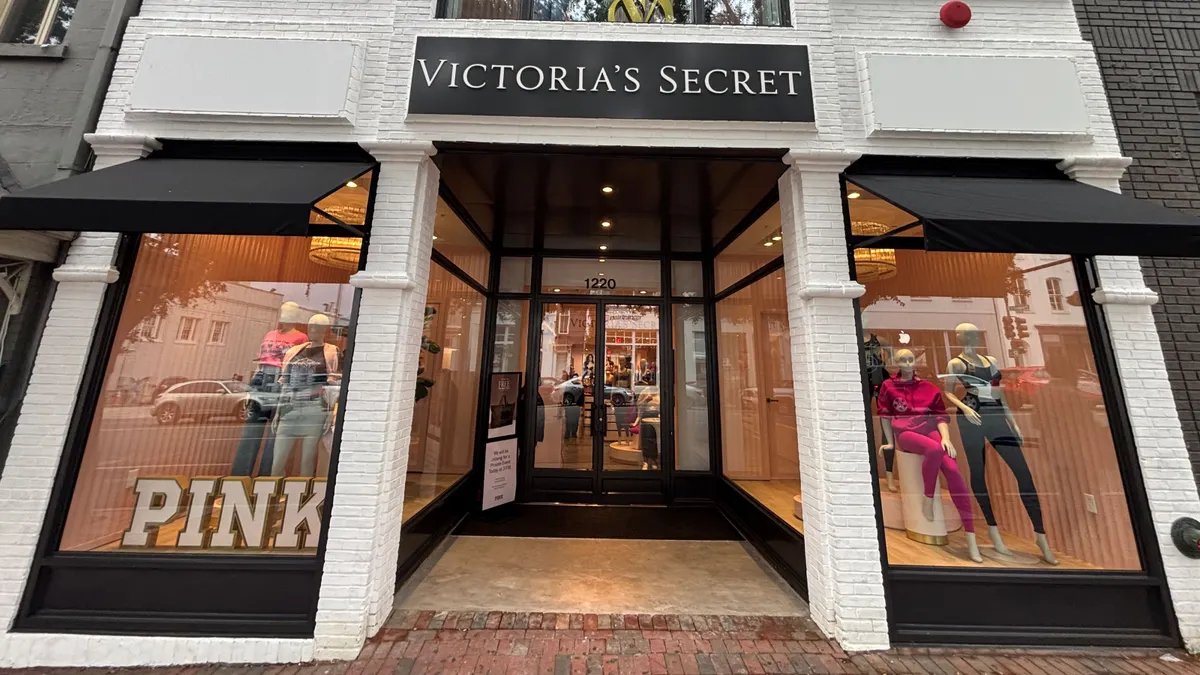
- So far this year, the lingerie giant has closed a net 15 company-run stores in the U.S. and Canada, a 2% reduction, and now runs fewer than 800.
Dive Insight:
With improvements across categories, geographies and both of its labels, Victoria’s Secret markedly raised its outlook for the year. In fact the company said it grabbed back some market share — up low-single digits in bras — instead of ceding it to rivals.
“Victoria’s Secret posted a standout Q3,” Jefferies analysts led by Corey Tarlowe said in a Friday client note.
The company now expects net sales to reach $6.45 billion to $6.48 billion, up from its previous expectation for between $6.33 billion and $6.41 billion, and adjusted operating income to range between $350 million and $375 million, up from $270 million to $320 million.
The hit from tariffs is also now expected to be about $90 million, down from $100 million, the company said.
The Victoria’s Secret brand is working to burnish its leadership in bras, which CEO Hillary Super called “the heart of our business.”
“We want to reinforce our position as her number one destination for all bras, because when we win in bras, it creates a halo effect across our entire brand,” she told analysts on Friday. “Our bra customer is among our most valuable and loyal. She spends more, visits us more frequently and shops additional categories, reinforcing her connection with us.”
At Pink, which is in the midst of a turnaround centered on newness, Q3 sales grew double digits quarter over quarter.
“We are focused on returning Pink to its roots as a lifestyle brand designed for 18- to 24-year-olds, a segment we pioneered and once dominated,” Super said. “That means reestablishing Pink's identity as digitally first and socially driven, while staying true to its DNA — bold, playful and irreverent. This is at the heart of everything we do, from product design to storytelling.”
The company is also focused on growing its beauty business, already a driver of sales and growth even though just 40% of its customers buy into the category, Super said.
The brand has rehabilitated its fashion show, which has in turn reignited its cultural relevance and fostered sales, according to Super. After being a hit for years, the annual spectacle devolved into a symbol of a tone-deaf attitude and failure to advance with the times.
“This year's fashion show was a defining moment, allowing us to show the world how we've evolved into our new era of sexy. In this era, beauty is no longer a singular standard. It's on her own terms — a conscious, liberating choice,” she said. “Some of this shift is subtle. It's in the tone, the gaze, the feeling, and some of it is unmistakable — more diverse bodies and ages, a fuller spectrum that's joyful at its core. And an expanded product assortment that empowers her to feel exactly how she wants.”
GlobalData Managing Director Neil Saunders singled this out as a significant accomplishment and “major step forward,” one that previous leadership teams at Victoria’s Secret & Co. never managed to take.
“Aside from product and selling, one of the most impressive moves by Hillary Super and her team has been to settle the debate over what Victoria’s Secret is and how it positions itself,” he said in emailed comments. “For many years there has been a conflict between whether the brand should be sexy or not and how it projects this into the world. The resolution is that Victoria’s Secret is a sexy brand, but that this is about allowing women to feel this in an empowering way that works for them — not about objectifying them or confining them to one stereotype.”