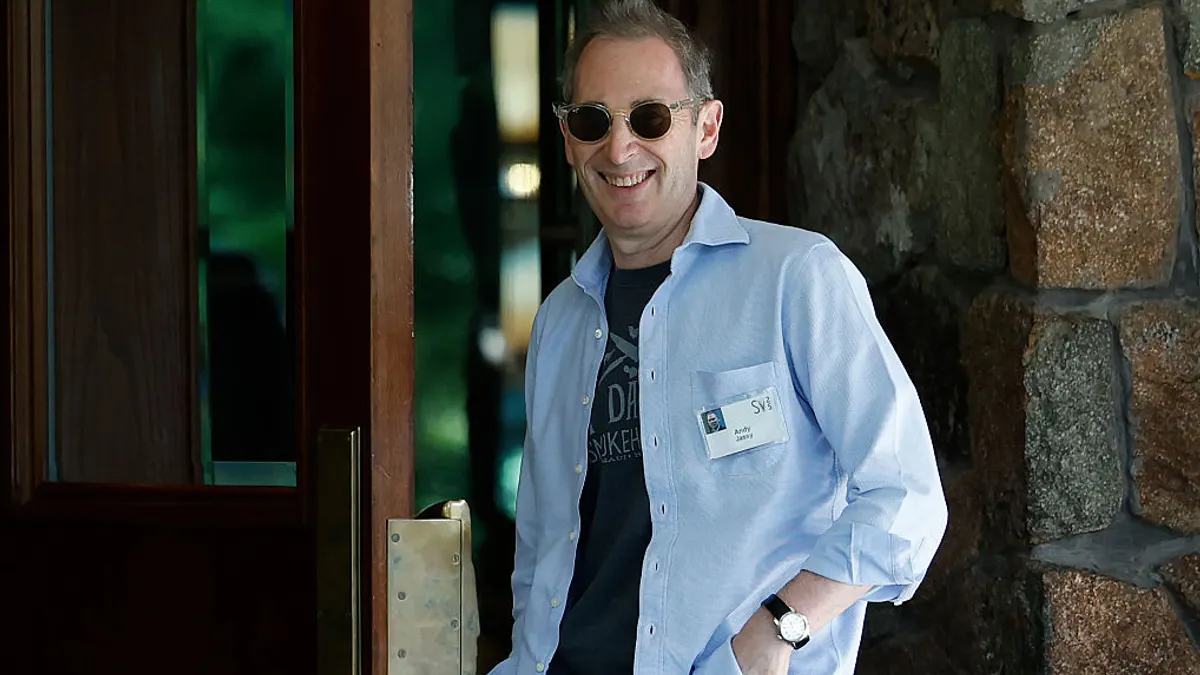
In his annual letter to shareholders, made public Thursday, Amazon CEO Andy Jassy touted the virtues of following “squiggly lines” rather than straight ones.
This applies to the letter itself.
Jassy opened the missive with the hopes and dreams he had in college, contrasting them with details about the odd jobs he took before graduate school and then “ending up at Amazon three days after my last final exam in May 1997.”
An anecdote about attending hockey games with his dad — a treasured tradition — illustrates what he holds up as an important principle at the e-commerce giant: “Be willing to pursue parallel paths when it’s unclear what’ll best drive the desired trajectory (2 > 0).”
The biggest takeaway, though, has little to do with post-graduate wanderings or the New York Rangers. Jassy defended Amazon’s investment in artificial intelligence and joins Nvidia founder-CEO Jensen Huang in pushing back against fears of an AI bubble. The rationale is reflected in a litany of returns poised to accrue to the company, mostly at Amazon’s AWS cloud unit, and its shareholders.
“We’re not investing approximately $200 billion in capex in 2026 on a hunch,” Jassy wrote.
Closer to retail, Jassy reiterated the company’s investments in rural America, saying “we understand that rural customers are often de-prioritized by logistics and telecom providers because remote communities are more expensive to serve.”
“While other companies have been backing away from these customers, we’ve been running to them,” he said. “We’ve committed over $4 billion to expand our rural delivery network.”
Amazon is also investing in drones and speedier fulfillment to achieve faster delivery of more items to more geographies. And a convoluted project to rewire virtual shopping assistant Alexa into Alexa+ was worth it, according to Jassy.
“The new Alexa+ is so much more capable, useful, and smart than her prior self,” he said, adding that, as a result, customers are spending more time with Alexa, making triple the purchases on devices.
As he did last fall, Jassy acknowledged the dominance of brick-and-mortar retail despite three decades of digital disruption but framed it as a massive opportunity for Amazon.
“Our retail business is now approaching $600 billion in topline, yet roughly 80% of global retail sales still happens in physical stores,” he said. “That will change.”