
Peak season has always been a defining moment for retailers. But today, peak season fulfillment is less about surviving volume spikes and more about delivering a consistent customer experience under pressure.
Consumers expect affordable shipping, reliable delivery and real-time visibility — even during the busiest weeks of the year. At the same time, retailers are managing tighter labor markets, rising parcel costs and more complex, omnichannel order profiles.
The result is a shift in what defines success. Peak season is no longer just a capacity challenge. It’s an operational discipline challenge.
Retailers that outperform don’t simply push harder in Q4. They build fulfillment operations that can adapt to changing demand, control costs and deliver on customer expectations — well before peak begins.
Why Is Peak Season Fulfillment More Challenging Today?
Peak season is no longer just a volume problem. It’s a complexity problem.
Retailers must simultaneously manage:
- Omnichannel fulfillment across ecommerce, retail and marketplaces
- Higher expectations for delivery predictability and transparency
- Parcel cost volatility driven by surcharges and dimensional pricing
- Labor constraints that limit how quickly operations can scale
At the same time, demand is also less predictable. Promotions can outperform expectations overnight. External factors — from economic shifts to viral trends — can quickly change buying behavior.
When forecasts miss — and they often do — rigid operations struggle. Labor can’t be redeployed quickly. Systems become bottlenecks. Service levels decline.
The result: peak season is now less about scaling up — and more about staying flexible.
When Should Peak Season Planning Start?
Peak planning should start immediately after the previous peak ends. The most effective operations treat peak as a year-round discipline. The biggest gains don’t come from last-minute adjustments — they come from structural improvements made earlier in the year.
That includes:
- Reworking workflows to improve throughput
- Standardizing systems to enable labor flexibility
- Strengthening integrations across order, warehouse and transportation systems
- Aligning marketing and operations plans
These are not changes you can make in October. By then, you’re executing — not redesigning.
What Does a Peak-Ready Fulfillment Operation Look Like?
High-performing operations are designed for adaptability. That flexibility typically shows up in four areas:
1. Labor Flexibility
Adding seasonal labor helps, but it’s not enough on its own.
More resilient operations prioritize cross-training and standardization — enabling experienced staff to shift across functions as demand changes. When teams operate within consistent systems and workflows, labor can be redeployed quickly — whether demand shifts across channels or spikes beyond forecast.
2. Scalable Automation
Automation is increasingly being used to improve peak performance—not by replacing labor, but by making it more productive.
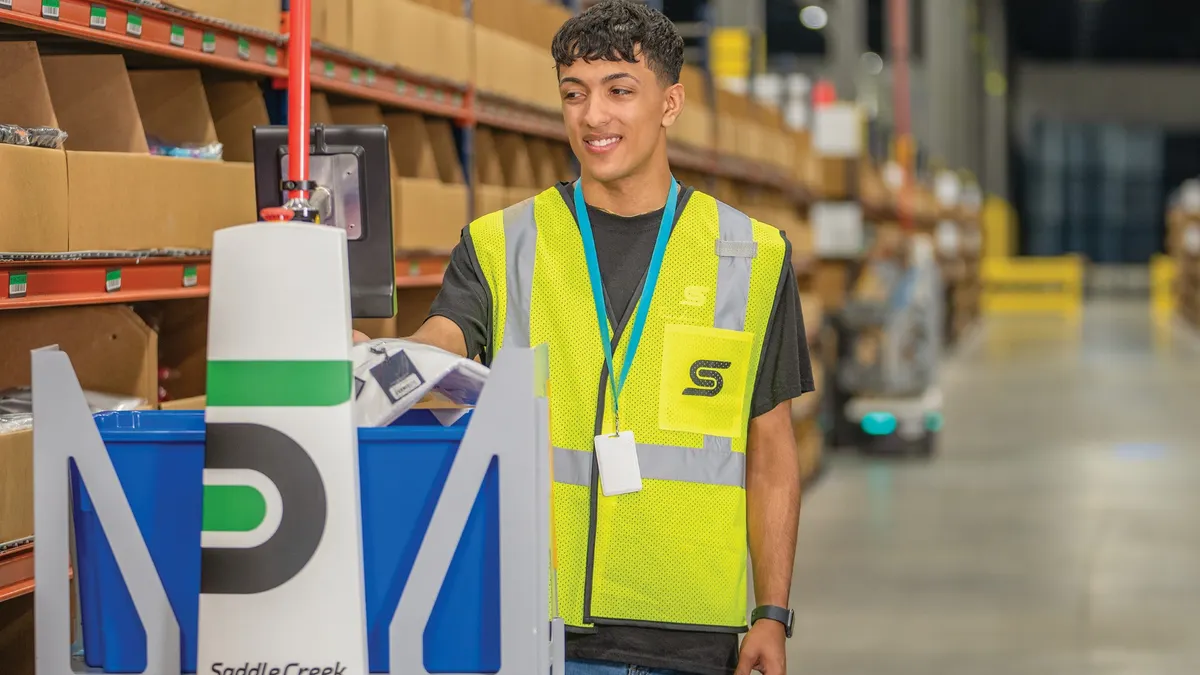
Technologies like autonomous mobile robots and automated sortation systems reduce travel time and streamline picking.
The impact is straightforward: higher throughput per associate, which becomes critical when volume increases sharply and labor is constrained.
3. Optimized Layout and Slotting
Warehouse design decisions have an outsized impact during peak.
Positioning high-velocity SKUs closer to pack-out, creating dedicated pick zones for promotions and adjusting slotting dynamically can significantly reduce travel time and increase output.
These changes are often simple — but they must be implemented before peak begins to be effective.
4. Proactive Parcel Strategy
Shipping is where many peak season margins are won or lost.
Retailers that perform well take a dynamic approach by:
- Diversifying carrier networks
- Using rate- and transit-shopping tools
- Optimizing packaging to reduce dimensional weight
- Monitoring cost and performance at a granular level
This allows them to balance cost and service as conditions change—rather than reacting after costs rise or service declines.
How Should Retailers Think About Forecasting?
Forecasting is essential—but it’s not enough. Most retailers enter peak with projections that don’t fully match reality. The more important question is whether the operation can absorb that gap.
The most effective operations:
- Validate forecasts using historical and year-over-year data
- Monitor trends in the months leading up to peak
- Revise projections continuously
- Build buffer capacity based on past historical variance
In practice, the ability to adjust quickly matters more than the accuracy of the initial forecast.
Why Communication Is a Critical Lever
Communication is often overlooked as a driver of peak performance.
Internally, alignment between merchandising, marketing and operations is essential. Promotions and product launches must be coordinated with fulfillment readiness.
Externally, communication with carriers and systems partners should be continuous — not episodic.
And for customers, proactive communication is critical. Clear expectations around delivery timelines and potential delays can reduce cancellations, lower service inquiries and protect brand trust.
During peak, communication isn’t just a customer experience tool. It’s an operational advantage.
What Separates Peak Leaders from Everyone Else?
Peak-ready organizations aren’t defined by capacity alone.
They are:
- Flexible enough to adjust as demand changes
- Standardized so labor and processes can scale efficiently
- Data-driven with visibility into performance and trends
- Aligned across internal teams and external partners
- Prepared for uncertainty, not just forecasted demand
These capabilities are built over time — not turned on when orders spike.
The Bottom Line
Peak season will always be high pressure. That won’t change. What is changing is what it takes to succeed.
Retailers that outperform aren’t the ones that simply add labor or space. They’re the ones that invest early in flexibility, standardization and planning.
Because by the time peak arrives, the outcome is largely already determined. The question isn’t whether demand will show up. It’s whether your operation is built to deliver when it does.