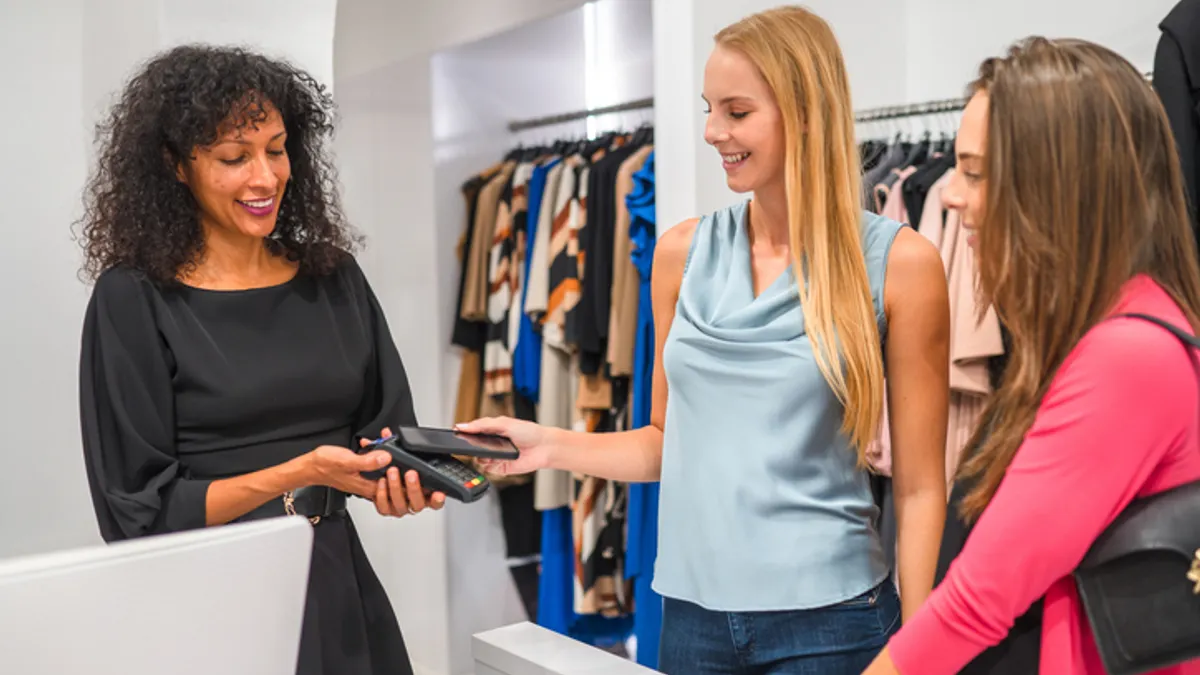

The physical wallet isn’t dead, but it’s now optional. A growing share of shoppers now pay entirely with their phone, whether they’re buying online, picking up in store or browsing a pop-up on a Saturday morning. One in five digital wallet users regularly leave home without a physical wallet.
That shift creates a missed opportunity for retailers who haven’t kept pace: a customer standing at your register, ready to pay, but unable to complete the purchase because your setup doesn’t support how they want to pay.
It’s more than your Gen Z customers
Although digital wallets were initially viewed as a Gen Z behavior, usage has broadened across age groups. Among millennials, 66.7% rely on digital wallets, along with nearly 44% of Gen X users, ElectroIQ reports. The behavior has spread well beyond any single demographic, and the reason is consistent: It’s faster, easier and the phone is always within reach.
Lola Moitoso and Tai Vieira have watched this play out firsthand. As co-founders of Shoppe Thirty One Boutique, an ecommerce-first clothing brand that also sells at farmers markets, pop-ups, and private events, they interact with shoppers online and in person each week. “At first it was probably just the younger people using digital payments,” says Tai, “but now everybody, every age, knows what to do. I don’t think we’ve had to explain how to pay with a digital wallet in a long time.”
Lola agrees. “We’ve seen a huge decrease in cash payments. It’s mainly tap-to-pay now — just that quick convenience of holding up your phone.” McKinsey & Company research explains why: 74% of U.S. shoppers say faster checkout and security are the primary drivers for using digital wallets. Convenience is the whole point.
What happens if your setup isn’t ready
Every missed tap is a missed sale. A customer who can’t pay isn’t like a customer who changes their mind — it’s a loss that didn’t have to happen.
Lola and Tai know this from experience. Before landing on their current setup, they regularly ran into friction. “People would want to tap-to-pay and the system either wasn’t equipped to handle it, or they’d ask, ‘Do you take this?’ and it wasn’t set up to accept all forms of payment,” Lola recalls. At markets and pop-ups, workarounds like manual card entry or cash transactions slowed everything down. “It got really difficult,” she says.
Since switching to a more flexible setup that enables more payment options, the friction is gone. “We haven’t had a payment issue since,” says Tai.
Consistency across every channel matters
Payment expectations don’t reset when a customer switches channels. The shopper who tapped her phone in-store expects the same seamless experience on your website. And increasingly, she’s not alone.
Researchers at Datos Insights sum up the stakes on both sides: “For consumers, wallets offer enhanced security, convenience, and additional features like loyalty program integration. For merchants, wallet acceptance is increasingly essential, with many consumers expecting these payment options both online and in physical stores.”
Security is part of that equation, too. When a customer pays with a digital wallet, their card number is never shared with the merchant. A 2025 Consumer Reports analysis compares comprehensive safeguards deployed by popular digital wallets, including biometric authentication and passcode requirements, revealing that digital wallet acceptance is now a security signal as much as a convenience one.
What easy could look like for you and your shoppers
Payment flexibility has to work in both directions. It should be easy for customers to pay the way they want and equally easy for retailers to accept it without adding operational headaches.
For Lola and Tai, the ease of consistency is foundational to their business model. “In person, it’s always a tap.” says Tai, “But convenience is key regardless of where they’re shopping – whether they’re on the website using a link that takes them directly to pay, or in person at a pop-up.”
Providing that consistency for their customers meant obtaining a portable terminal they could bring to any market or event, the ability to connect quickly to a hotspot, and inventory that syncs between their online store and their in-person setup. “I’ve been in this industry for 11 years and had never had a mobile terminal,” says Tai. “Being able to have a portable terminal come with us and just pop onto a hotspot — that was a major upgrade.” The inventory sync matters just as much. “We go to markets every week and the clothing rack changes every time,” she explains. “Being able to quickly switch out what we’re bringing and have it sync to the terminal is big.”
There’s a trust dimension to it, too. “Customers feel good about their preferred form of payment,” says Tai. “When you have a terminal and they can tap to pay and get a printed receipt, it creates a better look for your business.”
Catching up is getting ahead
For many retailers, getting payment-ready feels like catching up, but when it’s done right, it puts you ahead.
Payment flexibility doesn’t require a big operation or a dedicated IT person. It starts with an honest look at how your customers already shop and making sure your payment options match how your customers want to pay.
A few practical questions worth asking:
- Does your system accept digital wallets, tap-to-pay and cards consistently everywhere you sell?
- Can you take your devices with you?
- Does your inventory across locations stay in sync?
Getting those fundamentals right removes a recurring source of friction and frees you to focus on the customer experience rather than the transaction itself.
“It’s something I would 110% recommend — it’s so simple,” says Lola. “You add your inventory, and it’s ready to go.”
The phone is already the wallet. Getting ready for it is simpler than most retailers expect.
Get simpler payments and smarter operations, everywhere you sell. Explore what’s possible with Elavon.