For decades, holiday hiring followed a familiar rhythm. In the fall, retailers would begin posting jobs asking for seasonal workers in anticipation of long lines, a rush of in-store shoppers and — later on — the need for extra hands to help with e-commerce fulfillment.
But the nature of that tradition is beginning to change as more retailers switch their staffing strategies. Some companies are bumping up their numbers throughout the year and therefore don’t have to hire as many people during the fourth quarter. Others are increasing the number of part-time workers they hire, according to experts. Some roles are being pulled from brick-and-mortar locations and instead are becoming warehouse jobs to support operations.
These realities don't mean that holiday hiring is going away. Retailers are still expected to hire between 325,000 and 375,000 seasonal workers, which is in-line with the number of hires in 2025, according to The National Retail Federation. Also similar to last year, retailers are remaining cautious due to gas prices, inflation, higher interest rates and elevated consumer debt. All those factors equate to a “measured approach to seasonal hiring,” per the trade group.
While overall seasonal job postings on Indeed were up about 10% year over year as of the end of September, retailers in particular are relying less on seasonal postings than they did a year ago. Retail jobs account for just over 61% of seasonal postings, down from around two-thirds in the years following the pandemic.
And that may be indicative of larger trends.
“Seasonal hiring is really often a microcosm of what’s happening in the broader labor market,” Cory Stahle, senior economist at Indeed, said in an interview. “And what we’re seeing is that there’s just not as many opportunities as there were a few years ago.”
2026 retail and seasonal workers
Every year, one of the first retailers to make a big splash with holiday hiring comes from a spooky place: Spirit Halloween. As far back as June, the company said that it was hiring over 52,000 seasonal associates across more than 1,500 stores in the U.S. and Canada — around 4% more than its numbers last year. The retailer called 2026 “the largest hiring event in company history.”
About two months later, Michaels said it was hiring 10,000 people for the 2026 season, around the same number as the year prior.
Then things got a bit murky.
In late September, a report from Challenger, Gray & Christmas said that “only a handful of companies” were publicizing their 2026 hiring plans so far.
The “pattern of quieter announcements suggest retailers are again planning to lean on existing staff and on-demand pools rather than committing to large seasonal waves this early,” the report stated.
Target came out and said just that. In an October corporate post, the big-box retailer said it would offer additional hours to its current staff and also utilize its On Demand team, a group of 43,000 store workers who pick up shifts that work for their schedules.
The company also said it would hire seasonal staff around its 2,000 stores and over 60 supply chain facilities to meet local demand. When asked to get more specific with their seasonal hiring numbers, a company spokesperson said that Target doesn’t share estimates and hasn’t done so for the past couple of years.
Walmart also hasn’t come out with a formal announcement, and the company did not respond to requests for comment regarding the exact amount of projected holiday hires. However, interested workers can apply for positions online, and open seasonal team associate roles in Manchester, Missouri; Clarksville, Indiana; and Riverside, California, are highlighted.
Kohl’s did post a press release about seasonal opportunities at the company and said that it was hiring across stores, Sephora at Kohl’s, distribution centers and e-fulfillment centers. The department store did not state how many people it is looking to hire, and in a statement to Retail Dive a company spokesperson said that hiring is determined on an individual location basis that will “vary by location and staffing needs.”
“We haven’t shared a total hiring number or broken out by locations,” the spokesperson said.
Altogether, “almost every hiring announcement we’ve seen in the last three years is smaller and more surgical than the pre-pandemic playbook,” Andy Challenger, chief revenue officer at Challenger, Gray & Christmas, said in a statement in September.
By late October, though, Amazon proved to be the exception to the trend.
Amazon and holiday hiring
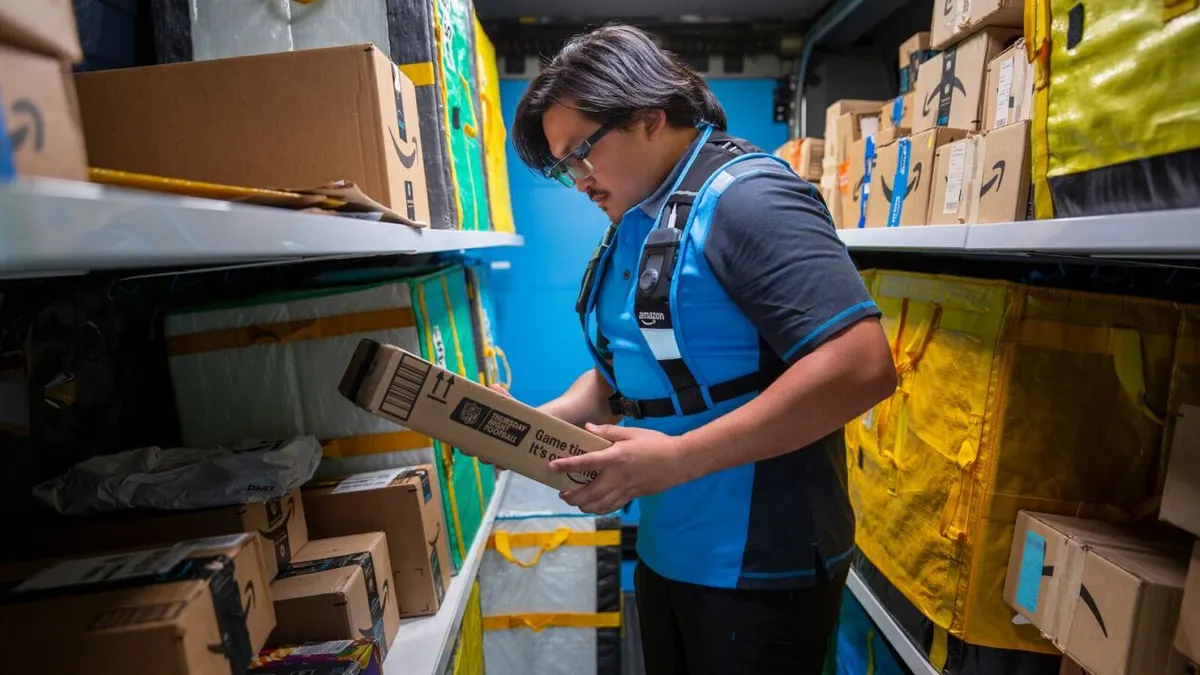
This year, Amazon aims to hire over 300,000 seasonal, part-time and full-time roles across its U.S. operations for the season. It’s a 20% increase from the number of people the company has hired seasonally since 2023.
Moreover, starting on Jan. 1, the e-commerce giant will offer seasonal employees who work at least 30 hours per week healthcare coverage starting on their first day.
“Our hiring reflects a mix of things, including the growth of our operations network with new sites coming online across the country, our planning for the holiday season, and the natural staffing needs of our busiest time of year,” an Amazon spokesperson said when asked about the increase in numbers. “Bringing on new teammates is how we deliver for customers during the holidays.”
The increase “does seem very large to me, and it is notable,” Kirthi Kalyanam, professor and executive director of the Retail Management Institute at the Leavey School of Business at Santa Clara University, said in an interview with Retail Dive.
Amazon has experienced a confluence of factors that may need operational support, according to Kalyanam. That includes its efforts to speed up rural delivery and its success in the grocery category. The company reported in its third quarter that fresh groceries and everyday essential assortments grew around three times faster than the rest of the store and represented about half of all units sold during the quarter.
Additionally, consumers may be leaning on e-commerce, and Amazon in particular, this season due to a very practical reason: gas prices.
“When consumers are economically stressed, and particularly when gasoline prices matter, they reduce the number of store visits,” Kalyanam said. “People will compensate store shopping trips for an online trip.”
Though there may be a surge in online shopping for the holidays, it may “favor Amazon a little disproportionately because of the Prime membership and the lack of a minimum order-cut off,” Kalyanam said.
Seasonal or part-time?
A factor that may be playing into the overarching changing tide of seasonal hires may have to do with those jobs instead being part-time.
While a number of large employers are posting fewer seasonal jobs versus one year ago, some of that pullback has been shifted to hiring more part-time roles. That may be a sign of optimism heading into Q4, according to Indeed’s Hiring Lab.
Last September, around a third of postings from large employers were labeled as seasonal, but this year that number is around 20%. However, part-time labels have become more common, rising from 38% to 49% year over year.
“Some of this may simply be timing, but the shift toward part-time roles is worth watching,” Stahle said in the report. “Unlike seasonal jobs, part-time jobs are less likely to end at the conclusion of the holiday season, suggesting that at least some employers may expect demand to hold up well into 2027.”
Although large retailers may not be revealing the numbers of exact hires, many are touting that a portion of seasonal workers tend to stay on with the company long after the holidays have ended.
Kalyanam points to Costco and Trader Joe’s as examples of companies that have a steady number of part-time workers, including during the holidays. And those employees have access to benefits.
Having more long-term employees “is, in my view, not a bad idea because you’re providing consistency,” he said.
The hiring of part-time workers “signals that there’s an intermediate step going on in the labor market right now,” Stahle said in an interview. Instead of “we only need these people for the next couple of months and then at the end of the season we’re going to let them go,” it transforms to “Hey, we might see a need to have these workers for not only the holiday season, but beyond that as well,” he said.
It may be a matter of communication as well, according to Stahle. Instead of companies hinting they may keep on a number of workers past the season, they may be trying to ensure workers from the beginning that companies are trying to keep people on for longer.
“I think this is an inflection point. This is one of the first years we’ve seen this shift,” Stahle said. “It will be interesting to see if this continues to hold up in the data, not only through the rest of the year, but as we look into the upcoming years as well.”