Dive Brief:
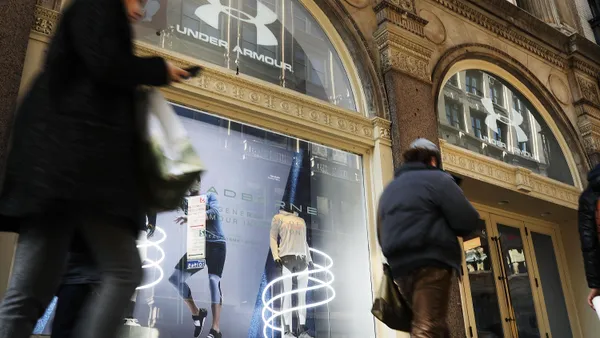
- Under Armour CEO Kevin Plank on Friday said the “most disruptive” phase of the brand’s turnaround is now behind it. The executive sees revenue volatility stabilizing, cleaner inventories and growing interest from wholesale partners.
- Importantly, Plank believes Under Armour’s declines in North America are hitting the bottom of their trajectory. Revenue in the region, which accounts for 57% of Under Armour’s business, declined 10% in Q3.
- Overall, Under Armour’s revenue was down 5% year over year to $1.3 billion, with wholesale declining 6% and DTC down 4%. By category, footwear faced the largest decline, at 12%, while both apparel and accessories fell 3%.
Dive Insight:
While revenue is still falling, Under Armour executives believe they’ve reached a turning point in the brand’s comeback efforts. The leadership team is now shifting its focus to stabilization and execution, according to Plank.
Looking ahead to next year, wholesale partners are buying into Under Armour’s strategy, according to Plank. Specifically, Under Armour is “no longer looking at significant declines” in wholesale, an important milestone. The retailer also continues to prioritize a strategy of building out “better” and “best” products, which are more premium offerings with higher price points.
An effort to reduce Under Armour’s SKUs by 25%, announced nearly two years ago, is now complete. Executives are now turning their attention to efficiencies in the raw materials the brand uses. Under Armour is still targeting reductions in its footwear business, with plans to exit certain styles and reduce SKUs across that category.
Plank acknowledged that the footwear business grew for too long by releasing new products without the demand to support them. Going forward, the brand is taking inspiration from footwear brands who are doing “a lot more with a lot fewer items.” The segment is expected to stabilize by 2027.
“There are no shortcuts in a turnaround like this,” Plank said on the call.
While the turnaround work is not yet finished, Under Armour now has the correct team in place to execute on its strategy, according to Plank. That includes a slate of recent changes that put Americas President Kara Trent into the role of chief merchandising officer and promoted 16-year veteran Adam Peake into her position. Longtime Adidas executive Eric Liedtke, who joined the company in 2024 to head up brand strategy, is also now chief marketing officer.
Analysts are not as convinced by the brand’s progress. GlobalData Managing Director Neil Saunders noted that the brand beat sales expectations, but said this was a “low bar” to begin with and still represents a weak performance against the broader sportswear market.
“Under Armour will argue that some of this step back is deliberately engineered as the brand tries to move away from excessive discounting and takes a more disciplined approach to ranging and product development,” Saunders said in emailed comments. “While we agree that these are sensible steps and concur that they have a material impact on the numbers, they do not provide the whole picture.”
Needham analyst Tom Nikic noted that the brand’s optimism is encouraging, but the company is awaiting “further proof points of a clear turnaround” at the company.
Chief among concerns for Saunders is that Under Armour is losing its importance to consumers at the same time that rival brands like Gymshark and On are gaining speed. Even successful lines like the Vanish range are getting “buried” under the brand’s other products and a lack of strong brand positioning, Saunders said.
“To be fair, this is the very thing the current management team is trying to unpick. But our blunt assessment is that this is not yet coming through strongly enough on the ground nor is it completely resonating with consumers,” Saunders said.