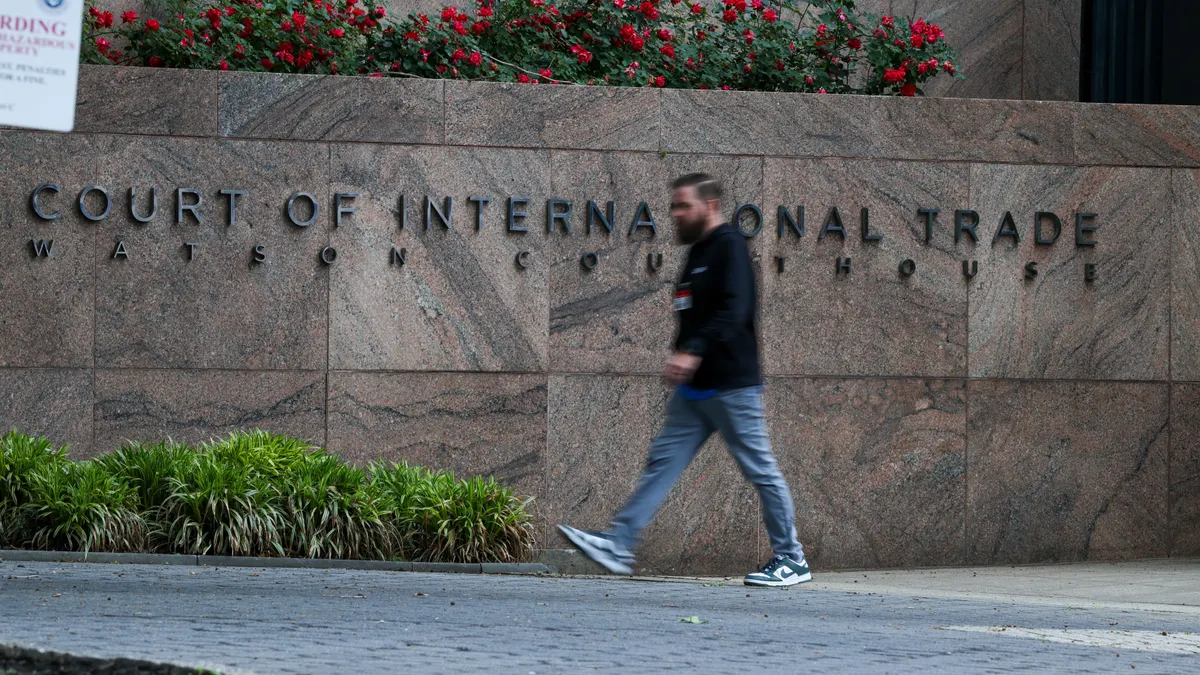

The procedural gridlock surrounding refunds for now-defunct Trump administration tariffs has started to loosen following an order from the Court of International Trade.
Senior Judge Richard Eaton on Wednesday ordered Customs and Border Protection to liquidate unprocessed entries on U.S. imports and re-liquidate those that have been processed but not finalized “without regard” to the levies President Donald Trump instituted last year under the International Emergency Economic Powers Act. The Supreme Court struck down those levies last month.
Liquidation, essentially the finalization of the total tariff amount owed, occurs following a roughly 300-day stretch during which companies can provide revisions to information related to a good’s entry into the U.S.
The court’s order means that CBP must issue refunds to shippers who paid IEEPA tariffs on imports that have not been finalized via liquidation, according to James Kim, an international trade partner at ArentFox Schiff.
“This is the most significant development on IEEPA refunds since the Supreme Court ruling itself,” Kim said in a LinkedIn post.
Meanwhile, for goods for which the tariff amount was estimated upon entry but not yet paid, CBP will simply remove the IEEPA charge upon liquidation, according to Pete Mento, director of global trade advisory services at Baker Tilly.
However, despite this critical step, there remains a great deal of uncertainty around what happens next.
“The real complexity — and where the real money sits — is with entries that already liquidated with IEEPA duties,” Mento said in a LinkedIn post. “That’s where protests, court orders, and whatever refund mechanism ultimately emerges will matter.”
Furthermore, despite the court’s ruling, the federal government could appeal the decision, further delaying any potential action by CBP until the Federal Circuit issues a ruling, according to Kim.
An appeal is all the more likely because authority to grant universal relief for entries subject to IEEPA duties is not clear, according to Gregory Husisian, a partner at Foley & Lardner. He added that the court could run into legal hurdles, including last year's Supreme Court ruling that federal courts lack the authority to issue nationwide injunctions.
"As such, we believe there is a 100% chance that this will be appealed," Husisian said in an email to sister publication Supply Chain Dive.
As the situation develops, Kim said that shippers should continue to monitor liquidation dates and deadlines to submit protests and register to qualify for electronic refunds via CBP’s Automated Commercial Environment.
“When refunds do start flowing, importers set up for ACH will receive their money faster and with less friction,” Kim said.
Less friction doesn’t mean no friction, however, as CBP has indicated that it plans to review entries before issuing any refunds, Mento said in another LinkedIn post.
“In other words, refunds may be coming, but they are not going to be automatic or instantaneous,” Mento said.