

Dive Brief:
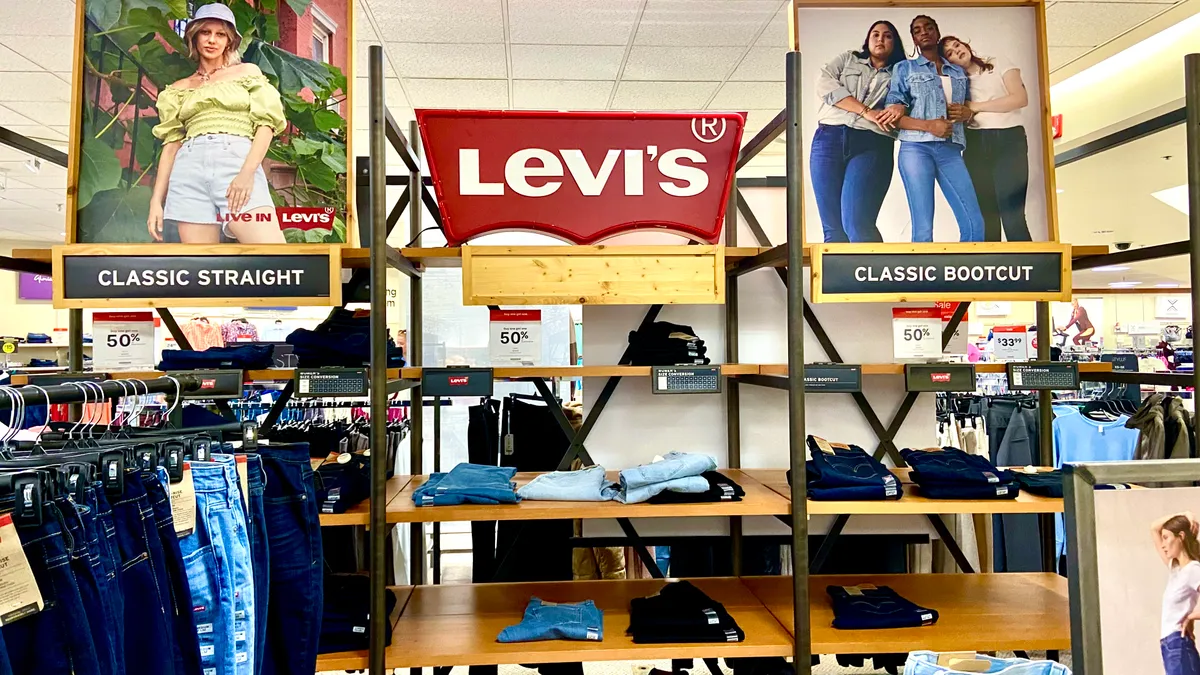
- Levi Strauss & Co.’s fourth quarter net revenues increased 1% year over year to $1.8 billion, per a Wednesday press release. In the Americas region, net revenues decreased 4%, with the U.S. specifically dropping 7%.
- The brand’s DTC revenues grew 8% while wholesale declined 5%, and net income dropped about 11% to $160 million. The company’s gross margin decreased from 61.8% last year to 60.8% mostly due to tariffs, though this was partly offset by price increases.
- Levi’s expects net revenue growth of 5% to 6% for fiscal 2026, factoring in current tariff rates.
Dive Insight:
Levi’s continued to focus on its direct-to-consumer channels during the fourth quarter and is looking to AI to help further growth across the business.
“Our efforts to build a strong digital foundation have enabled us to accelerate our e-commerce business,” CEO Michelle Gass said on a call with analysts Wednesday. “And in Q4, we delivered another quarter of very strong e-commerce growth, up 22%. We are leveraging AI to make online shopping easier and more inspiring for our fans.”
The chief executive also teased that Levi’s will launch a consumer-facing AI stylist chatbot allowing customers to get personalized recommendations through conversational queries. The news builds on Levi’s announcement in November that it would partner with Microsoft to develop AI-backed super agents for the entire business.
The apparel company’s chief financial and growth officer, Harmit Singh, said the retailer is facing 150 basis points of gross margin impact from tariffs and 20 basis points of foreign exchange headwinds, but has offset both.
“We are fully offsetting this with higher pricing,” Singh said on the call. “Most of this has been implemented. We are not seeing any initial demand reaction to it.”
The company’s overall Q4 performance was a win, according to industry analysts.
“We remain bullish on LEVI shares following a better-than-expected Q4 print and solid FY26 guidance,” Needham analysts led by Tom Nikic said in an emailed note Thursday. “We believe the company is not only benefiting from the current denim trend, but they are also executing well on their strategic initiatives.”
Still, some experts are watching the tariff mitigation efforts.
“We think FY26 guidance is achievable and may have upside potential, if the company can successfully execute on tariff mitigation strategies and drive efficiencies though expanding A.I. usage,” TD Cowen analysts led by Oliver Chen said in a Thursday note.