It’s striped, it’s mesh, it’s nostalgic. But is it happy?
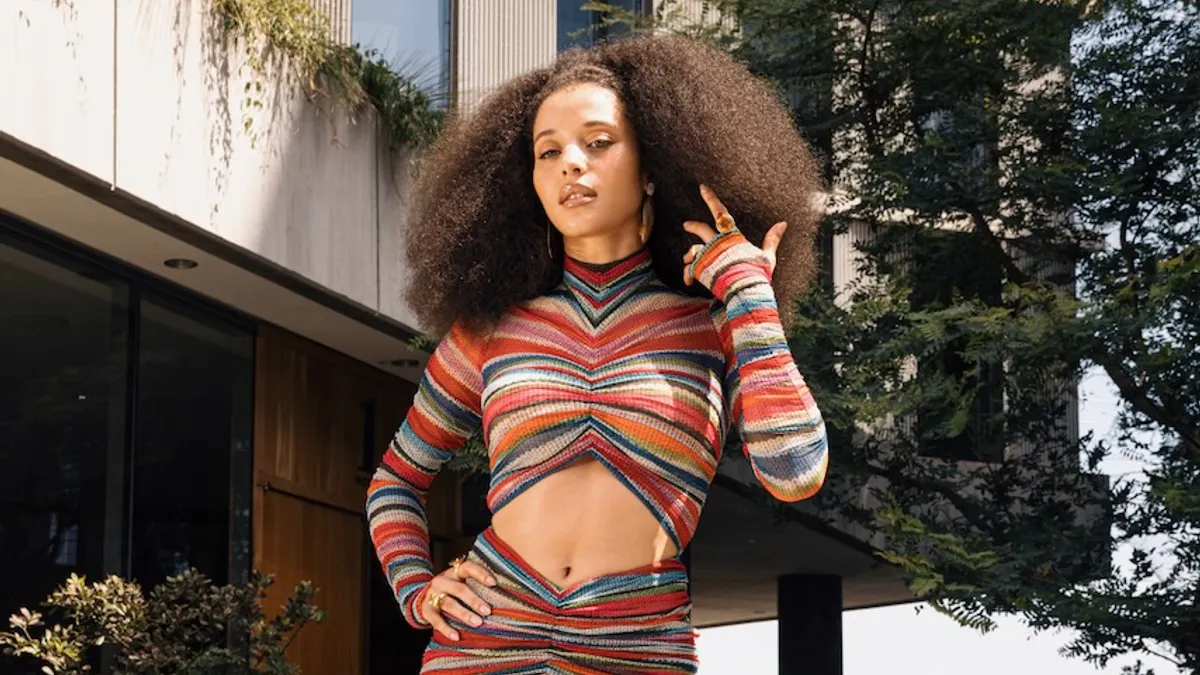
Anyone pining for what was known as Gap’s “crazy stripe” sweater — featured in director Michel Gondry’s iconic holiday ads a quarter-century ago — may have looked forward to the remake from the brand’s GapStudio design atelier, a “limited-edition Happy Stripe capsule” of tanks, T-shirts, dresses and skirts.
GapStudio is run by designer Zac Posen — who is also creative director at Gap Inc. and chief creative officer at the company’s Old Navy banner — and is described as “producing pieces of our highest expression of creativity and quality.”
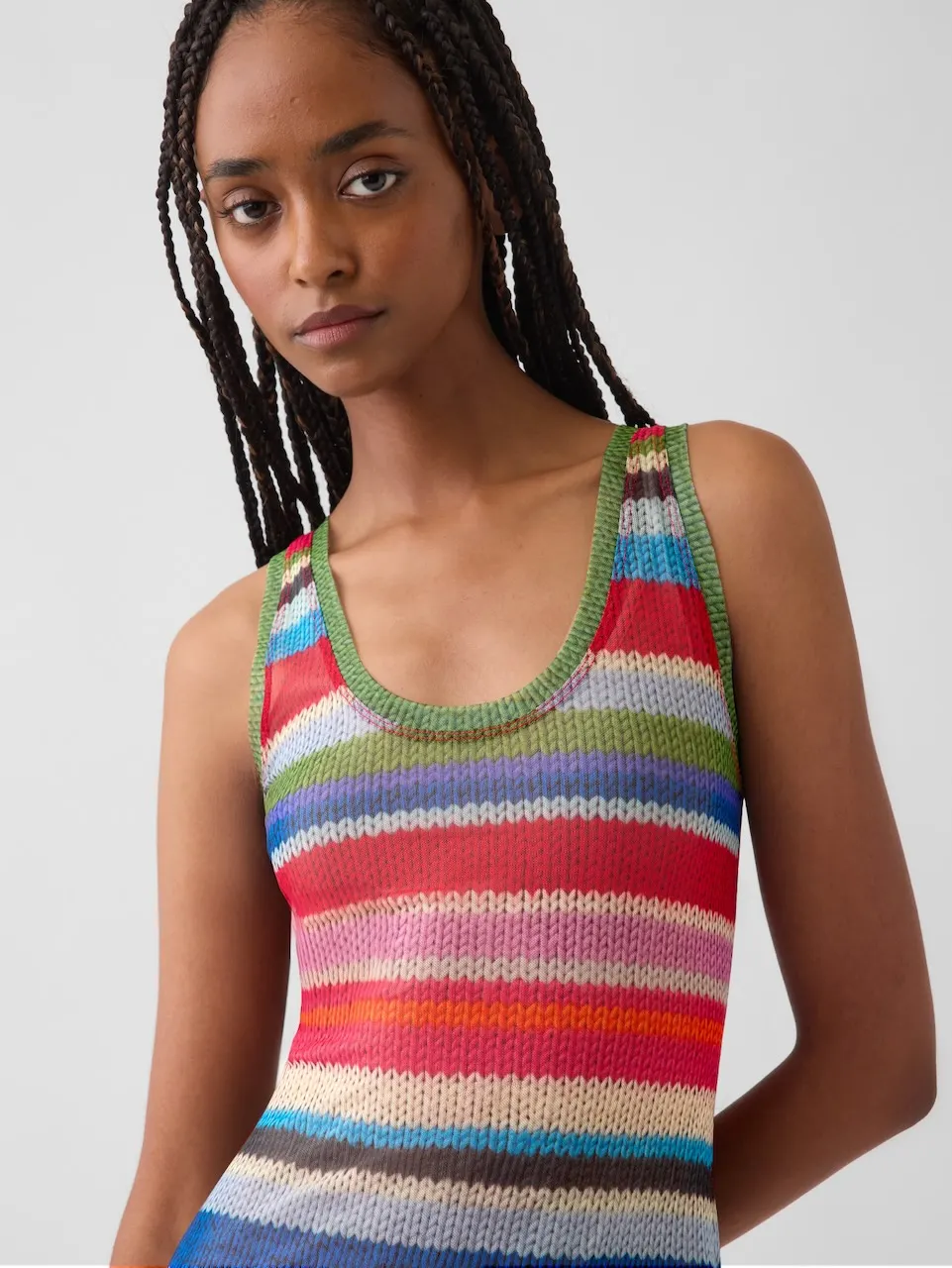
But when the garments were released at the end of June, priced from nearly $60 for the tank to over $120 for the dress, the reception was more “crazy” than “happy.” Influencers and commenters on social media lambasted the choice of polyester and the fact that the yarn loops were merely a printed mirage.
“In the late ’90s we introduced an iconic stripe, and it really took off,” Posen says in a social media post announcing the collection. “It became part of our DNA. So we took this archive piece that was in these stripes, and then said, ‘What could make it summertime?’”
Why make a mesh of it?
What wouldn’t make it summertime would be the wool and heavy cotton the vintage knits were made of. The updated items are a sheer polyester mesh with a touch of elastane, imprinted with a photorealistic image of the yarn.
GapStudio didn’t reply to multiple questions for this article.
This may have been a financial decision, given how expensive and time-consuming it is to knit stripes, according to Lee Peterson, a longtime apparel merchant who is now a retail adviser and thought leader. The range also seemed narrow, without V-necks or “slightly sexier silhouettes,” he said by email.
“Printed stripes are the worst, but woven ones are prohibitively costly and weave time is a beast,” he said. “Judging from what Posen’s done before, I’d bet the idea got value-engineered. Oh, to be a fly on the wall for that one! (Been there!)”
Consumers also may not understand that polyester can be moisture-wicking, a plus in the summer heat, and may even be better against sweat than cotton and other natural fibers. In a press release, GapStudio said that the Happy Stripe collection is part of its “mesh program, extending the technique into new summer-ready silhouettes,” but a spokesperson didn’t respond to follow-up inquiries about the fabric. At least one key figure at Gap Inc. — CEO Richard Dickson — reportedly doesn’t like the mesh material, though, according to a Vogue interview with Posen last year.
The backlash
The response has been brutal, including on the brand’s own social media posts.
“Nothing is sacred huh,” said one commenter.
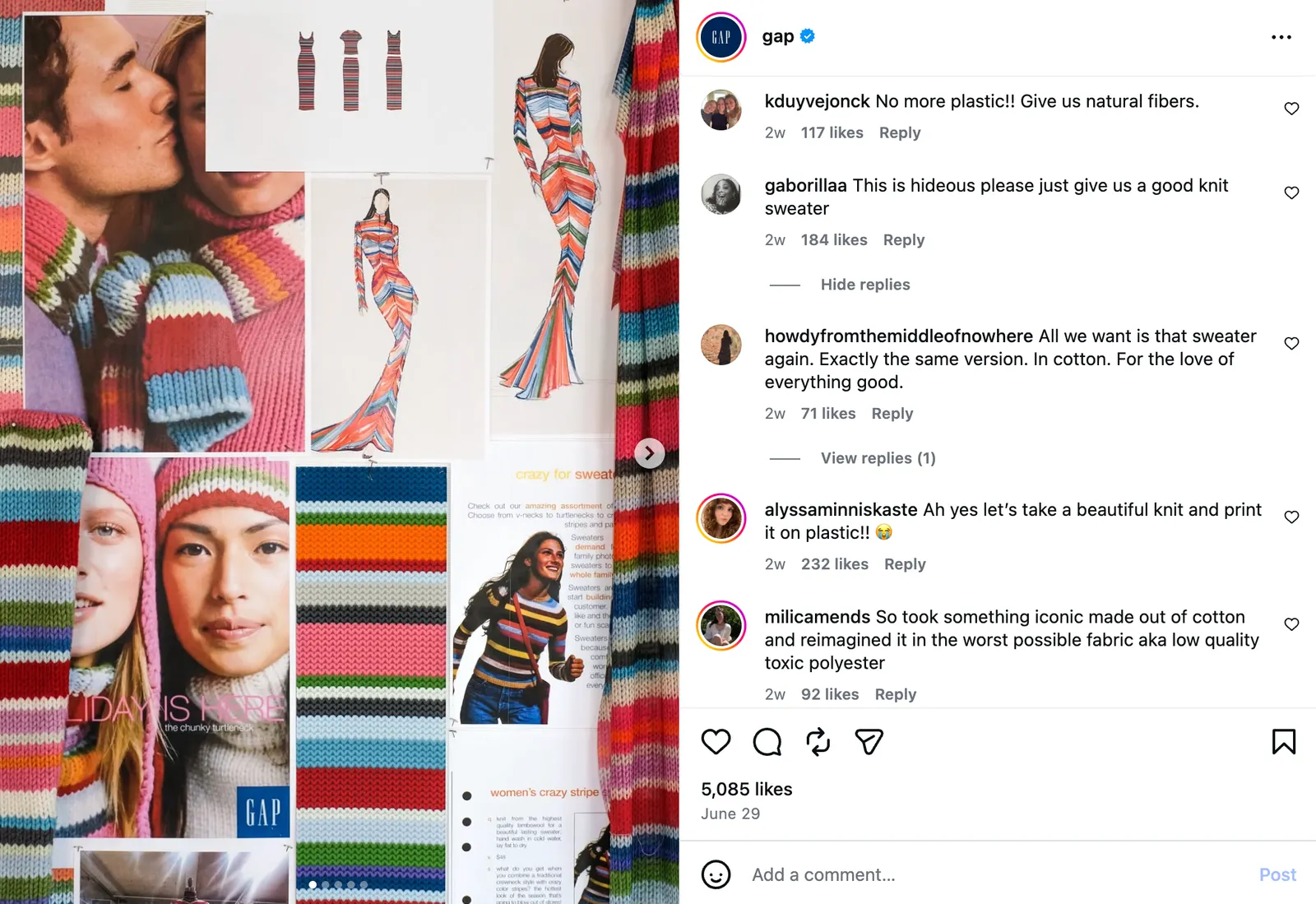
The reaction to the polyester take is not just a potential lack of knowledge about its hydrophobic versus other materials’ hydrophilic properties, however. It also reflects a growing sense that clothing was made better years ago.
This may sound like a complaint from the boomer generation, but many younger consumers are also aware of the disparity because they are scouring secondhand shops to fill their closets, experts say. And it’s obvious, even in pictures, according to Jessica Ramírez, co-founder and managing director of The Consumer Collective.
“I've been watching a lot of old-school films with my dad, and the quality of the clothes, even through the screen, is absolutely stunning. Such beautiful clothes, and you could see the fabrication is so good,” she said by phone. “In movies today, even if they're wearing luxury, the quality is like night and day. And it's not like back then they had high definition like we do today.”
Frankie Margotta, strategy director at brand transformation firm Triptk and author of a forthcoming book on authenticity, said this noticeable decline — which he agrees has occurred even in luxury — has happened at the same time that lower-priced brands like H&M and Uniqlo have stepped up the quality of some of their ranges. This has shrunk the quality differential between the high and low ends of fashion.
"I've been watching a lot of old-school films with my dad, and the quality of the clothes, even through the screen, is absolutely stunning. "

Jessica Ramírez
Co-founder and Managing Director, The Consumer Collective
A perceived deterioration in quality is especially hard to take when people are devoted to the original, according to Margotta. This is the very nostalgia that GapStudio aimed to capitalize on. But that can be a trap because backlash can arise around not just quality, but also any departure from what came before, he said. Yet changes are inevitable.
“Those stripes and those clothes were built in a different time under different realities, for a different person,” he said. “So you can't judge them based on what it was in the year 2000. That is the tension with vintage — you're automatically comparing it to a time and place, and we're living in a different one, in terms of the business, in terms of culture, in terms of everything. That's where it starts to get kind of weird, because people are making judgments based on then and not now.”
The upshot
The Happy Stripe capsule is sold out, according to the Gap website. While it appears to have been a misstep, the fallout is also a function of the kind of heated response that the internet fosters so easily, Ramírez and Margotta said.
“Those stripes and those clothes were built in a different time under different realities, for a different person."
Frankie Margotta
Strategy Director at brand transformation firm Triptk
“I don't think it was offending anyone. It was just literally that something wasn't delivered that I think someone expected,” Ramírez said, noting that the brand’s cultural comeback has gained traction as its quality has improved and its marketing campaigns have blown up.
Sales are back, too. In Q1, Gap brand net sales surged 10%, reaching $796 million, and its 10% increase in comp sales was the 10th straight quarter of positive growth. Neither Ramírez nor Margotta thinks the Happy Stripe effort will derail that momentum. Both believe that, in the end, it was an attempt to play with the brand’s history, emphasis on “happy.”
“I think they're having fun,” Margotta said. “I think there's a bit of levity in what they're doing. Like sometimes it's not that deep.”