

Dive Brief:
- In a significant miss, Build-A-Bear’s second quarter total revenues dropped 7.2% year over year to $115.3 million, according to a Thursday press release. Net retail sales declined 7.1% to $106.5 million and pre-tax income fell 24% to $11.6 million.
- The retailer lowered its full-year outlook, now expecting total revenues from $500 million to $525 million and pre-tax income of $60 million to $68 million (inclusive of about $13 million in IEEPA refunds). That's compared to its previous guidance of total revenue from $530 million to $550 million and pre-tax income of $72 million to $78 million.
- Build-A-Bear terminated the employment of Chief Growth Officer David Henderson on Wednesday, the retailer disclosed in a Thursday filing. The executive had been at Build-A-Bear for about two years and was named chief growth officer in June.
Dive Insight:
While Build-A-Bear had predicted a tougher first half of the fiscal year, Q2’s results were still a surprise to executives.
The summer of 2025 was a success that set up tougher comps after this year’s summer trend collection didn’t resonate as well with shoppers, CEO Chris Hurt said on a call with analysts.
“Summer is when we traditionally push that innovation,” Hurt said of the summer’s merchandise. “The reality is, you know, we pushed it too far. That product did not resonate as well with our consumers. It wasn't as dressable. It didn't go through the full customization experience, and as a result, we saw weaker results from that product line.”
Build-A-Bear’s commercial and international franchise revenues were a combined $8.8 million in the period, marking a 9% decrease.
While wholesale continues to be a focus for the brand’s growth, the channel experienced some setbacks in the quarter, Hurt added.
“We were unable to repeat the multimillion-dollar Walmart program, and other wholesale opportunities have progressed more slowly than expected,” he said. “However, our experience with Walmart, namely the successful sell-through of our Build-A-Bear branded nonlicensed products, demonstrated that a brand can extend into large-scale third-party distribution and reach consumers beyond our traditional channel.”
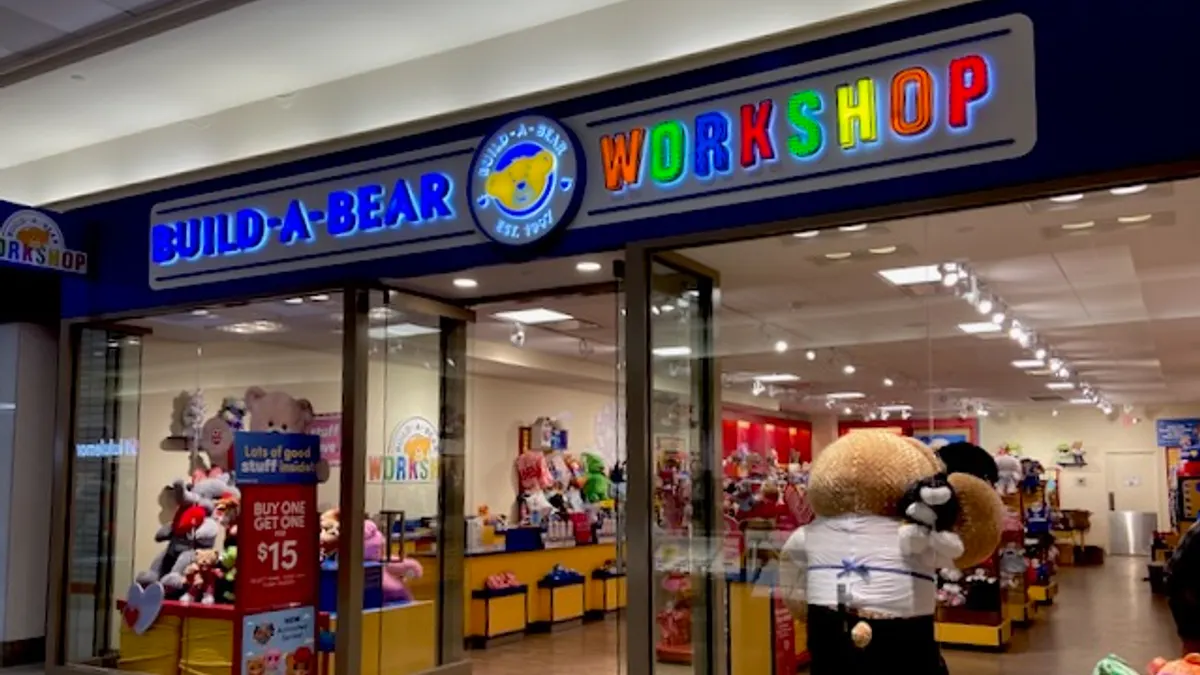
Build-A-Bear added five global experience locations and six franchise locations in Q2. That store growth was offset partly by a net decline of four partner-operated locations. The retailer had 674 locations globally at the end of the period.