In 2025, the number of department stores that have left New York City far outnumber those that remain. There are millions of New Yorkers who probably don’t even remember Gimbels, Ohrbach's, Abraham & Straus, B. Altman, Bonwit Teller, Wanamaker or Japanese retailer Takashimaya – an incomplete list of the long-departed. Many do recall when Lord & Taylor, Barneys and Henri Bendel closed, less than a decade ago.
That makes the presence of Macy’s, Bloomingdale’s, Saks Fifth Avenue and Bergdorf Goodman all the more precious, and the entrance of Nordstrom and Printemps a sign of hope for the segment.
But with Fifth Avenue losing much of its cachet and department store merchants losing much of their influence, this retail model has become a challenge even for these survivors.
There is a way to thrive, at least in this place, according to Thomaï Serdari, a professor of luxury marketing at New York University’s Stern School of Business. In New York, the trick is to forge a bond with city dwellers and not just tourists, she said, in conversations by phone and at the school’s Luxury & Retail Industry Conference, held Nov. 12.
“This is how New York works,” she said. “New Yorkers are very tied to their neighborhoods and they really appreciate those who understand that idea of neighborhood. I think this is what has helped New York survive after all the changes that have happened in the last 100 years.”
Printemps
We start with the latest arrival, Printemps, in Lower Manhattan, which opened in April. The 160-year-old Parisian retailer, which also runs 19 locations in France and one in Qatar, insists it is “not a department store.”
But it is – like Barneys, Lord & Taylor, Nordstrom and others – what is known as a “fashion department store.” In contrast to the emporiums that once sold a vast range of merchandise, including categories like wine, gourmet food, books and electronics, these retailers have always kept a more narrow focus on apparel, footwear, accessories and beauty.
Printemps’ location in the Financial District – address: One Wall Street, one of the city’s earliest art deco buildings – also distances it from the traditional New York stores. The surrounding neighborhood is a work in progress – with few families or other established residents living in the relatively new housing there, Serdari said.
“I love the department store, I love the location, I love the decision of renovating this fantastic jewel, but I'm still a little perplexed about the decision to put it there,” she said. It does give Printemps a foothold in the city and a potential catalyst for online sales, she said.
Printemps may be too far afield for many, but, on a chilly November morning, there were many chic customers, mostly from overseas – perhaps visiting, perhaps New Yorkers themselves now. The fashion is edgy, if not daring, and many of the brands, all pricey, can’t be found anywhere else. In order for Printemps to carry a familiar line, its quality must pass muster, according to an associate in the beauty section.
The cafe is small, with a tiny menu, and serves the best cup of coffee of the day.
Macy’s
It’s a 20-minute schlep by subway to Herald Square’s Macy’s, a colossal structure long described as “the world's largest department store under one roof.”
In the last few decades, Macy’s has closed hundreds of stores, an unwinding of the department store consolidation it spearheaded in the early 21st century. The turnaround there has been a long haul, reignited after getting interrupted by the pandemic, and now reimagined under a new chief executive. Sales at revamped stores have recovered, and many see hope for Macy’s under CEO Tony Spring – who spent nearly 40 years at sibling department store Bloomingdale’s, including as chief executive.
“Prior to Tony Spring, Macy’s seemed to be a business that was content to sit back and accept its fate as a fading icon of retail,” GlobalData Managing Director Neil Saunders said in emailed comments. “This passiveness has now gone and has been replaced by a determination to do better and to build a business that works in the modern era of retail.”
There’s little doubt that Macy’s flagship in Midtown Manhattan is safe from the company’s closure strategy. In 2021 the company announced an investment into the neighborhood and the building – which opened in 1902 and was expanded more than once in the early 20th century, giving it a mix of architectural styles – though plans for an office tower haven’t materialized.
November is an iconic month for this store. Not just because, like any department store, Macy’s must nail the holidays, but also because its Thanksgiving Day Parade arguably launches the season for America.
This may be the one store on this journey that has less need of a connection to locals, and it probably helps that so many visitors to New York converge in Times Square and other areas of midtown. On this November day, with Thanksgiving still weeks away, Macy’s Herald Square seems the same as ever, including its still-functioning wooden escalator – though the beauty floor is newly renovated and especially busy. The store is bustling, and most if not all shoppers seem to be tourists.
Inside and out holiday decorations are up. The exterior of the massive building – 2.5 million square feet, including 1.25 million square feet of retail space, according to the 34th Street Partnership – is covered in greenery and lights, with wreaths festooned in ornaments and bows in bright Macy’s red. “Elves at work,” reads one window.
With Macy’s ready, everyone can get ready for the season, as Tony Bennett sang: It's Christmas in Herald Square/ Carolers singing under Macy's Tree of Lights/ Capture the spirit as the season hits the heights.
Bloomingdale’s
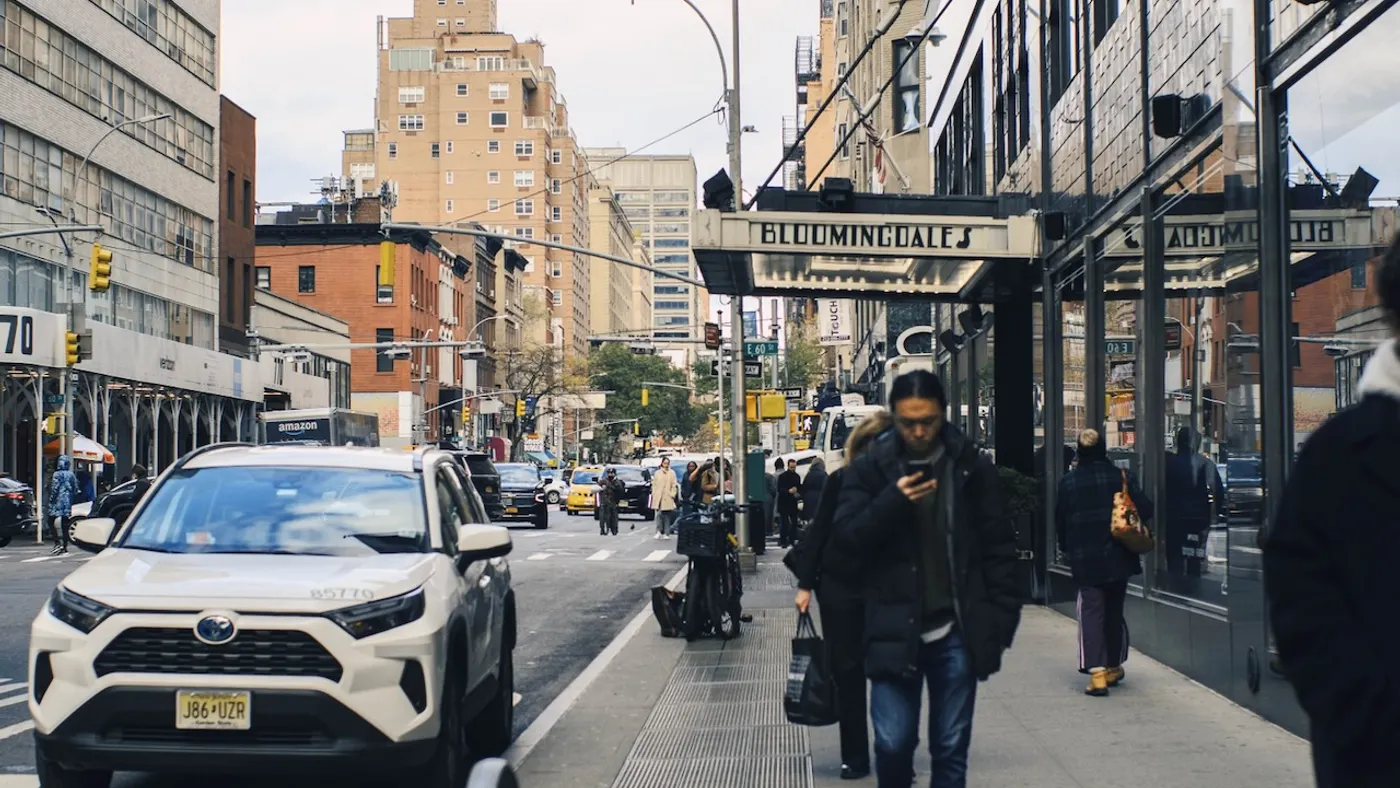
There may not be any classic songs about Bloomingdale’s, but it’s become an icon in its own way since its 19th-century beginnings as a dry goods store.
This department store traces its origins to the Lower East Side, where brothers Joseph and Lyman Bloomingdale opened their notions shop for ladies in 1872. They moved uptown in 1886, to its current spot between Third and Lexington Avenues, and 59th and 60th Streets, at the edge of the Upper East Side. The store expanded steadily and by the 1920's, took over the whole block, much as Macy’s did at Herald Square.
The retailer may have borrowed other ideas from its sibling, at least for this year’s holiday decor. It’s possible the same person decorated: It, too, emphasizes dark greenery and pops of red. The interior also features Hanukkah displays, which so far are not easily found elsewhere.
Columnist Blair Sabol pegged Bloomingdale’s height of cool in the mid-1970s — when Sabol was writing on fashion for the Village Voice. It was once known to its ardent fans as “Bloomie’s,” though the retailer has co-opted that nickname for its small-format stores.
“First of all, you have everything under one roof. You've got stockings, brassieres, tickets, Brie cheese. I mean, you've got everything you want at Bloomingdale's,” Sabol told 60 Minutes in 1976. “Plus the fact you're dealing with a fantasy. We are attracted by the fact that Bloomingdale's knows what's hip. They know what's in. They're telling us, ‘This is it, folks, get hip to the trip.’ And we want to get hip to the trip, so we're going to do it.”
In early November in 2025, though, Bloomingdale’s is more low-key. It’s less lively than Macy’s, though it seems to be New Yorkers who are shopping here. The retailer continues to support emerging designers, and recently arrived chief merchant Denise Magid is “trying to bring back that cultural edge,” Serdari said. She is doing great work, but the store isn’t back to its glory days, she said.
“No young person says, ‘We're going to Bloomingdale's to see what's trending,’” Serdari said. “It's a little overstuffed, with a lot of brands, and that doesn't inspire you to go there to discover. You go because perhaps you have been going there for years and it's part of your routine.”
A visitor can get easily turned around in the sprawling building. When asked for the exit, a dapper gentleman working there asks, “Lex or 59?”
It’s time to walk over to Bergdorf’s.
Bergdorf Goodman
Bergdorf Goodman runs his-and-hers stores across the street from each other. The buildings share architects – Buchman & Kahn – but the men’s store sits in an art deco style skyscraper with an early 20th-century modern vibe.
Across the street, the flagship store has some art deco elements, but its French-classical and beaux arts styles dominate.
Both stores radiate splendor. The 19th-century retailer retained some level of family control well into the 20th century, though, after a couple of deals in the 1970s and 1980s, it tied up with Dallas-based department store Neiman Marcus.
Throughout, Bergdorf has retained its stature as a New York luxury legend, and a fixture for a certain New York set.
“Bergdorf’s is a neighborhood destination,” Serdari said. “There are people who live on the Upper East Side, and it’s a place to meet. The ladies go there for tea in the afternoon.”
The recent departures of chief merchant Yumi Shin and Chief Retail Officer Melissa Xides have some observers worried that could change. Bergdorf Goodman is now owned by Saks Global, acquired as part of a $2.7 billion deal that merged Neiman Marcus Group and Saks Fifth Avenue late last year, and the new entity has dedicated 2025 to cutting costs. Saks Global has sued Shin in federal court, alleging she violated a noncompete agreement when she resigned to work for Nordstrom.
For now, in November, the store is preparing for the holidays, its windows covered up with billowing light blue drapes. Upon closer inspection, there is someone working on one of them, only their shoes visible.
A store associate inside who, like many customers, is impeccably dressed, says the retailer’s famous holiday windows will be unveiled in a few days, on Nov. 20.
The interior is already decked out, and it’s clear that Bergdorf Goodman has a large budget for holiday decor. Silvery white branches and trees are packed onto the marble floors and around the large doorways, with dramatic white geese overhead.
In cooperation with the massive chandeliers, it’s a magic forest filled with high-priced treasure.
Nordstrom
Seattle’s homegrown department store came to New York, like so many people do, with dreams of making it. In just a few years, it seems it’s on its way.
It hasn’t been easy. Opened in late 2019 after seven years of construction, the project, long desired by the Nordstrom family, almost immediately had to shutter due to the pandemic. The company said it trusted its neighborhood, and New Yorkers in general, to sustain the fledgling location.
Nordstrom had the audacity to build its own structure, a unifying edifice at the junction of existing buildings; even fellow newcomer Printemps is housed in a historic landmark. Yet Nordstrom’s wavy glass facade is a fixture of the street. The building itself expresses a new era of department stores, according to Serdari.
“This amazing building really expresses materially that energy and this new era of the department store,” she said during NYU’s conference as she presented the American Retailer Award to the store’s general manager, Chris Wanlass. “For the first time, they opened up the building. Think about department stores in New York City, they’re blocked up, you never see behind the windows.”
Serdari believes Nordstrom is on its way to establishing itself in its neighborhood and becoming a Bergdorf’s of sorts for a more diverse, somewhat less monied New York set.
In a way, in order to find its place, Nordstrom had to be different, according to Wanlass.
“I mean, you cannot outdo Bergdorf Goodman's windows, right?” he said. “How do you even try to compete with that? But, what is our version of that? That's what we look to do.”
Saks Fifth Avenue
The Saks Fifth Avenue flagship seems both stately and fresh, thanks in part to a three-year, $250 million renovation a decade ago. Despite its historic interior, its central space is defined by designer Rem Koolhaas’ psychedelic escalator.
But if Nordstrom has successfully found its place as a retail stop for New Yorkers, Saks Fifth Avenue has arguably lost it, as its flagship now caters to tourists more than to local shoppers, Serdari says.
The department store’s treatment of Barneys – a now-defunct fashion destination once beloved by luxury consumers interested in new designers and avant-garde style – serves as a case in point. Barneys lives on only as IP owned by Authentic Brands Group. As of 2019, Saks Fifth Avenue has been the exclusive retail partner for Barneys, which may have been a relief to Barneys aficionados.
On this November day, however, awareness of the tie-up was low, at least on the part of employees. One wasn't sure where the Barneys space was, maybe the third floor? Once found, on the fifth floor, it was unclear which merchandise or space was dedicated to Barneys. When asked, a store associate replied, “I wish I knew.”
The search for synergies at Saks Global could exacerbate this kind of disconnect. The company is having trouble paying vendors, and a series of merchants and other leaders have left, including at least one merchant who is now at Bloomingdale’s.
Bloomingdale’s and Nordstrom are also picking up market share from Saks Fifth Avenue, analysts say, and that includes their New York City stores. Serdari believes that Saks came to rely on tourists for foot traffic and took it for granted that Fifth Avenue would remain a reliable commercial corridor.
“That went away during Covid, and now nothing brings you back to Fifth Avenue, because there is no more glamor, right?” she said. “There are some very luxurious brands there, and definitely a lot of jewelry. But it doesn't have the character that it had – perhaps in the ‘50s or ‘60s – that represented the glamor of New York City.”