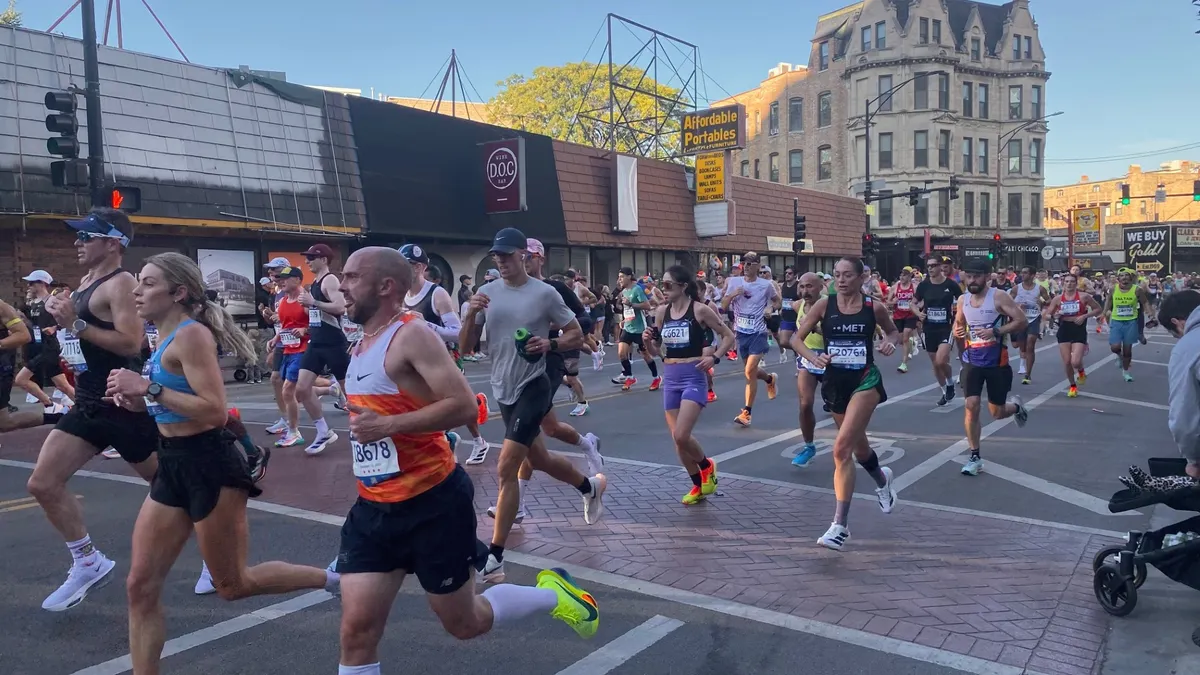
On a sunny October day in Illinois, 54,000 runners gathered to take part in the 47th Bank of America Chicago Marathon. People from over 100 countries and all 50 states came to compete in one of the world’s most prominent races.
They also came to shop.
“There’s the running marathon and then there’s the shopping marathon,” Terry Symonds said. She, along with two friends, came to the Midwest from Australia to participate in the event. “You have a whole bunch of shops here that we don’t get in Australia. … It’s a big shopping experience.”
Symonds and her group of friends estimated they would each spend around $500 in stores on the days surrounding the race.
Hotels and restaurants in race-hosting cities garner a financial boost. But the overall economy gets a windfall. The 2024 Chicago Marathon contributed a record-breaking $683 million to the local economy, a 22% increase from the year prior.
Because, as it turns out, those tens of thousands of Chicago runners — along with some of the 1.7 million spectators lining the streets — are going to want merch. That creates a revenue and branding opportunity for retailers.
The Nike of it all
If you happened to be walking in Chicago on Michigan Avenue on the morning of Oct. 11 you would have observed a rush of people outside of the Nike store. A line to get in snaked around the block, had its own security detail and held hundreds of soon-to-be marathoners. It was the day before the race, and most runners were there for one thing: the Finisher Jacket.
Nike generated the commemorative jacket, as well as a larger clothing collection, for the Chicago Marathon. Finisher jackets are specific to a race and year as a way to honor runners’ accomplishments.
It is also a way to visually flash bragging rights of past races that have been completed. Symonds plays a game with her friends they have dubbed “marathon bingo,” wherein they look out for runners wearing a piece of merchandise, most frequently a Finisher Jacket, worn from every major marathon. When they find all of the majors, then they’ve got a bingo.
This year’s Finisher Jacket was available at select retailers, on Nike’s website, at Fleet Feet and Chicago’s Heartbreak running location. It was ready for purchase on a first-come-first-serve basis at 10 a.m. at the Michigan Avenue store.
The mood at the flagship — even with the long line — was one of excitement.
“It’s part of the adventure!” runner Megan Prideaux said of waiting to get into the Nike store. “You get to talk to people. We’re having a guessing game as to how long it’s actually going to take us,” she said regarding waiting.
Nike declined to share numbers regarding how many people came into the flagship store that day or how many Finisher Jackets were sold, but did emphasize that the mood of the environment at the Michigan Avenue store stood out.
“Chicago’s running community — as well as runners who flew in just for the race — showed up with so much passion all weekend,” a company spokesperson said via email. “That spirit is what makes this sport special, and it’s what keeps us inspired to keep building for them.”
The athletic retailer creates specific gear for other marathons as well and said that it’s important to note that the company works with local city teams, retailers and partners “to make race day feel like a celebration of everyone who got there,” the spokesperson said.
On’s following
Even though Nike had a large presence in Chicago over marathon weekend, complete with a billboard campaign specifically targeted to runners, it wasn’t the only retailer that made its presence known during the race.
Athletic brand On also custom-designed merchandise for the Chicago Marathon. The merch dropped on Oct. 9 at 11 a.m., and by the afternoon of the next day had completely sold out.
The company partnered with Chicago-based, Mexican-American street artist Joseph Anthony Perez, also known as Sentrock, to create the exclusive collection. His signature “Bird City Saint,” a graphic seen around Chicago, was used in the product design for the marathon.
“When On releases custom merch, we strive for it to be meaningful,” a spokesperson said via email. “Rather than slapping on a logo, we prefer to do the work of understanding and supporting the communities to amplify the incredible work they’re already doing. Working with Sentrock was a natural extension of that approach.”
The company co-released the Chicago Marathon merch with Fleet Feet. As part of the partnership, On also collaborated with a local running club and brewery to construct a mural ahead of the race.
The unveiling of the mural was used as an opportunity “to be the first and only place where the merchandise could be purchased outside the expo,” a company spokesperson said by email.
Support for the race was also seen in On’s Chicago store location, which was merchandised with the marathon in mind. The company also hosted a number of activations surrounding the race, including cheer stations, a shakeout run and a post-marathon party.
“Marathons are a fantastic opportunity to connect with and celebrate runners,” the spokesperson said. “We activate at key marathons to meet runners where they are in a community-first way.”
Brand activations and reaching people
Other running brands hosted events and partnered with companies and local run clubs in a show of force over the Chicago Marathon weekend.
Brooks hosted a pop-up experience, dubbed The Brooks Hyperion House. Shoppers could make signs at the Cheer Card Station, learn about the company’s Hyperion Elite 5 and Hyperion Max 3 marathon shoes, pick up some swag, hear a guest speaker or join a finishers celebration.
New Balance partnered with the Endorphins Running community on a coffee pop-up shop and helped host a 3-mile shakeout run along the Chicago waterfront, among other events.
A reason brands may become involved in marathons is simply because it’s a great way to meet their target audience and foster connection.
“Marathon sponsorships provide a unique combination of B2B and B2C value, engaging diverse demographics, strengthening brand credibility, and extending influence far beyond race day,” Brand Finance Sports Services Senior Consultant Scott Moore wrote this past spring.
Running has been on the rise since the pandemic, according to The State of U.S. Marathons 2025 report from RunRepeat. Male participation is up 8.8% as of last year, while female participation has seen an increase of 1%. Additionally, the proportion of marathon runners older than 45 has accelerated, according to the report. The demographic also includes a high concentration of decision-makers, according to Moore.
Marathons are “strongly associated with passion, hard work, and a sense of community, making them an ideal way for brands to align themselves with these characteristics as well as connect emotionally with people,” Moore wrote.
But brand participation surrounding the long-distance race may go deeper than current demographics, as Nike points out.
“Marathons have always been a part of our DNA,” a Nike spokesperson said to Retail Dive. “They’re a testing ground for us and for athletes — we test innovation and athletes test themselves.”